




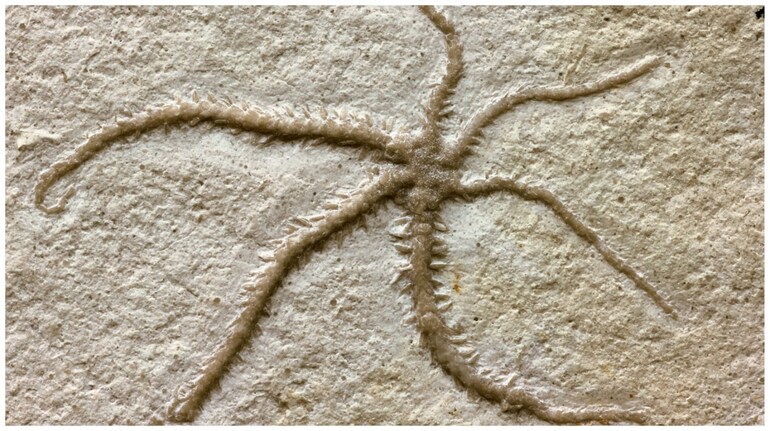
In an astonishing discovery, a 155-million-year-old fossil reveals a brittle star—a relative of the starfish—in the midst of cloning itself, offering unprecedented insight into ancient marine life. This fossilised specimen, preserved with six-fold symmetry and in the process of regenerating half its body, marks a world-first find in the study of clonal fragmentation.
Dr. Ben Thuy, a palaeontologist at Luxembourg's Musee national d'histoire naturelle, explained the significance of the find to the Mirror: "Some brittle stars and starfish have an unusual way of reproduction: they split in halves and regrow the missing body parts."
"While the biology of this process called clonal fragmentation is relatively well studied, virtually nothing is known about its evolutionary origin," Dr. Thuy said.
The international team of palaeontologists, who discovered the six-armed brittle star, named it Ophiactis hex. This species was uncovered during a 2018 excavation in southern Germany. The fossil, encased in limestone, was exceptionally well-preserved, capturing the creature in a moment of regeneration.
Dr. Thuy emphasised the rarity and importance of this discovery. "This specimen provides compelling evidence that clonal fragmentation in star-shaped echinoderms has deep evolutionary roots, and that it has been linked to life on a host and a six-fold symmetry since the Jurassic," he noted.
The study, which introduces Ophiactis hex to the scientific community, suggests that this form of asexual reproduction was well-established by the Late Jurassic.
The paper concludes, "Ophiactis hex seems to represent the first fossil case of a fissiparous ophiuroid. It suggests that clonal fragmentation, combined with six-fold symmetry and an epizoic lifestyle, was established as a means of asexual reproduction in ophiuroids by the Late Jurassic."
Discover the latest Business News, Sensex, and Nifty updates. Obtain Personal Finance insights, tax queries, and expert opinions on Moneycontrol or download the Moneycontrol App to stay updated!
Find the best of Al News in one place, specially curated for you every weekend.
Stay on top of the latest tech trends and biggest startup news.