Time's cover was staring at me. To put it rightly, I was staring at it! It read, "Into the Metaverse — The next digital era will change everything". The futuristic individual with an astronaut's headgear took me to my ideological musing. It was a cover of the same Time magazine from another era that made me disdain the current one. It showcased the 2006 Person of the Year as "you", a veritable projection of an individual at the core of the internet. For many years, that 2006 cover has been acting as one of the motivations for the subversive teenager in me.
 An edition of Time magazine from 2006
Time magazine selected the person of the year as "you" to entrench the idea that Web2 is revolutionising the Internet to go democratic. The users will be at the centre of it rather than corporations. What else do folks like me, who already believed that the open protocol of the internet was the foundation for the next socialist/anarchist utopia and the pinnacle of individual liberty, need to be joyous about?
Nonetheless, I witnessed a handful of huge platforms dominating the internet. According to the latest statistics, three out of the largest four social media platforms are owned by a single company. These giants were all born in some university dorm rooms or garages. They feigned themselves as the torchbearers of openness and connectedness, while secretly spying on our activities to build a centralised data repository for their future money-making engine called digital advertisement. Recent studies show that the plan worked better than they could have wished for; data-driven algorithms didn't stop at predicting our interests. Instead, they reached a level of manifesting one for us.
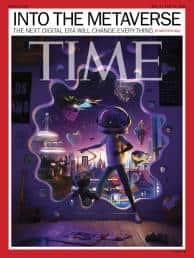 An August 2022 issue of Time magazine
Back to the present, now is the time for Metaverse and Web3 to elevate the hope of current-day idealists to believe in a decentralised internet where the agency of a user is valued more than profit. More or less the same way the idealistic dream-weavers of my generation believed and trusted in Web2, another generation of the same creed expects blockchain, game theory and some codes to free personal data from the ad-hungry platforms.
Before going any further, let me first define these two very different technologies (I hate when people use Web3 and Metaverse as synonyms). Metaverse focuses on providing a browsing/internet experience beyond the two-dimensional screens of our smartphones or laptops. An immersive experience spans the spectrum from our real world to the fully virtual and in-between using augmented reality (AR)/virtual reality (VR).
 Metaverse products like the Italian game 'Second Life' runs on Web2 (Photo: Wikimedia Commons)
Metaverse doesn't always require a Web3. There are many metaverse products which run on Web2. Second Life, Roblox, and Fortnite are some examples. On the other hand, Web3 is an emerging trend that redefines where data should be stored. It proposes a replacement for the current centralised data infrastructure, which is mostly in the cloud, with a decentralised and distributed one, where data is owned, validated and authenticated by the individuals. Some of the technologies under this umbrella are blockchain and tokenisation. Decentraland, The Sandbox, and Cryptovoxels are some examples of Metaverse powered with underlying data infra such as Web3. Metaverse + Web3 together offers a sense of immersion, real-time interactivity, and user agency.
A few months ago, I spoke about "Businesses in the Metaverse" at a technology conference in Kochi. Apart from the ideological expectations, I stayed reasonable. This advancement will change the internet into something bigger and more immersive. To espouse the business potential, I emphasised on dollar value thrown into the development of Metaverse infrastructure. The first five months of 2022 alone recorded an investment of $120 billion, almost 10 times that of 2021. Facebook changing its name to Meta and budgeting $10 billion-plus annually for the development of technology reflects the intensity at which Big Techs are pursuing the Metaverse as the next internet.
My co-panellist, a young consultant, Aishwarya Jaiswal from Microsoft, spoke profoundly about the infinite possibilities of the "Decentralised Autonomous Organisation" or the otherwise lovingly called DAO. Even during our after-event private conversation, she was highly excited about the notion of a corporate-driven without a central controlling figurehead or a hierarchical structure. She dismissed the current setbacks of DAO as early implementation glitches. This conference was part of an eight-day event on technology, art and design and its fluidity, hosted in a multistory business park waiting to be occupied by the foot soldiers of capitalism. After my presentation, I wandered alone like a lost nomad searching for familiarity or strangeness. Each person I met reminded me of the name of the event, Utopian Dystopia; they contain an overwhelming enthusiasm for the technology while at the same time fearfully anticipating its adversaries on the sustainability of the world and overall human wellness.
In over a decade and a half, I have seen many zealous people accepting defeat on their quest for a free internet and joining the Big Tech platforms. A cousin of mine, who kept all his temptation ashore for a long time, recently joined WhatsApp and added me to a group. For me, this act marked the last person I personally know accepting the inevitable death of privacy.
Companies that did not exist two decades ago not just own digital space but become invisible through ubiquity. A similar scenario can be expected as part of the Web3 revolution: new Big Techs may emerge out of nowhere or current ones may evolve to rule the new realm. While commenting on the crypto crash, the US head of the crypto exchange Binance said at Collision tech conference in Toronto, "Out of the dot-com bubble (and crash), Amazon emerged and we want to be an Amazon." Statements like this indicate the ambitions of many Web3 startups; they want to become nothing less than an East India Company. Gillian Tett, in her Financial Times article, also acknowledges that the future of Web3 lies in some global giants. Is our future getting predictably boring? A mere repetition of Web2 — new tech, old model. Though, as an outcome, not desired by the experimental spirit that makes humans human.
According to David Wengrow, the co-author of the pathbreaking book The Dawn of Everything: A New History of Humanity (2021), until humanity settled into the ruins of our capitalist neoliberal hellscape, we were building and rebuilding all social forms and structures. The anthropological and archaeological evidence discovered in the last decade proves contrary to popular writers. The hunter-gatherer societies had grandiose searches for different political forms. The philosophical offering of Web3 ignites this same spirit of our ancestors to explore egalitarian political structures against peeping corporations and authoritarian governments. Deep inside me, I wish to be wrong and expect Web3 as humanity's alternative attempt. Only the history of the future can tell us how our tale unravels!


Discover the latest Business News, Sensex, and Nifty updates. Obtain Personal Finance insights, tax queries, and expert opinions on Moneycontrol or download the Moneycontrol App to stay updated!
Find the best of Al News in one place, specially curated for you every weekend.
Stay on top of the latest tech trends and biggest startup news.