Top 3 stories
Zomato outpaces IPO-bound Swiggy
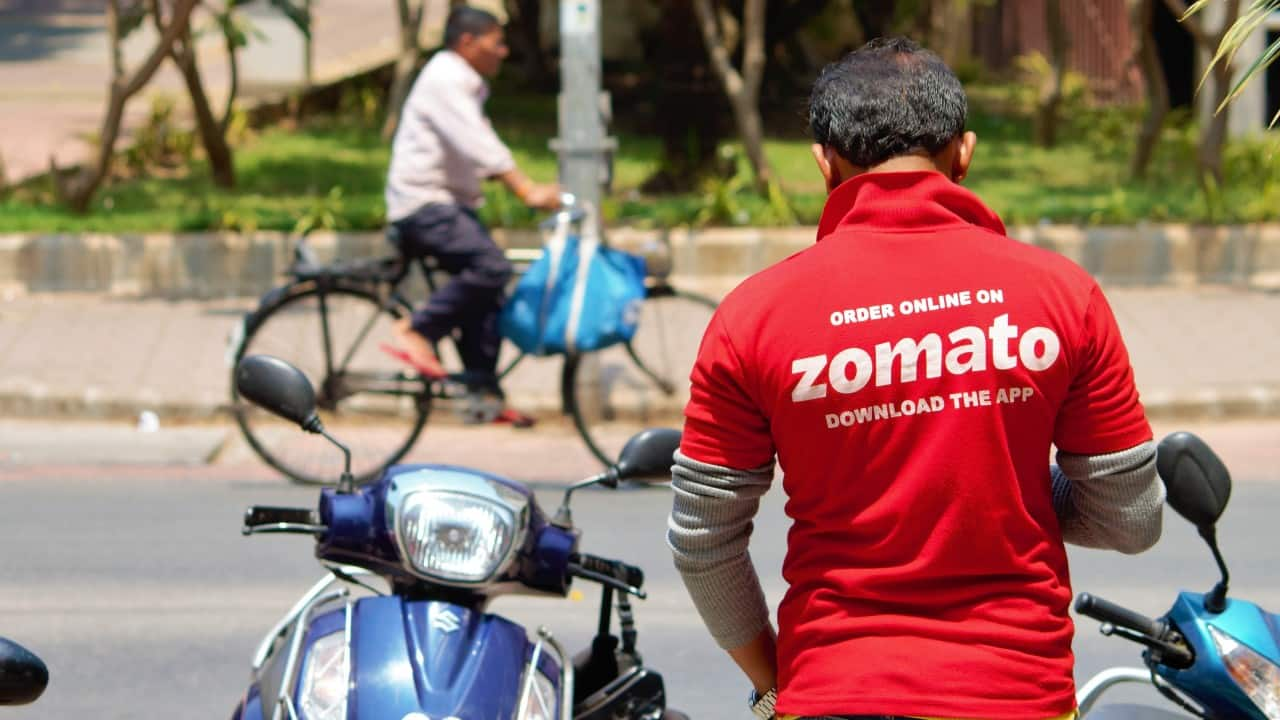
All eyes are on the rivalry between Zomato and Swiggy in India’s food delivery sector as the latter prepares to go public in the coming months.
At the moment, Zomato seems to be winning the turf war.
Driving the news
The Gurugram-based unicorn’s number of food delivery orders grew 29% in July, while Swiggy logged an 11% growth, compared to the year-ago period, according to brokerage firm UBS.
- While Zomato’s order volume rose by 1.6% month-on-month, IPO-bound Swiggy saw a contraction of 4.6% during the peak summer month
Also read: Antfin sells $570 million stake in Zomato, reducing holdings to 2.2%
Clash of titans
“Having a listed competitor is both good and bad. We don’t have to explain what on-demand is, what the gig worker economy means and what hyperlocal is – all of these are the positives,” Swiggy founder Sriharsha Majety said at the Moneycontrol Startup Conclave in Bengaluru on August 9.
The negative is that quarter-on-quarter you are going to be compared on the trajectory, he added.
Behind the scenes
While Swiggy reigned supreme with a 52% market share across India in 2020, Zomato has raced ahead to a 55% share in the past couple of years.
- According to experts, Zomato built its business in a more localised way, approaching each region with a strategy that was unique to that geography
- Meanwhile, Zomato has reported five consecutive quarters of net profits, whereas Swiggy logged an operating loss of over Rs 1,000 crore in the first nine months of FY24
Go deeper
Flipkart starts quick commerce price war
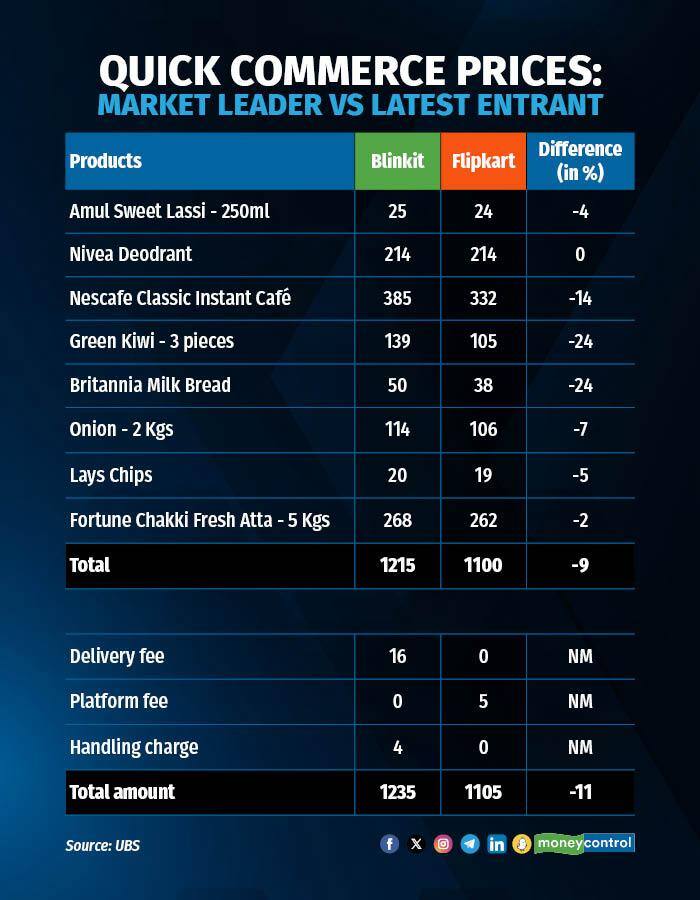
Flipkart entered the quick commerce turf and got price disruptions along.
Driving the news
Products on Flipkart Minutes, the Walmart-owned company’s quick commerce wing, are 10% lower than they are on Blinkit, as per UBS analysts.
- Prices on Flipkart Minutes are about 0-20% cheaper, giving it an edge over Blinkit, which is the market leader
- The absence of delivery fees and handling charges, combined with better product prices, has benefited Flipkart Minutes
This pattern mirrors what many players do during their initial phases: offering discounts, promotions, and other perks to attract customers from other platforms and build their own user base.
- However, Flipkart has been in this space for a long time and is large enough to have negotiating power with brands, which may mean that the discounts will continue
Thanks to its delayed entry, UBS noted that Flipkart Minutes has the advantage of not making early mistakes and can replicate successful models from other players.
What’s Blinkit’s take?
The Zomato-owned company does not believe in discounting to win customers over.
“...our focus is to build a valuable service that customers actually are willing to pay more for rather than trying to provide an inferior service and leaning on discounting to grow. And that will be our strategy going forward as well," Blinkit CEO Albinder Dhindsa said during Zomato’s Q4FY24 earnings call.
Dig deeper
NCPCR calls for KYC for children under DPDP

India's Digital Personal Data Protection (DPDP) Act rules are nearing completion and set to undergo public consultation soon.
- But can India's apex child protection body push a final recommendation?
Driving the news
The National Commission for Protection of Child Rights (NCPCR) will recommend that the Ministry of Electronics and Information Technology (MeitY) mandate KYC-based age verification for children under the DPDP Act, 2023, sources told us.
- The NCPCR will send a letter to MeitY by August 21 following a closed-door meeting with social media platforms on August 13
What’s the deal?
The body has urged major platforms like X (formerly Twitter), Instagram, and YouTube to implement KYC verification for children, as per Section 9 of the DPDP Act.
- The platforms have outlined their efforts to detect and report harmful content, including sharing data with the National Center for Missing & Exploited Children (NECMEC)
However, the NCPCR remains concerned about the accessibility of adult content to minors, highlighting the lack of KYC-based controls on platforms like Ullu.
Tell me more
MeitY is expected to release the DPDP rules for consultation within a month.
- The rules would detail the mechanism for children's age verification
- It will also list out establishments which will be exempted from restrictions related to processing of children’s data
Find out more
MC Special: Karnataka’s heritage in the metaverse

Karnataka is bringing its rich heritage to the metaverse!
The state's Department of Archaeology, Museums, and Heritage (DAMH) is embarking on a project to digitize and showcase 10 of its 530 protected monuments.
- This initial phase involves creating virtual representations of these historic structures, allowing people to explore Karnataka's cultural treasures from the comfort of their homes
Dig deeper



 PREVIOUS
 QUICK HITS
 GLOBAL PICKS