
Moneycontrol scoop: Byju's is set to raise a massive $1 billion funding round, which will serve as a sort of validation for the edtech giant, providing it with a much-needed boost amid regulatory scrutiny.
- $700 million will come from equity and the rest from structured instruments
- A major Middle Eastern sovereign wealth fund will lead the equity portion of the investment, while Oaktree Capital, Davidson Kempner, and Apollo, all US-based asset management firms, will invest through structured instruments
The deal is expected to close in about a month's time and will be at a flat valuation of $22 billion, marking the second time in the last eight months that Byju's has had a flat round. Find out more
In today’s newsletter:
- Top investors cut startup deals by 80% in India
- ONDC's growth strategy beyond discounts
- Karnataka bets big on blockchain
Was this newsletter forwarded to you? You can sign up for Tech3 here
 Top 3 stories
Top investors cut startup deals by 80% in India
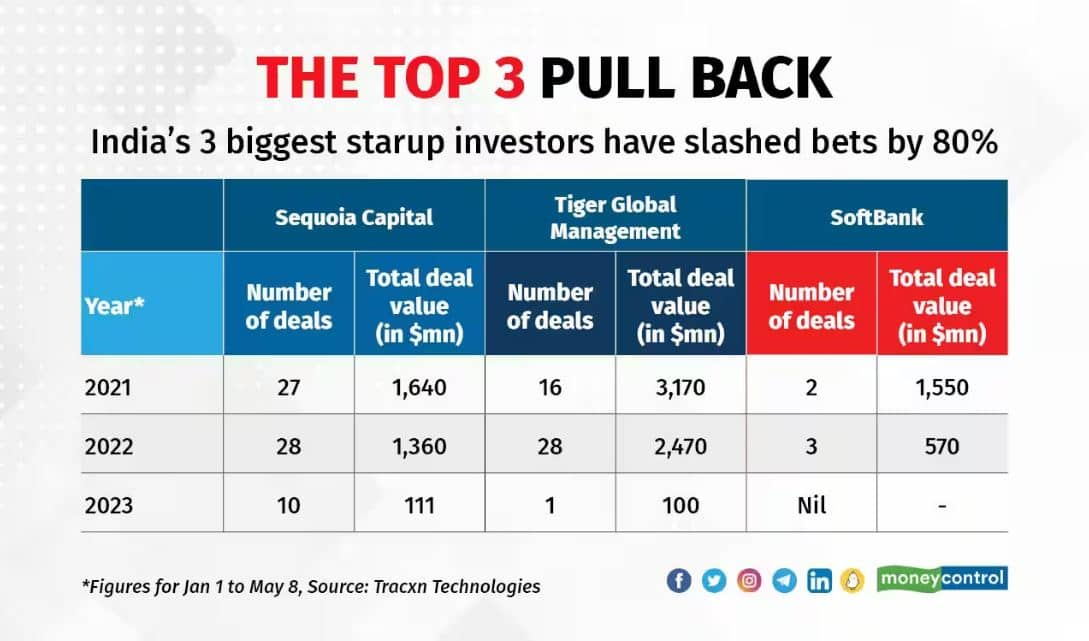
As Byju's edges closer to closing what is expected to be one of the biggest funding rounds in recent times, India's most significant startup investors are nowhere to be seen.
“There’s absolutely no activity,” an investor said.
Driving the news
India’s three biggest startup investors--Sequoia Capital, Tiger Global Management and SoftBank--have invested in only 11 deals so far in 2023, compared to 59 in the year-ago period.
This underscores the severity of the funding winter.
- In 2023, Tiger Global has only participated in one deal, while SoftBank has not written a single check since July last year
- Sequoia was the most active of the three, with 10 deals
Why do these figures matter
Sequoia Capital, Tiger Global Management, and SoftBank have been the most prolific startup investors in India over the last 10 years.
- Sequoia has backed 31 unicorns, Tiger Global has backed 38, and SoftBank has backed 21 of the 108 unicorns in the country so far
Sequoia recently raised a $2 billion fund for Indian startups, and Tiger Global has also been very bullish on India. However, the numbers do not seem to add up.
“Tiger has shown all the optimism, Sequoia has raised a large fund but are they investing?” another investor argued.
With the top 3 investors choosing to sit out, India's startup ecosystem, currently ranked third in the world, is poised to face more challenges. Only time will tell when the funding winter will come to an end.
ONDC's growth strategy beyond discounts

The question that seems to be on everyone's mind in tech land is: will ONDC become a threat to the Swiggy and Zomato duopoly?
ONDC has become a hot topic in the tech industry, as it has grown 100X in just a few months. In February, it was processing only 200 retail orders per day, but last weekend the number had soared to 25,000.
Driving the news
The industry has not overlooked the fact that the fast-paced expansion has largely been driven by significant discounts, the type typically offered by venture-funded e-commerce platforms.
Strategic call
ONDC Chief T. Koshy stated that the discounts are merely a short-term phenomenon, and the network must succeed on its own merits in the long run.
Koshy believes that having sellers listed on one seller app visible to buyers on any buyer-side app will foster competition, resulting in the emergence of numerous cost-effective and efficient seller apps.
"Participants do agree with our philosophy that we should nurture a sustainable network building on cost economics resulting from specialisation and innovation and driven by competition and fair practices and not based on unhealthy price discounting building walled gardens," Koshy said.
When the dust settles
In several cases over the past weeks, buyers have been surprised to find that the bill payable on ONDC for a particular food item from some restaurants could be as much as 30-40% lower than that of Zomato and Swiggy.
- The difference in prices between buyers and sellers is not expected to persist in the long term, according to a senior executive at a seller-side app on the network.
He believes that the price difference between ONDC and other major e-commerce platforms will likely stabilize at a maximum of 10-12%.
Go deeper
Karnataka bets big on blockchain

Karnataka is taking big strides towards blockchain adoption, cementing its position as a pioneer in technology and innovation.
Driving the news
How will it help?
- Will reduce manual verification processes
- Will prevent fraudulent representation of qualifications
- Will be secure and accessible
- Cannot be altered/duplicated
What about other departments?
Different government departments in Karnataka have adopted blockchain technology for various purposes.
For example, Secondary School Leaving Certificates and PUC marks cards have been stored on the blockchain since 2020, while caste and income certificates have been stored since January 2018. Additionally, birth and death certificates have been stored on the blockchain since April 2022.
Find out more
Today in tech history: Walmart acquires Flipkart for $16 bn




 PREVIOUS
 Tweet of the day
 QUICK HITS
 GLOBAL PICKS