One important thing: A NASA spacecraft intentionally slammed into an asteroid in what is being termed as humanity’s first test of planetary defence.
Indian scientists say this is a step toward preparing the world for a potential doomsday asteroid collision like the one which killed the dinosaurs millions of years ago. Meanwhile, Google has a mock demo on its search engine.
In today's newsletter:
- Meat and India's hypocrisy
- Smartphone bonanza drives e-comm sales
- Why the iPhone 14 won't be cheap in India
 Top 3 stories
Meat and India's hypocrisy

Isn't it common to be rejected by venture capitalists? Abhay Hanjura and Vivek Gupta, co-founders of online meat seller Licious, experienced the same problem. But wait...they were rejected because of their product. Here's what happened.
Many of the investors they approached were not category consumers. They encountered so much opposition that the pair coined the term "vegetarian capitalists" to describe VCs. They were asked to make paneer instead of meat and to display a similar global model. A third withdrew because a large Gujarati family, one of the fund's backers, did not want to invest in the sector.
"Meat continues to languish in the kali thaili (black plastic bag) with sanitary pads, condoms, and alcohol. It's the fourth stepchild. Cultural hypocrisy was the greatest impediment," Hanjura told us.
Buyers have been purchasing meat from the neighbourhood butcher shops for many years. But with so many meat delivery firms popping up online, we made the decision to go to a processing facility to see what happens before the package is delivered.
Inside the processing plant
Licious' 25,000-square-foot facility produces a wide range of products. The facility is divided into two floors. One is where the tests and quality inspections are performed, and the other is where the processing is completed.
This facility employs 500 people, 20% of whom are women, who work eight-hour shifts. The plant processes 25 tonnes of produce per day on average. Every day, Licious processes over 100 tonnes of produce across India. However, the types of produce vary from region to region.
How big is the online meat market?
The pandemic acted as a catalyst for this emerging market. The average order value for meat delivery startups increased by 10-15% in 2020. Even customer retention improved by 10-15%.
Licious, which became a unicorn in 2021, now serves approximately 2.5 million customers per month and expects to generate Rs 1,500 crore in revenue in FY23. Licious began opening offline stores modelled after Haldiram's this year, complete with a snack-in counter and the option to purchase meat.
Read it here
Smartphone bonanza drives e-comm sales
One of the major topics of discussion in our friend and peer groups over the last few days has been "which smartphone should I buy?"
This is further helped by the genuinely decent festive deals e-commerce platforms are offering customers. Although it has also caused some glitches (Hello, Flipkart!)
This is evident in the numbers too! Almost one in every 100 Indians would end up purchasing a phone online during the first week of the festive sales. This much is clear from the first four days of the annual e-commerce deals season.
Festive fervour
Following a period of flat demand in recent months, e-commerce platforms have seen a 5.4X increase in sales in the last few days.
- In the first four days of the festive sales, 50-55 million shoppers made purchases
- Fashion items worth Rs 5,500 crore and phones worth Rs 11,000 crore were sold
- Premium smartphones (iPhone 12, 13, OnePlus) have fueled mobile sales
- According to a Redseer analyst, sellers are also more bullish this year, and thus more aggressive with discounts
Ticket size stagnation
Despite sales growth, the average ticket size of purchases during the first week of the festive season is expected to be similar to last year.
- In the first half of the festive week in 2022, the ticket size is expected to be around Rs 5,400
- It was in the range of Rs 5,000- Rs 5,200 in the festive sales of the last two years
- The average ticket size in 2018 was Rs 7,350 and Rs 6,750 in 2019
Cause for concern?
Average ticket sizes have been trending downward over the years as the share of smartphone sales in total festive sales has decreased, said a Redseer analyst. However, with consumer inflation on the rise, this could be cause for concern, as it means that e-commerce hasn't been able to capture a larger share of the wallet over time.
Why the iPhone 14 won't be cheap in India
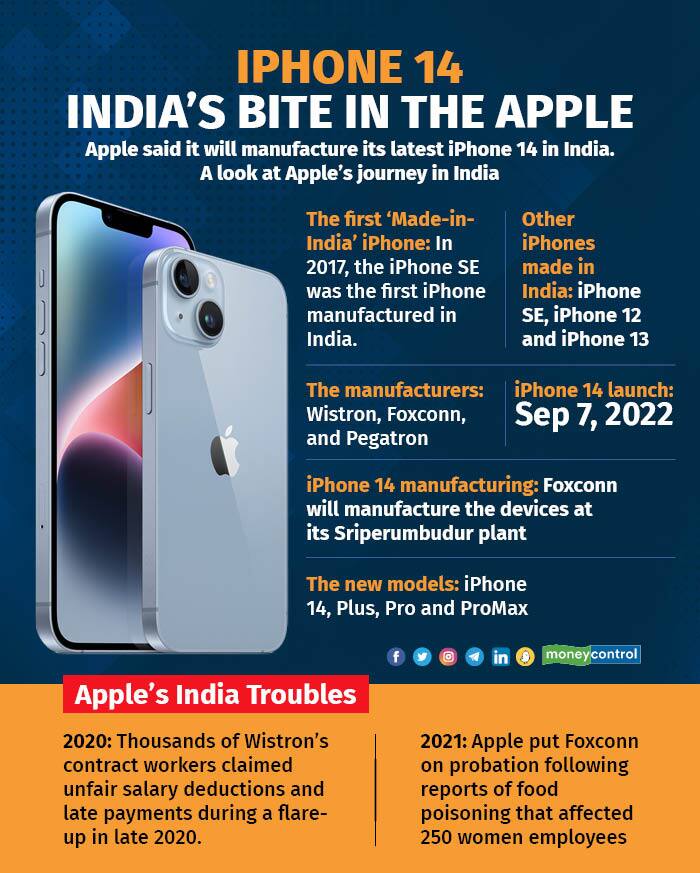
It was a milestone moment for Apple in India yesterday as the tech giant said it will start making iPhone 14 in the country. But, will this mean the device will become cheaper here? Not so fast.
No immediate price drop
Analysts say they don't expect Apple to lower the prices of these devices in the near future.
"Our estimate is Apple will either absorb the savings or invest in marketing," says Navkendar Singh, associate vice president for device research at IDC India, South Asia, and ANZ.
Boost for Make in India story
Apple's move to make iPhone 14 in India would, however, boost the country's ambitions to become a global manufacturing hub.
- India aspires to become a preferred destination for electronics manufacturing, with an ambitious plan to produce $300 billion in electronics products by 2025-26, with $120 billion exported and $70-80 billion consumed by domestic firms.
Junior IT minister Rajeev Chandrasekhar recently told us that India has a great opportunity to become a "trusted supply chain" at a time when the world is looking for diversification of the $1.5 trillion electronics value chain dominated by China.
What it means for Apple?
The tech giant has been gradually trying to reduce its reliance on China, with the goal of diversifying its manufacturing capabilities. This is partly due to the supply chain impact of the Covid-led restrictions and the escalating tensions between China and the United States.
- Apple may move 5% of its global iPhone 14 production to India by late 2022 and later expand its capacity to make one out of every four iPhones in India by 2025, according to a recent JPMorgan report.
MC interview: Fisker sees an opportunity where Tesla does not
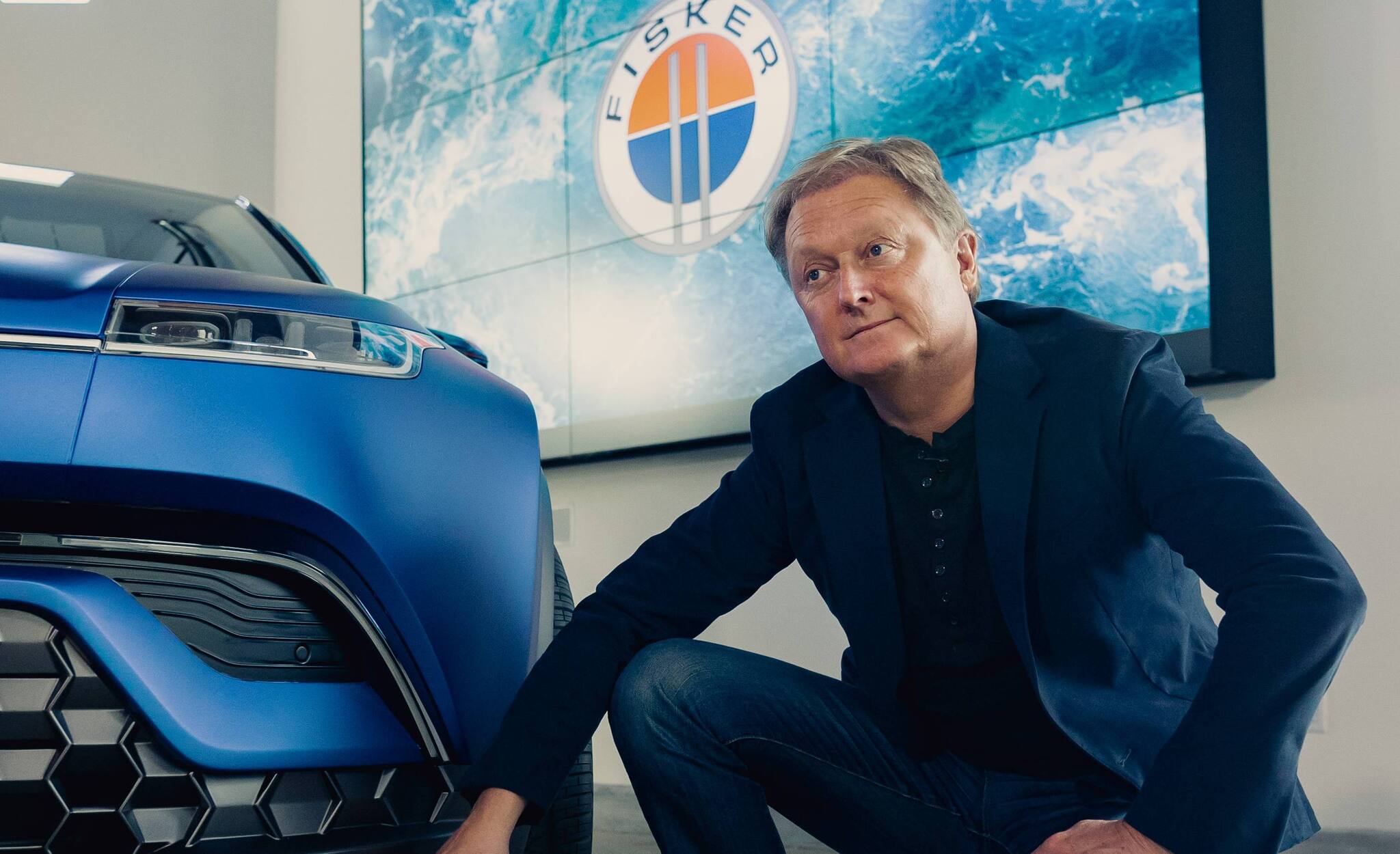
Elon Musk’s Tesla is wary to enter the Indian electric four-wheeler market due to high import duties, but Fisker Inc. CEO Henrik Fisker disagrees.
He sees the lack of foreign car OEMs in India as an opportunity to capture a significant portion of the market in the subcontinent.
“...this import duty applies to everyone, so we have no plans to go to the government and request special treatment, because I believe it is a level playing field for all,” he told us in an interview.
Apart from importing their car Ocean (a sport utility vehicle) next year, Fisker also plans to manufacture PEAR (which stands for Personal Electric Automotive Revolution), another Fisker product that Henrik claims will be more affordable and suitable for the Indian market.
Fisker also spoke about the company’s hiring plans for their "only" India office in Hyderabad, why they chose Hyderabad over Bengaluru, his takeaways from the 2013 bankruptcy of Fisker Automotive, and his bet on Make in India among others.
Read the full interview
MC Special: Fintech Files Part 1
The Indian fintech ecosystem received nearly $8 billion in funding in 2021 and experienced tremendous growth as a result of increased digitisation and plush coffers. However, the narrative began to shift in 2022, when compliance overtook aggressive growth targets.
If you are curious to know more about what makes up the Indian fintech ecosystem, what the concerns are, and how technology has changed financial services, we at Moneycontrol have launched a series called 'Fintech Files' to give you the lowdown on everything fintech.
In the first part, we take you through the basics of the size of the Indian fintech sector and how the economics have evolved over time.
Read the full story here.



 PREVIOUS
 Tweet of the day
 QUICK HITS
 DEALS OF THE DAY
 GLOBAL PICKS