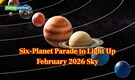
Six planets will line up after sunset on 28 February, visible across India under clear skies. From bright Venus to faint Neptune, this rare parade holds more surprises than many expect.
Six planets will line up in late February 2026, and NASA’s Chandra X-ray Observatory has turned three of them into sound. What does Jupiter, Saturn and Uranus actually “sound” like in space?
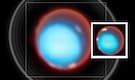
NASA's James Webb Space Telescope has captured giant auroras blazing across Uranus, revealing powerful magnetic storms and rewriting what we know about the distant ice giant.
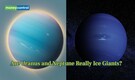
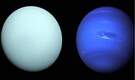
New research suggests Uranus and Neptune may not be true ice giants, with rocky interiors dominating instead, challenging long-standing models of planetary formation and classification.
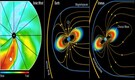
Scientists believe a powerful solar wind burst may explain Voyager’s unusual 1986 radiation readings at Uranus, offering new insights into distant planetary environments.
Uranus is unlike any other planet in space. It tilts sideways, spinning like a barrel in orbit. Each pole gets 42 years of direct sunlight.
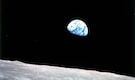
Have you ever wondered how our home planet, Earth, looks from other planets in our solar system? Let's take a cosmic journey to explore the breathtaking views of Earth from our celestial neighbors.
Scientists have made an exciting discovery with the James Webb Space Telescope (JWST), finding carbon dioxide ice on Ariel, one of Uranus' moons.
Planet gazers would be in for a treat, this week. A report in the Times of India confirms that according to ...