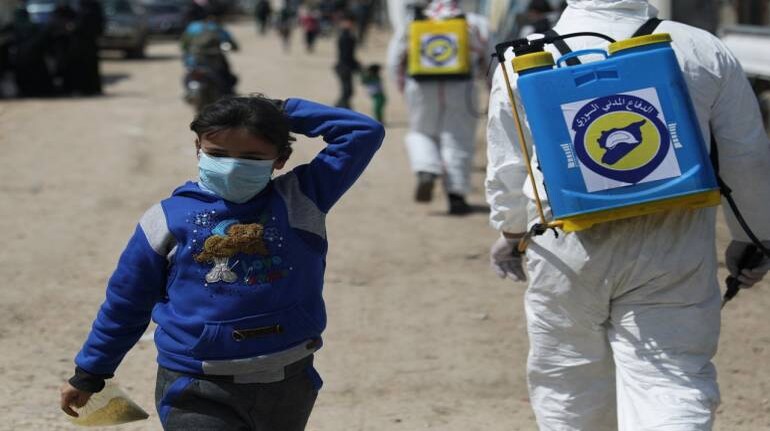
The myth of the universalist liberal order amidst the novel coronavirus (COVID-19) outbreak is caught between two paradoxes: the universal responsibility to protect the human rights and the inexorable demand to reassert the Westphalian model of sovereignty to enhance and maximise healthcare needs of their relative population. This institutional approach of the governments and health systems would disproportionately defile the socially-excluded and powerless members of the global order — the refugees. In the post-modern global order, refugees make up the most vulnerable section of society.
In 2019, there were 20.4 million refugees under the mandate of the UNHCR. Across the world, around 70.8 million people are forcibly displaced. Overcrowding, malnutrition and poor access to healthcare services are already leading to higher morbidity and mortality rates among refugee and displaced populations. Yet, countermeasures adopted by countries during this outbreak have failed to take into account the vulnerability of refugees.
The pandemic has infected more than 1,202,242 people and with at least 64,729 fatalities. A pandemic of this severity poses a threat to global health and to upholding human rights.
Apart from the right to health, several institutional measures, such as censorship, discrimination, arbitrary detention have received criticisms from the civil society which believes that draconian measures have no place in the fight against the pandemic. According to Amnesty International, “human rights violations hinder, rather than facilitate, responses to public health emergencies and undercut their efficiency.”
In the wake of the outbreak, the UNHCR has pledged $33 million to improve conditions at refugee camps and settlements, expanding primary and secondary health services, establishing surveillance networks, and countering the infiltration of misinformation among refugee communities. Considering the intensity of the pandemic, these efforts are droplets in the ocean. Around 80 percent of the world’s refugees reside in economically weak countries, which reports lower rates of immunisation and higher rates of malnutrition than their higher-income counterparts. These deteriorating health facilities further weaken people’s immune systems, proffering them susceptible to emerging health hazards like the coronavirus.
Recently, the UNHCR, the International Organization for Migration, the World Health Organization, and the International Federation of Red Cross and Red Crescent Societies released an interim guidance silhouetting COVID-19 readiness and response mechanisms for refugee camps and camp-like settings. On March 17, the UNHCR and the International Organization for Migration announced a temporary suspension of resettlement travel for refugees. Leaders such as Matteo Salvini, former Italian Deputy Prime Minister, and Viktor Orbán, Prime Minister of Hungary, have attempted to assign blame for the outbreak to refugees and migrants.
A policy is not an idea, it is implementation. Several national policies hamstring the social-inclusiveness of emergency planning. Some countries have overtly stated their ineffectiveness and unwillingness to provide equitable rights and access to health services to refugees taking the defence of national security and perceived threats to State sovereignty. While in some countries, legislative lacunae, bureaucratic barriers and administrative loopholes often prevent refugees from accessing health services.
Pandemic is a transnational crisis, a problem without a passport. Issues like these demand States and institutions to come together (global cooperation) to fight for humanity. Even solitary measures adopted by countries need to align with the United Nations’ UDHR norms, which affirms ‘every person’s’ right to health.
The geopolitical and geo-economical backdrop of coronavirus makes refugee health protection an even more critical public health priority. Social practices, such as quarantining and social distancing, are a luxury, especially for those whose survival depends on a nation’s benignity.
In years to come, the effectiveness of our modern civilisation’s response to COVID-19 may be judged not just by the scale and speed of the cash hypes, or whether the recovery curve is flat or steep, but by what we did for the most vulnerable among us.
Adithya Anil Variath is a Mumbai-based lawyer. Views are personal.
Discover the latest Business News, Sensex, and Nifty updates. Obtain Personal Finance insights, tax queries, and expert opinions on Moneycontrol or download the Moneycontrol App to stay updated!
Find the best of Al News in one place, specially curated for you every weekend.
Stay on top of the latest tech trends and biggest startup news.