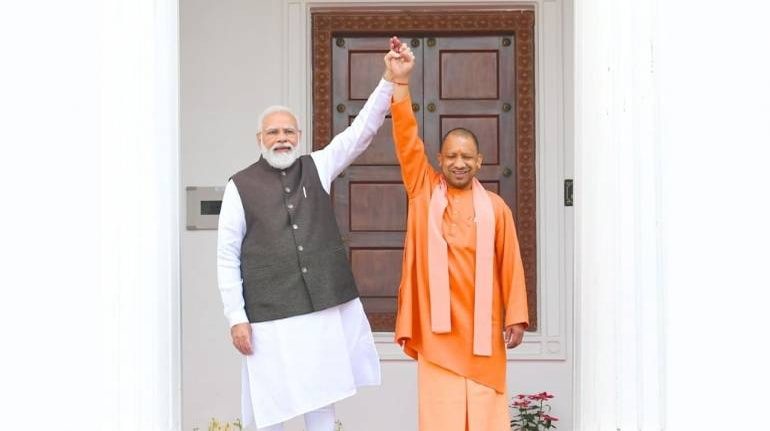
Yogi Adityanath’s new Cabinet of 52 ministers has been crafted with due representation to various segments of society, gender, regions in line with party’s ‘sabka saath, sabka vikas’ model of governance.
While KP Maurya who lost the assembly elections has been retained as Deputy Chief Minister in a bid to not antagonise the non-Yadav OBC vote bloc who have emerged as staunch supporters of the Bharatiya Janata Party (BJP), Dinesh Sharma has been dropped and replaced by Brajesh Pandey. Both Sharma and Pandey are from the same caste (Brahmin).
Thirty-one new faces have been admitted to the Cabinet, while over two dozen ministers have been dropped. Performance has not been the only criteria is finding a place in the Cabinet, as ministers such as Shrikant Sharma and Siddharth Nath Singh have also not been retained. They could be accommodated at the organisation level, as state party president Swatantra Dev Singh has been made a minister.
The average age of the Cabinet is 52 years — in the 2017 Cabinet it was 54 years. In terms of caste and communities, the ministry has 21 upper castes, 19 OBCs, 10 SCs/STs, one Muslim, and 1 Sikh member. Five women ministers have also been sworn in, including former Uttarakhand Governor Baby Rani Maurya.
There are only three caste- or religion-based groups where the BJP is not the number one choice for voters — the Muslims, the Yadavs, and the Jatavs (SC).
In terms of the size of the ministry, while the SC and the OBC representation is more or less in line with the population, the upper caste representation appears to be fairly high. The BJP is able to do this higher allocation to other groups because it does not give many tickets to the Muslims (who are about 19 percent of the state’s population).
In the case of the ministry, there is a buffer of ~15 percent (see table below) which is allocated to the Brahmins, the Rajputs, the Banias, the Vaishyas, the Bhumihars, among others—all groups that are traditional supporters.

Of the MLAs elected on a BJP ticket, 43 percent belong to the upper caste — 46 Brahmins, 41 Rajputs, 21 Banias, etc. About 24 percent of its MLAs hail from the SC community, while 33 percent are OBCs. The allocation of ministry is thus in line with the electoral performance (see graphs below).
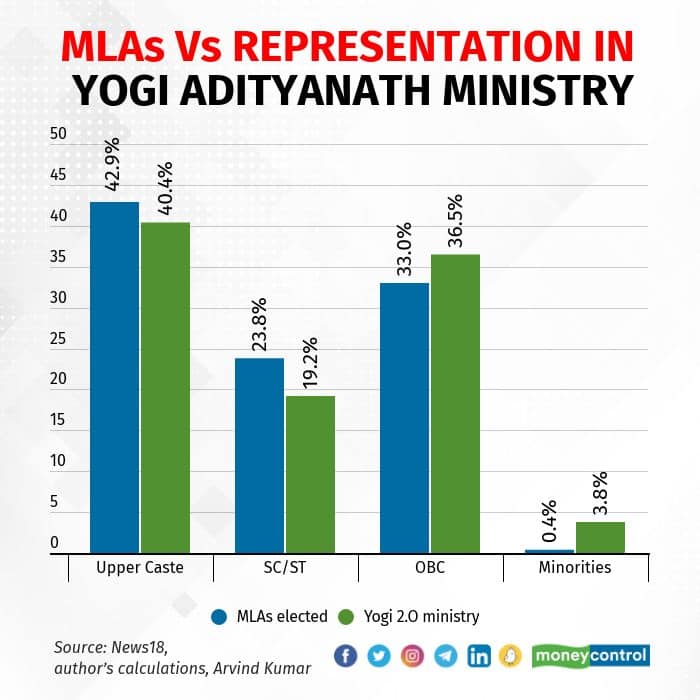

If one compares the distribution with the vote base of the BJP, one can see that the party is sending a signal to the Dalits that they will get a higher share of representation in the ministry if they vote in large numbers for the BJP. About 51 percent non-Jatavs and 21 percent Jatavs have voted for the BJP in 2022.
Roughly about 15 percent of the votes the BJP won are from the SC community, however they form about 19 percent of the ministry. The national party feels that with Mayawati’s Bahujan Samaj Party (BSP) weakening, wooing the BSP’s core base of Jatavs now will give the BJP an edge in the 2024 general elections.
There is only one Muslim and Yadav minister each, with a clear message that people who don’t vote for the BJP will not be represented in the ministry. This could be because the BJP feels that the Muslims and the Yadavs are likely to back the Samajwadi party in the future. This exclusion is contrary to the strategy adopted for the Jatavs who have got representation in Baby Rani Maurya, and ex-bureaucrat Asif Arun.
The Kurmis and the Banias are in the top five MLAs elected on a BJP ticket, and have been adequately compensated. So have been the Jats with three ministries for having backed the BJP despite the farmer agitation and a formidable RLD-SP alliance.
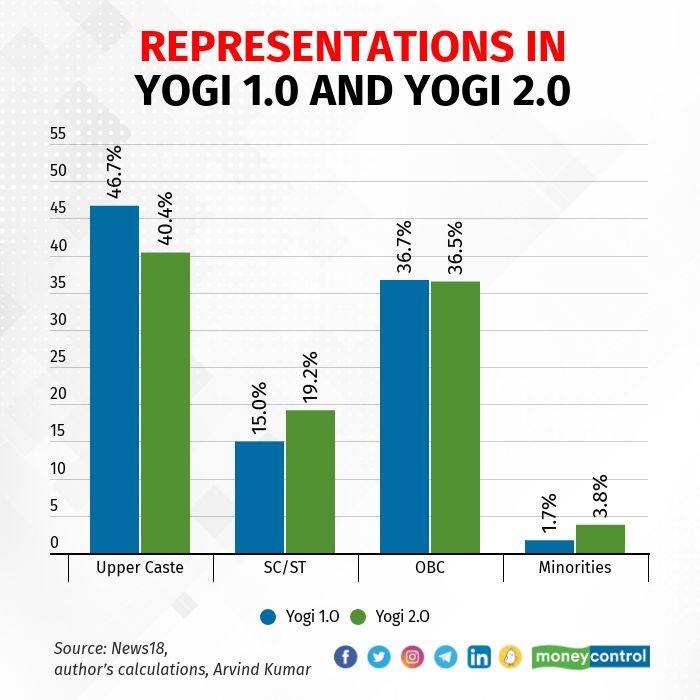
Compared to the earlier ministry by Adityanath, there are fewer upper caste ministers and more Dalit ministers in sync with the BJP’s strategy for 2024. The party sees here a clear opening to create a formidable social coalition of Hindutva and welfarism.
Amitabh Tiwari is a former corporate and investment banker-turned political strategist and commentator. Twitter: @politicalbaaba.Views are personal and do not represent the stand of this publication.
Discover the latest Business News, Sensex, and Nifty updates. Obtain Personal Finance insights, tax queries, and expert opinions on Moneycontrol or download the Moneycontrol App to stay updated!
Find the best of Al News in one place, specially curated for you every weekend.
Stay on top of the latest tech trends and biggest startup news.