







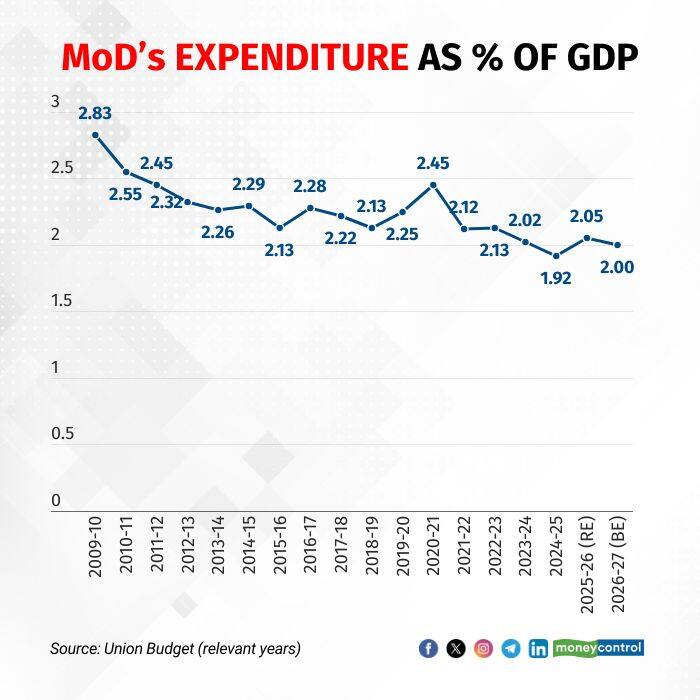
Soon after the presentation of the Union Budget 2026–27, the Ministry of Defence (MoD) released its official press statement, highlighting, among others, that its “allocation [Rs 7.85 lakh crore] stands at 2% of the estimated [gross domestic product] GDP” for the coming fiscal year.
The reference to the GDP is not without significance. After all, when the previous Union Budget was unveiled in February 2025, the defence allocation had fallen to 1.91% of the then estimated GDP, causing some anxiety within the defence establishment and among the strategic community. But why is the reference to an innocuous figure like GDP important, and what does it entail?
Share of Defence Spending
Defence’s share in GDP represents the proportion of a country’s wealth devoted to its security. If a country’s GDP consists of, say, only 100 vehicles or horses in a particular year, a 2% allocation of GDP for defence in that year would mean that its security forces get only two vehicles or horses to protect the country.
Suffice it to say that the entire GDP is not available to the government for spending; rather, only a fraction of it flows into the government’s budget through various tax and non-tax measures. The latest Union Budget, for instance, amounts to just 14% of the estimated GDP for 2026–27.
In academic literature, the defence–GDP ratio is acknowledged as a defence burden, as the resources devoted to defence are not available for spending on welfare activities for taxpayers.
No Universal Benchmark for Defence Burden
There is no uniform norm regarding what should constitute an appropriate defence burden or defence–GDP ratio for a country. The ratio varies from country to country, depending on its security environment and defence strategy.
According to the Stockholm International Peace Research Institute (SIPRI), which tracks military expenditure in more than 170 countries worldwide, the defence–GDP ratio ranged from as low as 0.24% in Ireland to as high as 34.48% in Ukraine in 2024. This wide variation reflects the very different security environments in which these countries operate.
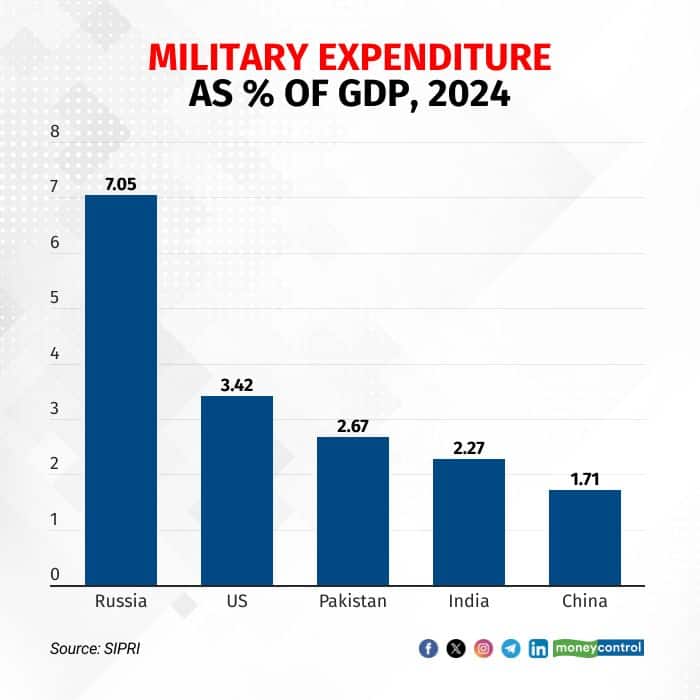
Figure 1 depicts military expenditure as a percentage of GDP for select countries, including India, based on SIPRI’s military expenditure database. It is worth noting that SIPRI’s military expenditure figure for India is overestimated, as it includes the expenses of several paramilitary forces—such as the Border Security Force, Central Reserve Police Force, Assam Rifles, Indo-Tibetan Border Police, and Sashastra Seema Bal—which do not fall under the MoD’s purview and are therefore not part of India’s official defence budget.
Defence–GDP Ratio: A Downward Trend
Figure 2 shows India’s defence expenditure—as accounted for by the MoD—as a proportion of GDP since 2009–10. Barring a spike in 2020–21, the overall trend has been on a downward trajectory.
Should India’s declining defence–GDP ratio be a cause for concern? Should the ratio be fixed at an elevated level, comparable to that of other countries such as the United States, Russia or even Pakistan? Or should India emulate China, which has a much lower defence burden than India, even though in absolute terms it outspends India by a wide margin? In 2024, China’s military expenditure of $314 billion was nearly four times that of India.
Why the Ratio Matters Less Than Capability
India’s declining defence–GDP ratio need not be a concern as long as the MoD receives adequate resources through the annual Union Budget to meet its operational and modernisation requirements. However, given the scarcity of resources and competing demands from various socio-economic sectors, it is not surprising that the MoD’s annual budgets often fall short of its expectations.
What matters most, therefore, is the extent of shortages faced by the MoD in running its vast security apparatus. Needless to mention, the higher the shortages, the greater their adverse impact on the country’s defence preparedness.
The ideal way to address these shortages is through resource augmentation rather than by committing to a fixed share of GDP. A fixed share of GDP does not necessarily guarantee a steady increase in defence spending, as a contraction in GDP—as witnessed in India in 2020–21—can result in a smaller defence budget than that of the previous year.
Case for Predictable and Steady Increases
In recent years, several countries have announced plans to raise their defence spending to a specified share of GDP. In June 2025, for instance, members of the North Atlantic Treaty Organisation (NATO) committed to increasing their core defence spending to 3.5% of GDP by 2035.
This commitment must be viewed in the context of European NATO members’ long-standing free-riding on US military power in the post-Cold War era. With President Trump showing scant respect for the transatlantic military alliance, European NATO countries have little option but to spend their way towards greater defence preparedness. Put differently, NATO’s June 2025 commitment reflects an American insistence that its allies bear a higher defence burden and take greater responsibility for European security.
India, being part of no military alliance, carries no such free-rider label. It can calibrate its defence spending to best serve its security requirements without undue concern over the precise share of GDP devoted to defence.
This does not mean, however, that annual increases in defence spending should be subject to wide fluctuations, as has often been the case. Over the past decade, the year-on-year increase in MoD expenditure has ranged from as low as 3% to as high as 15%. Given that defence modernisation involves long gestation periods and capability development takes years to materialise, what is required is a steady and predictable increase in annual spending—particularly on the capital side of the defence budget.
(Laxman Kumar Behera is Associate Professor at Special Centre for National Security Studies, Jawaharlal Nehru University (JNU), New Delhi.)
Views are personal, and do not represent the stand of this publication.
Discover the latest Business News, Sensex, and Nifty updates. Obtain Personal Finance insights, tax queries, and expert opinions on Moneycontrol or download the Moneycontrol App to stay updated!
Find the best of Al News in one place, specially curated for you every weekend.
Stay on top of the latest tech trends and biggest startup news.




