




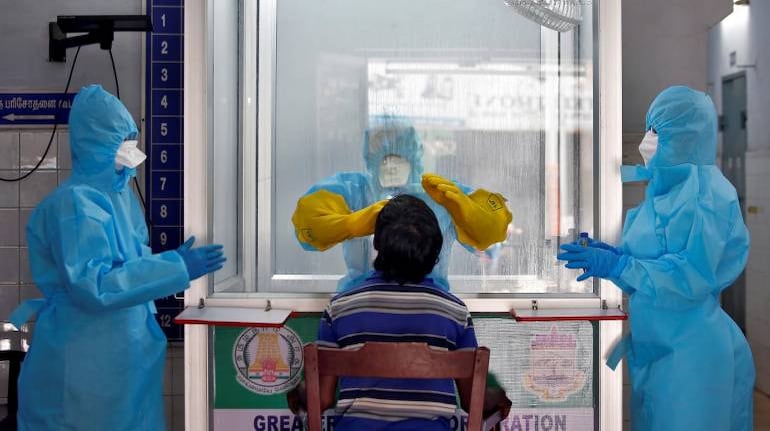
One state, which until three weeks ago was doing relatively well in managing the COVID-19 crisis, was Tamil Nadu. On April 23, Tamil Nadu had 1,683 confirmed positive cases, and now (May 13) it has over four times as many patients at 9,000-plus positive cases. This spike in cases happened thanks to a super cluster that spread from the Koyambedu wholesale market in Chennai. Chennai itself has become a red hot COVID-19 centre vaulting from 400 cases on April 23 to 4,882 on May 12.
In Tamil Nadu the first coronavirus case was reported on March 7, and then there was a lull until March 18 when the case count started to increase. By then the state government had already started screening at airports; but this was little more than using a thermal scanner and asking passengers to fill out a self-declaration form — both of which were of little benefit as we now know.
The case count remained low in the early days but began to spike soon after the news came about the Tablighi Jamaat congregation in Delhi. Around 1,500 members from Tamil Nadu had visited Delhi for the meet and the State scrambled to trace and test them. The government claimed to have traced almost all of them, though it is speculated that a few remained untraced. The next few weeks until April 3 was all about those who attended the ‘Delhi meeting’, as it was referred to later being renamed just as ‘single source’.
In terms of testing, Tamil Nadu started off slowly claiming that it was following the ICMR guidelines and there was no need to test more; but as pressure increased from the media and medical experts, the State stepped up the number of tests done each day. As of May 12, Tamil Nadu has done the maximum number of tests in India (266,687 samples tested) and are currently testing over 3,367 people per million population — a rate higher than Vietnam and Taiwan, both of whom are seen as successful examples of nations that have controlled the outbreak.
On April 24, the Edappadi K Palaniswami-led AIADMK government made its first major mistake in the fight against coronavirus when it announced a ‘lockdown within a lockdown’ in major cities announcing that even vegetable shops and grocery stores would be shut from April 26 to 30. People thronged the markets on April 25, and social distancing was thrown to the winds as customers scrambled to stock up on essentials. One cluster of cases, the Thiruvanmiyur market cluster, is attributed to this rush, though there is no way one can ascertain this.
The next major misstep was in not ensuring social distancing and adequate sanitation at Tamil Nadu’s largest wholesale vegetable, fruit and flower market at Koyambedu in Chennai. While retail sale was banned early, this was not properly enforced. As thousands of people surged the markets each day, there emerged from the narrow confines of the Koyambedu market one of the biggest virus clusters in India. It is believed that this cluster could be contributing to around 3,500 cases, almost 43 percent of the total cases in the state today.
As the virus spread rapidly from Koyambedu, the cash-strapped state government decided to re-open liquor shops across the state, except in Chennai. The sale of liquor contributes almost Rs 30,000 crore each year to the state coffers and with liquor shops remaining closed for 45 days the losses had already crossed Rs 3,000 crore. Also with virtually no revenue from registration of land/vehicles and only minimal VAT/ST collections on fuel, a full blown financial crisis loomed.
While the decision to re-open liquor shops came in for fierce criticism from Opposition parties, what was inexcusable was not enforcing social distancing on the day the shops opened. The sight of surging crowds pushing and shoving to buy liquor hardly did the image of the government any good. Mercifully, the next day the Madras High Court stepped in and ordered closure of these shops.
With the total case count crossing 8,500, the state government finds itself under pressure. So far it has done several things right. It has done the most number of testing so far, it has painstakingly done contact-tracing, it has enforced quarantining in containment zones and has established adequate facilities in hospitals and other corona care centres.
There have been sporadic complaints about the lack of personal protective equipment (PPE), but this was mostly in the early weeks and the issue appears to have been sorted out. The government has also managed to take care of migrant workers better than most states by ensuring adequate food and shelter. Very few migrant workers were seen trekking on the highways back to their home states.
Tamil Nadu is still doing what it should to contain the spread of COVID-19. A few errors from the government and the inevitable easing measures have pushed these efforts back, but with one of the better public health systems in India, Tamil Nadu has the capability to flatten the curve.
The biggest factor going in its favour is the low mortality rate from the infection (among the lowest in the country at 0.69 percent) with only 61 patients having succumbed so far. The fervent hope is that it will stay that way.
Sumanth Raman is a Chennai-based television anchor and political analyst. Views are personal.
Discover the latest Business News, Sensex, and Nifty updates. Obtain Personal Finance insights, tax queries, and expert opinions on Moneycontrol or download the Moneycontrol App to stay updated!
Find the best of Al News in one place, specially curated for you every weekend.
Stay on top of the latest tech trends and biggest startup news.