






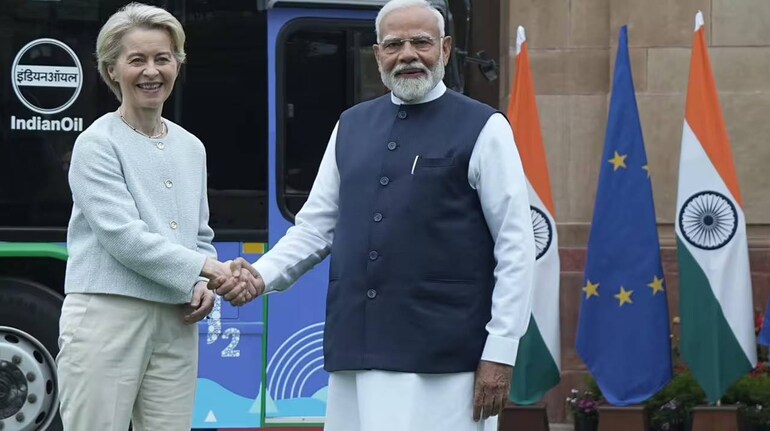
When Ursula von der Leyen recently described the proposed EU–India trade agreement as “the mother of all deals,” the phrase drew attention not only because of its ambition, but because of the extraordinary journey behind it. Few trade negotiations have lasted over two decades, survived multiple global crises, and still remained politically relevant.
Negotiations encapsulate evolution of India’s approach to trade
The EU–India free trade talks are not merely a delayed agreement waiting to be concluded. They are a record of how India’s trade positions evolved over time, shaped less by a grand plan and more by changing domestic politics, global economic shocks, and shifting geopolitics.
The 22-year timeline shows why India hesitated early, why talks collapsed midway, and why the present moment looks fundamentally different. With negotiations now approaching a political close after more than a dozen rounds since 2022, the timing of the EU–India FTA has become as important as its content.
Early ambition and the limits of openness
The idea of a comprehensive EU–India trade agreement took shape in the early 2000s, when globalisation was widely seen as a growth engine. Formal negotiations began in 2007 under the Broad-based Trade and Investment Agreement (BTIA), one of the most ambitious trade frameworks India had attempted. The scope was expansive. It covered goods, services, investment protection, intellectual property, and public procurement. But ambition soon collided with political and economic realities.
The European Union pushed for deep tariff reductions, particularly in automobiles, wines, and spirits, alongside stronger intellectual property protections and access to India’s public procurement markets. India, meanwhile, focused on services access, professional mobility, and regulatory flexibility, areas where European willingness was limited.
Agriculture and asymmetric liberalisation
Agriculture and dairy became some of the most politically sensitive fault lines. For India, opening these sectors was not just a trade issue but a livelihoods concern, given the scale of smallholder farming and the role of dairy in rural incomes. European efficiency and subsidies sharpened these fears. While agriculture was not the only sticking point, it came to symbolise India’s discomfort with asymmetric liberalisation.
By 2013, talks collapsed. This was not the outcome of a coherent long-term trade doctrine. It reflected uncertainty, domestic constraints, and the limits of what India was willing, or able, to concede at that stage of its economic development.
Collapse, recalibration, and a changing global order
The years between 2013 and 2021 were shaped by forces far larger than the EU–India negotiations themselves. Global faith in free trade weakened sharply. The eurozone crisis exposed structural fragilities. Brexit disrupted Europe’s own trade orientation. Most significantly, the election of Donald Trump altered the global trade environment. Under Trump administration trade wars, tariff threats, and open scepticism toward multilateralism became normalised. Trade agreements were no longer viewed as purely economic instruments. Trade increasingly became a tool of exercising power.
This shift mattered for India. The global trading system itself grew less predictable. Even advanced economies began prioritising industrial policy, supply chain control, and national interest over liberal norms.
India’s own decisions reflected this uncertainty. The choice to stay out of the Regional Comprehensive Economic Partnership (RCEP) in 2019 was driven by concerns about manufacturing competitiveness, trade imbalances, and loss of policy space. Rather than pursuing large trade blocs, India began reassessing what kind of openness it could sustain.
This period did not produce a clear trade strategy overnight. Instead, it forced India to adapt, learning through disruption rather than design.
Re-engagement shaped by geopolitics, not ideology
When EU–India negotiations resumed in 2022, the context had shifted decisively. Europe was seeking to reduce its dependence on China and diversify supply chains. India had gained economic scale and geopolitical weight. The relationship was no longer defined by optimism, but by mutual necessity. The structure of the talks reflected this realism. Instead of a single sweeping agreement, negotiations were split into three parallel tracks: a free trade agreement, an investment protection agreement, and a geographical indications deal. This allowed progress without forcing resolution of every sensitive issue at once.
The substance of the negotiations also changed. Tariffs remained important, but newer concerns moved to the forefront, climate regulation, sustainability standards, data governance, and carbon-related trade measures. These issues now shape access to markets as much as tariffs once did.
A more confident India that’s at the same time more cautious
India’s engagement today is more confident, but it is also more cautious. This is not openness driven by ideology or reformist zeal. It is openness shaped by experience, global uncertainty, and strategic positioning.
A predictable business environment is the biggest gain
For businesses and markets, the significance of the EU–India FTA lies less in immediate trade gains and more in predictability. Clearer rules, regulatory stability, and long-term access matter more than headline tariff cuts. Export-oriented firms benefit from certainty. Services firms gain from institutional cooperation. Smaller firms will face higher compliance costs, underscoring the need for domestic support.
For Indian companies, the real impact of the EU–India FTA will be felt less through headline tariff cuts and more through long-term regulatory certainty in one of the world’s largest consumer markets.
Let us be realistic about immediate gains
However, the scale of this potential should not be overstated. While the FTA may widen market access, rising green compliance costs, particularly carbon-related levies and sustainability standards, are likely to limit immediate gains for Indian exporters. The real challenge will lie in navigating these costs while simultaneously negotiating long-standing red lines, such as wines and spirits, public procurement, intellectual property protections, services mobility, and sensitive sectors like dairy and agriculture. The agreement’s success will depend not just on market opening, but on how these overlapping constraints are managed in practice.
The agreement will not mark a dramatic opening of the Indian economy. It will reflect how India’s trade positions evolved under pressure, responding to global shocks, political shifts, and a more contested world economy.
(Tarun Agarwal is an Associate Fellow at the Center of Policy Research and Governance, New Delhi, where he leads the International Relations and Conflict vertical.)
Views are personal and do not represent the stand of this publication.
Discover the latest Business News, Sensex, and Nifty updates. Obtain Personal Finance insights, tax queries, and expert opinions on Moneycontrol or download the Moneycontrol App to stay updated!
Find the best of Al News in one place, specially curated for you every weekend.
Stay on top of the latest tech trends and biggest startup news.




