






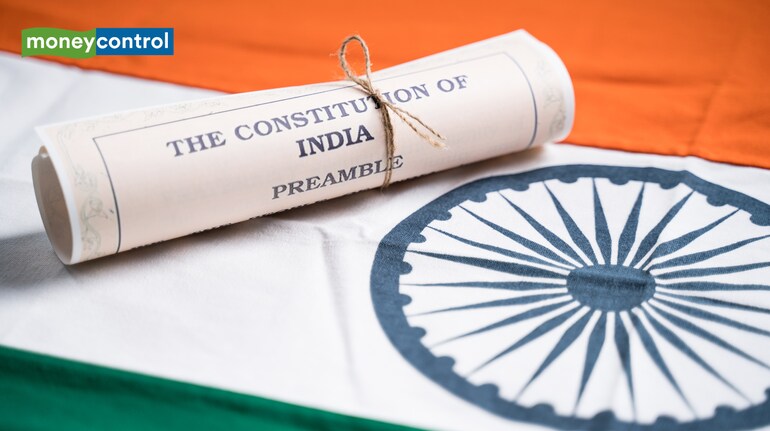
As India commemorates its 77th Republic Day in a few days, the nation will pause to honour the Constitution that came into force on January 26, 1950. This remarkable document has steered the country through profound transformations, upholding democratic principles amid diverse challenges.
In the wake of the intensely contested 2024 general elections, leaders across the political divide have demonstrated profound reverence for the Constitution. This bipartisan homage is indeed heartening, reflecting a shared commitment to its foundational values. Yet, it compels us to reflect: Should we enshrine the Constitution as an immutable, beyond the reach of amendment, or recognise it as a living document capable of evolving with societal needs?
Bipartisan reverence amid electoral turbulence
In recent political discourse, the Constitution has emerged as a potent symbol. Prime Minister Narendra Modi bowed before a copy during the inaugural post-election meeting of the National Democratic Alliance, describing it as a "holy book" that embodies the nation's soul. Congress leader Rahul Gandhi prominently displayed a compact pocket edition at opposition gatherings, positioning the Congress as the sole protector of the Constitution.
This mutual veneration arose from a fractious campaign dominated by the Bharatiya Janata Party's ambitious electoral target. The opposition alliances framed the ruling coalition's pursuit of a supermajority as an existential peril to the Constitution.
Slogans such as "Samvidhan ko bachana" resonated when coupled with "Arakshan" - reservations for marginalised communities. This sleight-of-hand linkage, reminiscent of earlier controversies surrounding the Citizenship Amendment Act and National Register of Citizens, portrayed any prospective amendment as an assault on social justice.
Misinformation proliferated through videos, stoking fears that quotas for Scheduled Castes, Scheduled Tribes, and Other Backward Classes might be dismantled.
In reality, the electoral outcomes reflected a complex interplay of factors. The emotive appeal to "save the Constitution," while potent, frequently lacked specificity, functioning as an evocative yet nebulous alarm - akin to a voodoo charm that instils dread without articulating precise dangers.
Today, reservation policies encompass vast segments of the population, with 95% coverage (except for non-EWS General Category) when aggregating central quotas and state-level enhancements. This expansive framework renders debates on reform extraordinarily contentious, often forestalling constructive dialogue.
The essence of a living document
India's cultural heritage offers a profound analogy. We may view ourselves as the cradle of open-source wisdom, exemplified by the fusion of Shruti (eternal revelations) and Smriti (adaptable interpretations), refined through oral transmission across generations. Similarly, the Constitution balances enduring principles with provisions for evolution.
BR Ambedkar and the framers deliberately crafted the Constitution as a living instrument, responsive to changing realities. Amended 106 times to date, it ranks among the world's most frequently updated foundational texts, underscoring its inherent flexibility.
Amendments adhere to rigorous procedures, requiring a special majority in Parliament and, in certain cases, state ratification. This safeguards against capricious alterations while permitting democratic refinement.
Proclaiming it an uneditable holy book invites rigidity, a peril Ambedkar himself forewarned could foment unrest. In a nation as diverse and dynamic as ours, continual adaptation is imperative to address emerging challenges, from digital governance to environmental imperatives. Public discourse, amplified through social media and civic forums, increasingly advocates this balanced perspective.
Historical Amendments: Triumphs and cautionary tales
Amendments have historically driven progress, though not without contention.
The First Amendment of 1951 introduced restrictions on free speech to curb incendiary content, abolished the zamindari system to facilitate agrarian reform, and affirmed affirmative action for disadvantaged sections. Widely regarded as progressive, it nonetheless drew criticism for infringing on free expression, as the curbs were seen by detractors as shielding the nascent government from robust journalistic scrutiny and overriding judicial preferences for absolute freedoms.
The 42nd Amendment, enacted during the 1975-1977 Emergency - a period marked by suspended fundamental rights and press censorship - stands as a stark warning. Dubbed a "mini-Constitution," it dramatically expanded central authority, curtailed judicial review, and altered core features, including additions to the Preamble and Fundamental Duties. Critics decried its authoritarian tilt. Post-Emergency, the 43rd and 44th Amendments restored equilibrium by repealing many excesses.
In contrast, the 106th Amendment of 2023 mandates one-third reservation for women in the Lok Sabha and state assemblies - a landmark stride toward gender parity, slated for implementation following delimitation.
These precedents demonstrate that amendments, when pursued through legitimate channels, foster inclusivity and justice. Misapplication during crises, however, can erode democratic safeguards.
A vision for the future on Republic Day
As parades unfold and the tricolour unfurls nationwide on January 26th, we will proudly celebrate the Constitution's enduring resilience. Over 76 years, it has unified a pluralistic society, enshrining rights and equity.
The bipartisan tributes affirm its transcendent importance. Yet, true homage lies in preserving its amendability. By embracing evolution via established processes, we align with the framers' vision: a document of the people, for the people, perpetually relevant.
May this Republic Day renew our commitment to a Constitution that adapts while enduring, securing liberty, equality, and fraternity for generations ahead.
Jai Hind!
(Views are personal, and do not represent the stance of this publication.)
Discover the latest Business News, Sensex, and Nifty updates. Obtain Personal Finance insights, tax queries, and expert opinions on Moneycontrol or download the Moneycontrol App to stay updated!
Find the best of Al News in one place, specially curated for you every weekend.
Stay on top of the latest tech trends and biggest startup news.




