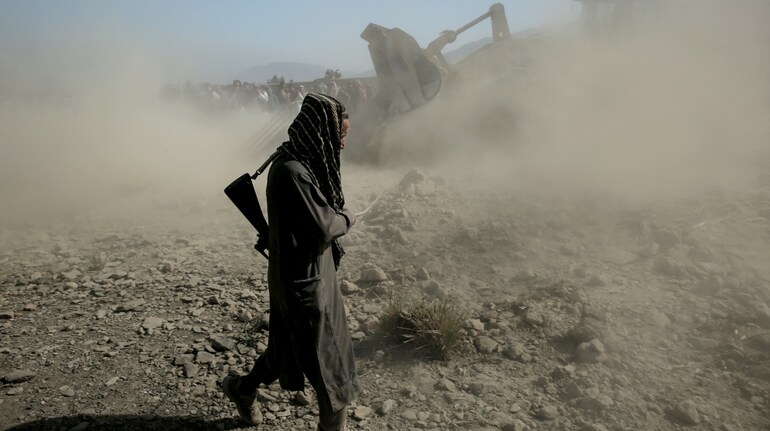

On February 27, in a highly unusual move, reiterating a security alert for US citizens against remaining in or traveling to, Afghanistan, Doha-based US Mission to Afghanistan, spelt out serious developments in the region.
It informed that “Pakistan launched airstrikes on Kabul, Paktia province, and Kandahar province on February 27 at 1.50 am local time. According to media reports, Pakistani aircraft remained in Afghanistan airspace and continued to look for targets as of 9:00 am local time. Media outlets have also reported fighting along the Afghanistan-Pakistan border. Major border crossings between Afghanistan and Pakistan remain closed.”
Subsequently, the Afghan Ministry of Defense put out a message claiming that at “approximately 11:00 am, the Air Force of the Ministry of National Defense conducted coordinated airstrikes targeting a military camp near Faizabad in Islamabad, a military base in Nowshera, military positions in Jamrud, and additional locations in Abbottabad.”
Later in the evening, other nations began advising their citizens to leave Afghanistan.
‘Ghazab lil-Haq’ and the fallout
In furtherance of the declared ‘open war’ against Afghanistan under operation Ghazab lil-Haq, Pakistani Director General of Inter Services Public Relations (ISPR), Lieutenant General Ahmed Sharif Chaudhry publicly claimed that, at least 274 Afghan Taliban personnel and fighters were killed and more than 400 were injured.
On the other hand, the Afghan Interior Minister, Sirajuddin Haqqani, who was once the closest ally of the Pakistan security establishment, has warned that the Taliban had “defeated the world’ and that the victory ‘was not achieved through advanced technology or military equipment, but through determination, unity, and consensus.”
The military escalation between Afghanistan and Pakistan is unprecedented and may quickly lead to heavy losses on both sides before the process of de-escalation even begins. It is important to examine recent developments in the region to better appreciate the trajectory up till now and what to expect in the coming days and weeks.
ISKP and the Pakistani hand
Ever since the withdrawal of US forces from Afghanistan in August 2021, the relations between Taliban-ruled Afghanistan and Pakistan have continued to deteriorate. Afghanistan under Taliban 2.0 began witnessing a string of deadly attacks claimed by the Islamic State Khurasan Province (ISKP), including targeted killings of important Taliban leaders, and it pointed a finger at Pakistan security establishment for supporting ISKP on its soil. It even blamed the ISKP of being part of complex coordinated attacks mounted in Iran and Russia in 2024.
TTP and Baloch insurgents have declared war on the state
On the other hand, Pakistani forces have continued to suffer hundreds of casualties each year since then on account of unrelenting attacks on security forces, bases and patrols by TTP and the Baloch insurgent groups. Pakistani officials openly blame the Taliban for sheltering these groups on the Afghan soil, and have started calling the Taliban an ‘Indian proxy’ even since India and Taliban have restored diplomatic relations in 2024.
The year 2025 has witnessed a sharp surge in terrorist violence in Pakistan, with a Pakistani think tank reporting 699 attacks- which was an increase of 34% compared to 2024. The total fatalities also rose in 2025 by 21% to 1034. Irrespective of the war of words, for Pakistan, the threat of homegrown terrorism has become super serious.
Late last year, the ISPR had categorically stated that in 2025, over 1873 terrorists had been killed, which included only 136 Afghans - the rest were Pakistanis. Pakistan has witnessed more than 30 suicide attacks in 2025 and majority of them were against military or police targets.
Pakistan’s army has no quick fix
The threat is domestic, persistent and beyond any muscular quick-fixes employed by the army over the past many years.
By blaming Afghanistan and India, Pakistani army has been trying to ward off domestic pressure as well as protecting its reputation at a global level. In September last year, Pakistan signed a Strategic Mutual Defense Agreement with Saudi Arabia, boldly extending its nuclear umbrella. In order to perhaps please the US administration, Pakistan is also signalling a proactive role in proposed Gaza Stabilisation Force. At such times, repeated failures to secure its own installations and forces is a huge embarrassment.
The elevation of General Asim Munir as a Field Marshall and then as the Chief of Defence Forces was showcased as a reward for ‘exemplary performance’ in a limited war against India. This too comes under cloud for failures to secure internal peace across two key provinces along the Afghan border- the Khyberpakhtunkhawa and Balochistan.
Arab nations may step in facilitate de-escalation
The current ‘open war’ appears to be a distraction for internal failures as well as an attempt to rope in external powers to help work some kind of cooperation with Taliban against the TTP and the Baloch groups. However, for the Taliban, it would be a dangerous move to fight Pakistan’s ‘war on terror' on its own soil.
The current levels of hostilities are likely to continue and bleed both sides until their Arab and other allies, probably prompted by the US jump in to defuse this round of military engagement. This would not fix the problems in the Af-Pak region or larger South Asia as the malice is much deeper than the propaganda wars.
Anju Gupta is a security and geopolitical analyst, and former Director General of Police. Views are personal and do not represent the stand of this publicationDiscover the latest Business News, Sensex, and Nifty updates. Obtain Personal Finance insights, tax queries, and expert opinions on Moneycontrol or download the Moneycontrol App to stay updated!
Find the best of Al News in one place, specially curated for you every weekend.
Stay on top of the latest tech trends and biggest startup news.