






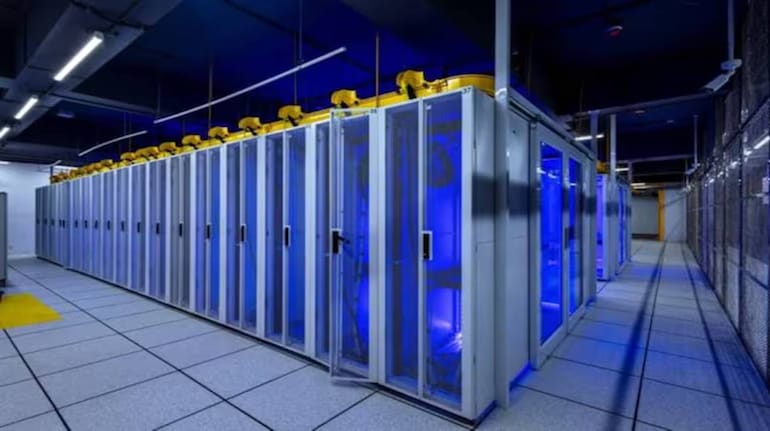
Earlier last month, US President Donald Trump stipulated that Big Tech must "pay its own way." The statement followed a mounting crisis where wholesale electricity prices near US data centre hubs surged by as much as 267% over the last five years. Microsoft was the first to announce a "Community-First AI Infrastructure" initiative. The tech giant pledged to pay higher utility rates to ensure residents aren't stuck with the bill for the grid upgrades required by its power-hungry servers.
This pivot signals a shift in the global data centre narrative. While environmentalists have long focused on the water consumption of data centres, the real existential threat to digital growth isn't just a lack of water—it’s also a lack of sustainable and continuous access to power.
Currently, India stands at a critical juncture. While the current data centre capacity is roughly 1.8 GW, Reliance and Google are investing in single campuses that could each dwarf the country’s entire 2025 footprint. The development of this industry not only provides the opportunity for significant economic growth, but is also a strategic imperative to strengthen India’s position in the global technology supply chain and ensure reliable access to emerging technologies. With it, the dependence on natural resources is intensifying.
Public anxiety in India has largely centered on water, which is a logical fear in a country where 40% of the population faces high-to-extreme water stress. To their credit, major data centre operators like Nxtra, CtrlS, STT GDC, and Equinix have responded with some transparency around prioritising near-net zero water use. Most new Indian facilities now utilise direct-to-chip cooling and closed-loop systems that recycle nearly every drop. While India needs traceable water use to build local trust, the technical solutions for water are maturing.
On the other hand, AI doesn't just use more power; it uses it differently. High-density AI racks consume 30-100 kW each, compared to the 7-10 kW of traditional servers. This "power density" generates immense heat, creating a vicious cycle: as chips get hotter, they require more power-intensive cooling (even if air-based), further straining the grid.
Increase in inference use cases also has a compounding effect. We are moving from a world of "storage" to a world of "inference". Every time a user does a Google or Bing search, the compute requirement is ten times higher than a traditional Google search as a result of the automated AI output.
The US experience over the past year offers a stark roadmap of the pitfalls of aggressive expansion. In July 2025, In 2025, the US administration declared a "national energy emergency" to fast-track domestic power production for the next generation of tech infrastructure. This was followed by another executive order, which specifically bypassed environmental red tape for "Qualifying Projects" exceeding 100 MW to accelerate the development of AI-ready data centres. To maintain 24/7 uptime, the administration deprioritised intermittent solar and wind in favor of dispatchable baseload power, essentially locking in natural gas and coal use.
The result was a "grid tax" on the average consumer. When a massive data centre plugs into a local grid, it doesn't just consume energy; it necessitates massive capital expenditure for new transmission lines and substations. In the US, these costs were often socialised, leading to the increased utility bills that eventually forced the current administration’s hand.
Since India is at the beginning of its capacity curve, there is a unique opportunity to avoid the US "grid tax" model.
India must stop viewing data centres as mere real estate projects and start treating them as anchor customers for a green grid. The concurrent growth in power generation capacity with a focus on renewables is a welcome move. Planning grid upgrades, renewables, and storage around data centre hubs can ensure they become anchor customers for clean power instead of locking in more non-renewable power use.
Beyond grid upgrades, India can leverage its growing capacity by mandating that data centres exceeding 5 MW invest proportionally in energy bonds. By channeling private capital into grid-scale infrastructure through entities like the NTPC, this model secures a more reliable energy pool for operators while accelerating the development of both stable clean energy and essential baseload power.
Finally, establishing a centralised regulatory framework for water, power, and land-use efficiency would move the needle from fragmented state-level policies to a unified national standard. This would not only guarantee environmental compliance but also lower the cost of doing business by providing the long-term regulatory certainty that global hyperscalers crave.
(Anwesha Sen is Assistant Program Manager, GCPP-Technology and Policy, The Takshashila Institution.)
Views are personal and do not represent the stand of this publication.


Discover the latest Business News, Sensex, and Nifty updates. Obtain Personal Finance insights, tax queries, and expert opinions on Moneycontrol or download the Moneycontrol App to stay updated!
Find the best of Al News in one place, specially curated for you every weekend.
Stay on top of the latest tech trends and biggest startup news.






