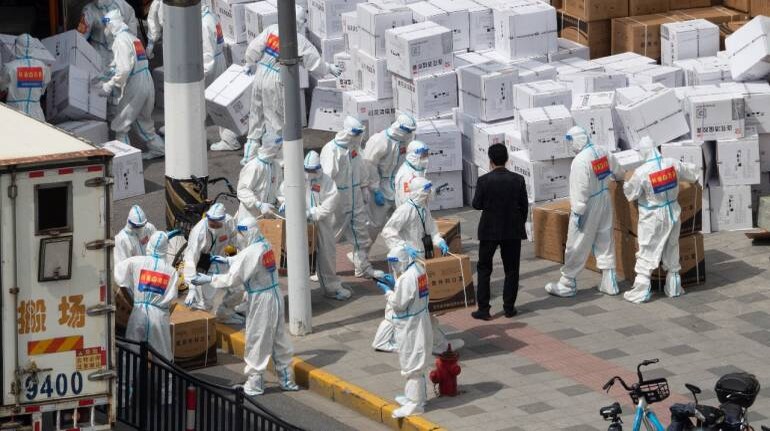
The lockdown in Shanghai, accompanied by media accounts of food shortages and unreported deaths, are evoking painful recollections of January 2020 and the central city of Wuhan, where COVID-19 first broke out. For investors, the memory will also include the economic stimulus that China unleashed then to fight off a recession — as well as the bull market that ensued.
That may explain why China’s main stock indexes have not sunk below their mid-March low, even as the number of COVID-19 cases soared. Counterintuitively, since the initial outbreak in 2020, index returns were positively — not negatively — correlated with the number of cases, according to Goldman Sachs Group Inc.
By now, China has built a track record of containing COVID-19 outbreaks. As such, investors are looking through the short-term economic losses, and focusing instead on the policy goodies that Beijing is willing to hand out.
This time, the government may not be willing to shower the country with helicopter money. In 2020, a rapid expansion in credit caused the real estate market to overheat, driving home sales and prices to records. Then China spent much of 2021 trying to cool it down, argued Gavekal Research’s Wei He.
These days, regulations and the political backdrop — not COVID-19 outbreaks — have become influential trading themes. China can act on both those fronts to help its financial markets.
Chinese stocks had a major slump last July when the government moved to investigate Didi Global Inc. over possible cyber-security issues just days after the ride-hailing giant’s $4.4 billion mega initial public offering in New York; the crackdown on big tech then stretched to more companies on issues such as data security and antitrust. In March, after Russia invaded Ukraine, stocks extended their losses, reflecting worries over secondary sanctions.
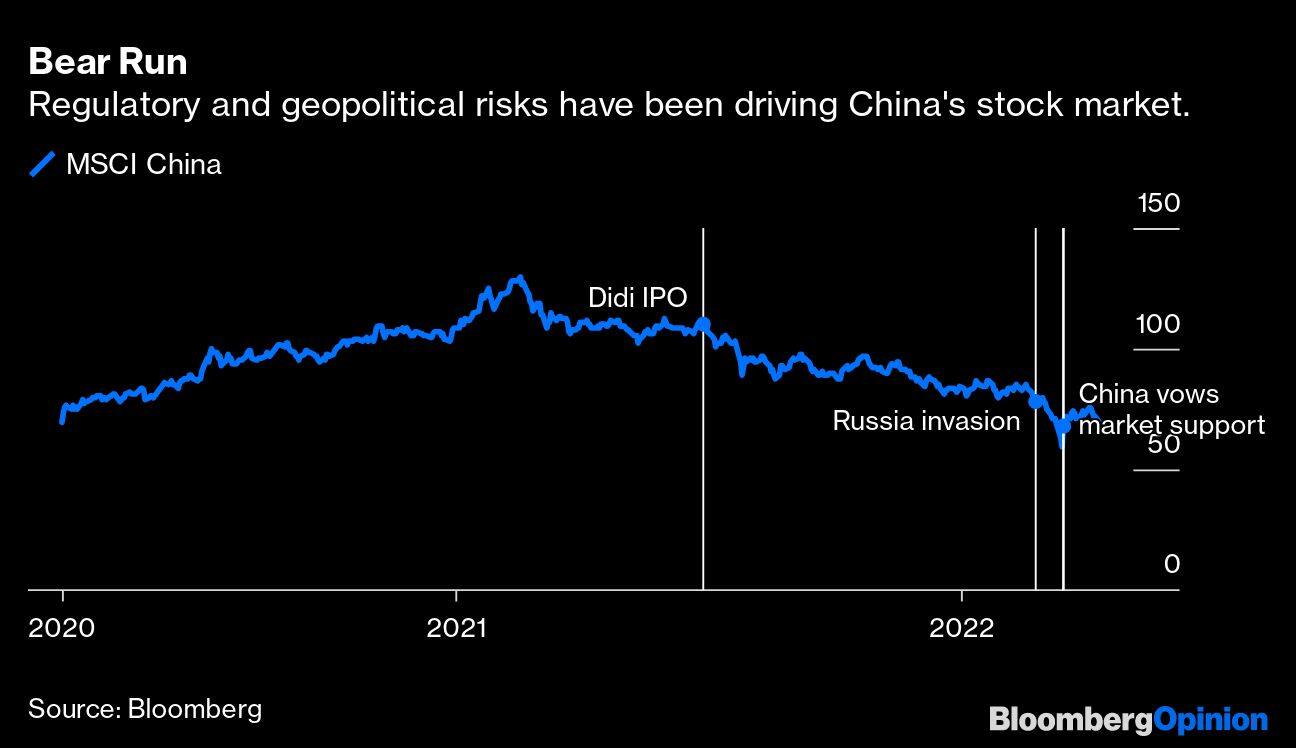
In recent days, we’ve started to see the first signs of the government unclenching its fists. On March 16, China’s top economic policy maker issued an unusual public statement seeking to “actively introduce policies that benefit markets.” This week, came the first batch of new video game licenses since July, ending a months-long hiatus that threatened the business models of Tencent Holdings Ltd., Netease Inc. and Bilibili Inc. Earlier this month, the government made a significant concession to the US Securities and Exchange Commission by revising rules that prevented US regulators from inspecting audit papers of New York-listed Chinese companies.
With an estimated 373 million people ensnared in some form of movement restrictions, economists are now talking about the risk of a recession. Goldman, for instance, sees China growing at only 4.5 percent this year, short of the government’s 5.5 percent target. Even Premier Li Keqiang has issued growth warnings to local government officials. When things are not going so great domestically, the hawkish branch of the political elite may just lose a little bit of their sway, be it in geopolitics or via tough regulations.
That’s because financial markets do matter. Ultimately, they determine the financing conditions for companies. The central bank could be cutting benchmark rates, but if stocks and corporate bonds are in a slump, how can businesses raise money to invest for the future?
For over a year now, investors were having a tough time, prompting some to question whether China has become ‘uninvestable’ due to the unpredictable policy making. The nation’s recent COVID-19 outbreaks change that view. After all, something’s got to give: China wants to save face and not be seen as ‘lying flat’ on COVID-19. A potential recession that triggers an urgent government response is not necessarily a bad thing for markets.
Discover the latest Business News, Sensex, and Nifty updates. Obtain Personal Finance insights, tax queries, and expert opinions on Moneycontrol or download the Moneycontrol App to stay updated!
Find the best of Al News in one place, specially curated for you every weekend.
Stay on top of the latest tech trends and biggest startup news.