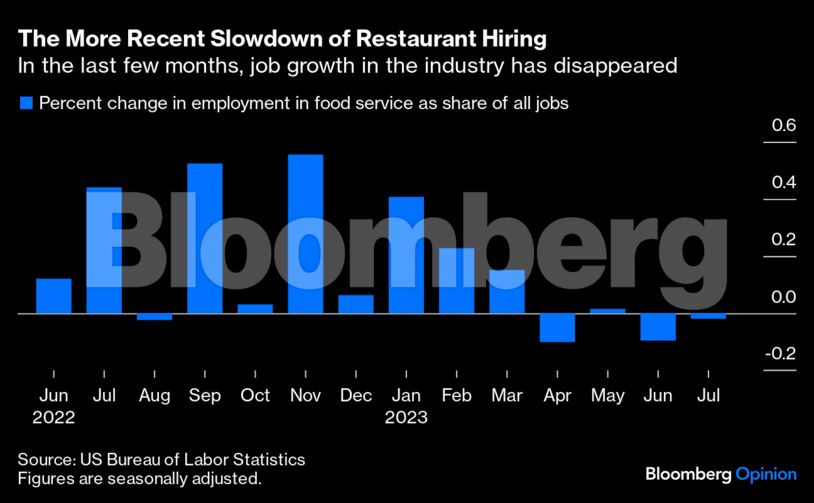
If you think the service at your favorite restaurant isn’t what it used to be, you’re probably right: Chances are, it has fewer workers than it did just before the pandemic. Still, even if you have to wait a little longer for that extra hot sauce you asked for, this is a trend that’s good news for the US economy — and evidence that Bidenomics is working.
The share of the US workforce employed in food service establishments, a number that had been rising relentlessly for decades, is still lower than it was before Covid. Some of that is the impact of the pandemic itself, which had a particularly negative impact on food-service jobs.
Consider a workforce that’s mostly toiling in the fields. If some factories open up offering slightly higher wages, that can be a double win for the economy: Not only do more people move to cities and earn more, but the amount of arable land per worker also rises — so farm incomes go up as well. At first the increased agricultural productivity can come from simply abandoning the most marginal plots or expanding any given farm worker’s workday. But as urbanization continues, the agricultural sector starts to rely more on more capital-intensive modes of production.
Today’s US farm sector generates staggering levels of value per worker compared to historic norms because the technology for production is so much better. That same technology is available to poorer countries, but it goes unused because labor is so abundant. Part of the benefit of industrialisation is creating the incentives to modernise agricultural practices.
The analogy to food service is inexact but instructive.
Consider that there are more and less labor-intensive ways to serve people a meal. Which means that, on some level, every person serving food or bussing tables at a mediocre restaurant represents a form of labor market slack. In a world where wages are rising fastest at the low end of the labor market, the fast-casual business model looks a lot more compelling than traditional full-service. If the boom in factory construction continues, that will suck workers out of restaurants and into factories. That could result in raises for those left behind — but also a strong incentive to make dining more like Chipotle and less like Chili’s.
After all, the technology to have customers order at kiosks rather than from cashiers has existed for years. As wages rise, it will be deployed more widely and aggressively. These days when I stop by Cava or Sweetgreen, I usually place my order in advance on my phone. But a restaurant with the boldness to make app-based ordering the only option would reap significant efficiencies by eliminating the need for customer interaction altogether. So-called “ghost kitchens” boomed during the pandemic only to fade
during the recovery, but they could enjoy a longer-term renaissance under conditions of sustained full employment.
Which isn’t to say it’s all over for full-service restaurants — not by a long shot. But like luxury hotels, they could increasingly be places where customers are willing to pay a premium price for lavish service.
Some may find this to be a bleak vision of the future. But in many ways it is the expected result of progress. In a properly functioning economy, wages rise over time and consumption of labor-intensive services declines. What was unexpected, in retrospect, was the long rise of restaurant employment given the generally low pay and marginal social utility.
It was probably a consequence, in part, of the huge expansion of the labor force associated with second-wave feminism but also with the much-bemoaned de-industrialisation of the US economy. As China entered global markets, production of tradeable goods shifted offshore, and US workers transitioned into untradeable sectors. For some that meant finance, technology and other high-wage industries. But for many it meant washing dishes or serving food — and with it the rising inequality that helped fuel so much backlash politics in recent years.
The past few months of strong employment, rising wages and falling inflation raise profound questions about whether that backlash is really warranted. Neoliberalism has come into such discredit that even leading Republican wonks are pushing to rethink capitalism. People should at least be open to the possibility that with the labor market finally firing on all cylinders, good old-fashioned market economics really can work, with tight labor markets not only pushing employers to raise pay and switch to more productive business models, but also pushing employees to switch into more sectors. It has been only a few months, but it’s notable that
productivity rose this past quarter at a rapid clip — the same quarter when the restaurant share of employment fell.
Rising wages and productivity, and falling inequality? That’s exactly what political leaders say they want to see. Is it the result of Bidenomics? In part, yes. But the more visible consequence, which you can ponder while you try to catch the attention of your waiter, could be the end of restaurants as we know them.
Matthew Yglesias is a columnist for Bloomberg Opinion. A co-founder of and former columnist for Vox, he writes the Slow Boring blog and newsletter. Views are personal and do not represent the stand of this publication.
Credit: Bloomberg
Discover the latest Business News, Sensex, and Nifty updates. Obtain Personal Finance insights, tax queries, and expert opinions on Moneycontrol or download the Moneycontrol App to stay updated!
Find the best of Al News in one place, specially curated for you every weekend.
Stay on top of the latest tech trends and biggest startup news.