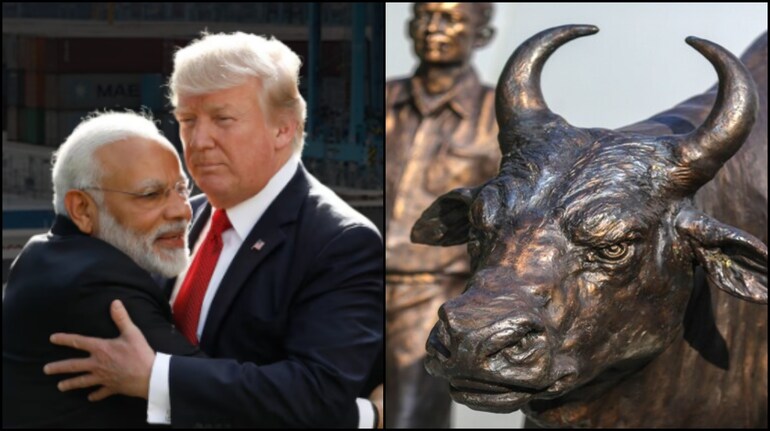

The interim trade deal framework, announced on February 6, brings more clarity to the eventual India-US Bilateral Trade Agreement.
The joint press statement lays out several details. Let us start with the total purchase of $500 billion by India. This is a commitment over the next 5 years. So, it is approximately $100 billion every year, with initial years starting at lower numbers and the later years crossing the $100 billion such that it reaches $500 billion over the period. Current merchandise imports from the US is $42 billion.
India’s total merchandise imports for FY25 were $720 billion. Additionally, India imported around $200 billion of services in the same year. The largest segment in the merchandise export was $210 billion worth of petroleum, crude, and products.
This is what is also targeted as the prime product category for India to import from the US under the agreement. India already imports around $12-14 billion under this category from the US. This is likely to increase significantly under the agreement. Let’s assume that petroleum-related products are likely to increase to $30-35 billion. However, this will be subject to India getting competitive prices from the US sources.
Another major product that India is likely to import, irrespective of any deal,s is commercial aircraft. India is expected to require around 2,200 aircraft by 2042. This works out to approximately 150 aircraft every year. Assuming that initially, it is 100 aircraft per year at an approximate price of $200-250 million each, that is a total demand of $20-25 billion per year. This is likely to be divided between Boeing and Airbus. This was, anyway, part of the total demand from India. What remains to be seen is how much Boeing gets vs Airbus.
A third large segment under the deal is the investments in AI data centers, including GPUs. According to Minister Ashwini Vaishnav, this is expected to cross $200 billion in the near future. We can assume that this will be worth about $50 billion per year. This is likely to be structured as joint ventures between the Big3 cloud providers and Indian business houses. FDI and transfer of technology are likely to come into the JVs, and then purchases happen from these.
Another large segment that India imports is machinery and mechanical appliances, worth $60 billion annually from multiple sources. This includes nuclear reactors. With the passing of the SHANTI Act, India’s nuclear market is open for FDI, transfer of technology, and investments. This is likely to see movement away from the energy transition initiative from fossil fuels towards clean energy and nuclear. Focus being the small modular reactor or Bharat Small Reactors. This category is likely to be one of the major ones for imports.
The above shows that reaching $100 billion in annual imports from the US is not challenging, nor is it going to step on existing domestic demand. Rather, these are typically from categories where India is anyway going to make large imports, and those are critical to India’s long-term growth plans.
Coming now to the critical area of agricultural imports. The joint statement lists dried distiller’s grains (DDG), red sorghum for animal feed, tree nuts, fresh and processed fruits, soybean oil, wine and spirits, etc.
The DDG market in India is estimated at $2.5 billion currently and expected to reach $5 billion by 2035. The other categories are also relatively small ones and Indian agriculture, or the typical Indian small farmer, is not a large producer of such products and not likely to have a major impact on India. Again, Minister Piyush Goyal has specifically stated that the agreement shielded Indian farmers in sensitive agricultural and dairy products. Rather, he emphasized that the US market will be opened for Indian agricultural products, such as spices, tea, coffee, cashew, areca, chestnuts, avocadoes, guava, mango etc.
India also benefits given the lower relative tariffs versus the competing Asian neighbours, in textiles, footwear, plastics, and rubber, etc. India exports around $10-11 billion of textiles to the US and this could increase significantly under the deal. Gems and jewellery is another category that could see growth from the current $5-7 billion, with preferential treatment on tariffs.
India is also likely to increase its exports of aircraft and automotive parts, in addition to pharmaceuticals.
Overall, it looks like a mutually beneficial deal with India agreeing to buy more in categories where, anyway, the imports are high and likely to grow, and it will more likely migrate the purchases from other sources towards possible US sources, and not in areas that are sensitive to Indian producers and farmers. Rather, many of these import categories were required for our technological growth.
There is a strong likelihood of additional FDI and transfer of technology happening, which is not specified in the documents so far.
Disclaimer: The views and investment tips expressed by experts on Moneycontrol are their own and not those of the website or its management. Moneycontrol advises users to check with certified experts before taking any investment decisions.
Discover the latest Business News, Sensex, and Nifty updates. Obtain Personal Finance insights, tax queries, and expert opinions on Moneycontrol or download the Moneycontrol App to stay updated!
Find the best of Al News in one place, specially curated for you every weekend.
Stay on top of the latest tech trends and biggest startup news.