






Highlights:
* India approves Rs 7,280 crore scheme for rare earth magnet manufacturing
* India plans to increase rare earth production, now under 1% of global output
* US-India collaboration to strengthen critical mineral supply chains
India has signalled a significant shift in its rare earth strategy, with the Union Cabinet approving an Rs 7,280 crore (approximately $820 million) scheme to build 6,000 metric tonnes per annum (MTPA) of integrated rare earth permanent magnet manufacturing. This marks the country’s first such initiative. The move comes as rare earths are increasingly shaping diplomatic priorities in both New Delhi and Washington, amid tightening Chinese export controls.
Global Rare Earth Supply Chain Dynamics
Over the past few weeks, the United States has signed multi-billion-dollar frameworks with Australia and announced collaborations with Malaysia, South Korea, Japan, and Saudi Arabia to strengthen the rare-earth supply chain. US President Donald Trump even hosted leaders from Central Asian nations, which are home to significant rare earth deposits, signalling Washington’s intent to rebuild resilience across the value chain.
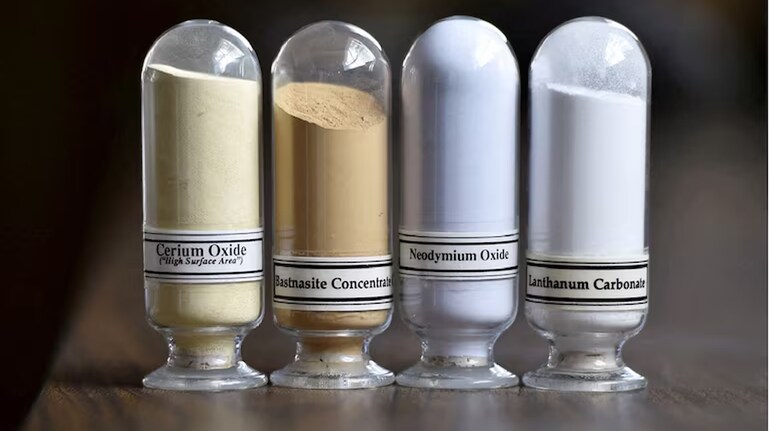
Rare earth elements are not “rare” in terms of abundance; they are considered rare because separating them from one another is technically complex. These elements are present in almost every modern device – mobile phones, laptops, automobiles, medical devices, wind turbines, refineries, and even advanced defence systems. For example, an F-35 fighter jet requires more than 900 pounds (408 kilograms) of rare earth elements.
China’s Dominance and the Need for Diversification
China currently dominates every stage of the rare earth supply chain, not only in mining and refining but also in the technology and machinery required for separation and processing. The world’s second-largest economy controls approximately 70% of global rare earth mining and over 90% of refining. It processes not only its own ore but also most of Myanmar’s and nearly half of the United States’ production.
This dominance was not built overnight. Beijing has had its eye on rare earth metals for a long time, working on controlling capacities and capabilities. In 1992, former Chinese leader Deng Xiaoping famously remarked that while the Middle East had oil, China had rare earths. Over the past year, China has imposed a series of restrictions on rare earth materials, technologies, and processing equipment. These curbs have triggered temporary factory closures around the world. For example, Ford Motor Co. shut down production of its Explorer SUV in Chicago for a week due to a shortage of rare-earth magnets.
The US Response and India’s Strategic Moves
The International Energy Agency’s (IEA) World Energy Outlook 2025 report suggests that although rare earths represent small markets, supply disruptions could have outsized economic consequences. A mere 10% drop in rare-earth magnet exports could disrupt the production of 6.2 million cars, nearly 1 million industrial motors, 230,000 civilian aircraft, or more than 650 hyperscale AI data centres. Securing a reliable rare-earth supply chain is therefore a strategic priority for both the United States and India.
The United States has taken decisive action to strengthen its domestic base. The government has acquired a minority stake in MP Materials, a Nevada-based company, catalysing private capital and setting a floor price for MP Materials’ rare earth output, nearly double the then-prevailing market rate. These measures aim to ensure that domestic production remains viable despite global price fluctuations, while guaranteeing the purchase of magnets. Recently, two startups – Vulcan Elements and ReElement Technologies – sealed a $1.4 billion deal with the US government and private investors to support rare earth projects.
India’s Challenge and Path Forward
India, too, has begun recalibrating its approach to rare earths. Until recently, these resources were restricted by the country’s atomic mineral regulations. However, the 2023 amendment to the Mines and Minerals (Development and Regulation) Act, 1957, has changed that. For the first time, private and foreign-linked Indian firms can now compete for government-auctioned critical mineral blocks, with the central government directly leading the process.
While the rare earth permanent magnet scheme is an important step in strengthening the country’s rare earth supply chain, India must address several bottlenecks. For instance, the machinery required for rare earth separation is still largely dependent on China. Additionally, Indian Rare Earths Limited (IREL), under the Department of Atomic Energy, is the country’s only commercial producer of Rare Earth Oxide (REO), but it produces barely 500 tonnes a year – far below the 6,000 MTPA required to support the new magnet manufacturing capacity.
Despite holding around 6% of global rare earth reserves, India accounts for less than 1% of global output, estimated at around 2,900 tonnes in 2024. Closing this gap will require a complete overhaul of the value chain, with significant investments in exploration, refining and separation capacity, metal and alloy production, and the establishment of competitive magnet manufacturing at scale.
US-India Collaboration: A Game Changer
This is where US-India collaboration can play a crucial role in shifting the global balance. With the US Development Finance Corporation and EXIM Bank now funding rare-earth projects overseas, including a recent investment in Brazil, Washington can help accelerate mining, separation, and magnet production in India. The February 2025 US-India Joint Statement reaffirmed both countries' commitment to strengthening resilient and diversified critical mineral supply chains.
Joint efforts on processing technologies, advanced recycling, and coordinated exploration – such as collaboration between the USGS and India’s geological agencies – would further enhance this cooperation. Platforms like the Minerals Security Partnership (MSP) and the Quad Critical Minerals Initiative already provide the diplomatic framework for such cooperation, and a dedicated industry-government working track on rare earths could help turn these frameworks into actionable projects. With new mines taking up to a decade to develop, both countries must prioritise brownfield investments and partnerships in trusted third countries now.
(Rahul Sharma is Managing Director, US-India Business Council; Pradeep Karuturi is Director - Energy, US-India Business Council.)
Views are personal, and do not represent the stance of this publication.
Discover the latest Business News, Sensex, and Nifty updates. Obtain Personal Finance insights, tax queries, and expert opinions on Moneycontrol or download the Moneycontrol App to stay updated!
Find the best of Al News in one place, specially curated for you every weekend.
Stay on top of the latest tech trends and biggest startup news.




