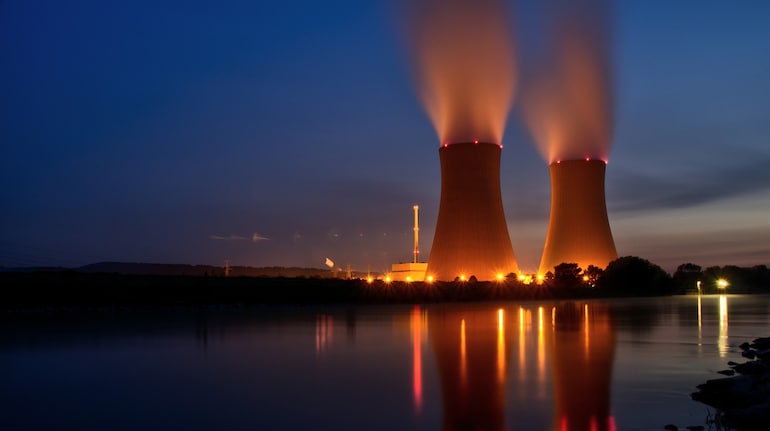
Six decades into India’s three-stage programme, India has achieved mixed results from its nuclear tryst. The success of the strategic weapons programme and pressurised heavy water reactors (PHWR) has been dampened by a lack of progress on the second and third stage involving the building of fast breeder reactors (FBR) running on plutonium and thermal breeder reactors running on thorium, respectively.
I argue that India needs a new nuclear dream that goes beyond the three-stage plan. Doubling down on PHWRs, pursuing direct thorium utilisation reactor designs, overhauling liability law, clarifying the role of the private sector, and solving the vexed problem of nuclear waste should be the focal points of the new nuclear dream.
Origins of the three-stage dream
For a newly decolonised country that was short on hydrocarbon resources or uranium, energy security was a question that preoccupied India’s scientists in the 1940s and the 1950s. After all, millions of people were to be lifted out of poverty and economic growth was closely tied to energy consumption — be it by industries or individuals.
Perhaps no one understood India’s energy aspirations and constraints as much as Homi J. Bhabha. Nehru’s confidant and a renowned physicist, Bhabha architected India’s three-stage nuclear power programme in the 1950s.
The Indian nuclear establishment led by Bhabha understood that India had scant uranium resources that were of low quality. Also, India did not have the coveted uranium enrichment technology that was closely guarded by the victors of World War II and early developers of nuclear weapons. Even if India secured enrichment technology anyhow, could the political leadership that was denouncing nuclear weapons pursue the development of one? Public pacifism notwithstanding, India’s political and scientific leadership wanted to keep the nuclear option open. If not weapons-grade uranium enriched to above 90 per cent, then what could India get its hands on?
The three-stage plan was a response to all the above questions and constraints. First stage involves setting up PHWRs running on natural uranium. Hence no need for enriching uranium and setting off alarm bells in Western capitals. But the spent fuel of first stage reactors can be reprocessed to obtain Pu-239. And how do you justify securing Pu-239? By saying that the second stage involves setting up fast breeder reactors that use Pu-239 and depleted uranium (U-238) from the first stage. At some point thorium (Th-232) which is fertile but not fissile is introduced to FBRs. Th-232 transmutes to U-233 which is fissile. Once sufficient U-233 is stockpiled, thermal breeder reactors running on a self-sustaining fuel cycle of U-233 and Th-232 are then established. The third stage has the potential to power India for decades and even centuries. Because unlike uranium, India’s thorium resources are quite significant.
Why abandon the dream
Fast forward six decades, India currently has 25 operational nuclear plants with a total installed capacity of only about 8.7 GW. Out of these, 21 are PHWRs, two are US-supplied boiling water reactors and two are Russia-supplied water–water energetic reactors (a type of pressurised water reactor).
India has mastered the first stage of the sequential programme by indigenising the PHWR reactor design which was first built with Canada’s support in the 1960s and 1970s. India has built multiple PHWRs since then and operated them successfully. The second stage remains in a very early stage, with a 500 MW prototype FBR built at Kalpakkam yet to achieve criticality. The third-stage that finally utilises thorium is in the R&D phase. Therefore, apart from progress in the first stage, India has very little to show for despite six decades of work. The three-stage plan is not working for India.
As much as the three-stage plan had strategic weapons objectives, these have been met after India credibly demonstrated its nuclear weapons capability in 1998 and since then developed around 170 nuclear warheads deployable from air, land and sea based platforms. Further, India separated its strategic and civil nuclear programme as it secured a waiver from the Nuclear Suppliers Group (NSG) in 2008. Hence abandoning the three stage plan would not adversely affect India's nuclear weapons capability.
Contours of a new dream
India urgently needs cleaner sources of energy to balance rapidly rising energy demand with climate goals. Instead of the three-stage plan, I argue that India should focus on five areas.
First, doubling down on PHWRs, a technology that India has successfully indigenised. The country can build these PHWRs either in the small modular reactor style (300 MW or less) or as large reactors (700 MW or more). The NSG waiver means that India can strike bilateral deals with uranium-rich countries to secure natural uranium to run these reactors which would be under International Atomic Energy Agency safeguards. While other reactor types from the West are welcome, India should not overlook its own successful reactor design in pursuance of external ones.
Second, instead of sequential three stages, India should directly pursue thorium utilisation through various reactor designs in addition to the advanced heavy water reactor (such as molten salt, accelerator driven system and high-temperature gas-cooled reactor designs).
Third, India’s nuclear liability law should be overhauled to remove uncertainties for the private sector suppliers. The quantum of liability for suppliers (only about Rs 1500 crores that too covered to some extent by insurance) is not the problem. Uncertainty introduced by section 46 of the Civil Liability for Nuclear Damage Act, 2010 is an issue (which allows proceeding against operators under other laws).
Fourth, the government needs to clarify and establish the role and expectations from the private sector in India’s nuclear power programme. Would the government of India allow the private sector to assume the role of operator (in addition to supplier of various components of a plant)? Would the government do away with the monopoly of the Nuclear Power Corporation of India Limited, at least in case of a captive nuclear power plant?
Fifth and finally, any expansion of nuclear reactors in India has to go hand-in-hand with building nuclear waste processing and storage facilities. The Indian nuclear establishment has committed itself to the disposal of high-level nuclear waste in deep geological repositories but has not built or commissioned one yet. India should pursue technologies that burn more nuclear waste within the reactor, produce less radioactive waste having a higher half-life and safely store remaining high-level waste for potentially tens of thousands of years.
Discover the latest Business News, Sensex, and Nifty updates. Obtain Personal Finance insights, tax queries, and expert opinions on Moneycontrol or download the Moneycontrol App to stay updated!
Find the best of Al News in one place, specially curated for you every weekend.
Stay on top of the latest tech trends and biggest startup news.