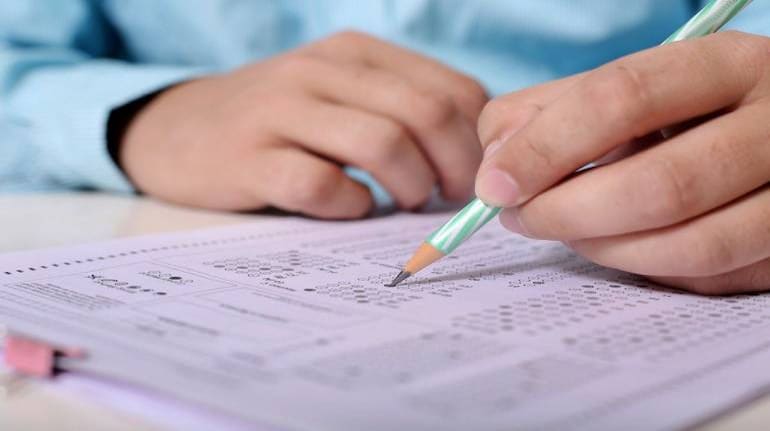
The most significant event in China this week was the gaokao — the annual two-day national exam to qualify for college. Anxious parents wait while their children go through the nine-hour ordeal. Those with younger kids sift through the test questions — published once the exams are over — preparing their offspring for the inevitable. As for couples considering starting a family, just imagining the gaokao for theirs can be a pretty effective contraceptive.
The exam questions are almost designed to fail you. For instance, the closed-book essays in the Chinese language test demand a near-encyclopedic knowledge of history, classic literature, and even current events. This year, one question was on the naming of a pavilion in the classic 18th century novel ‘Dream of the Red Chamber’; another queried strategies for the game of Go; a third requested an 800-word critique of a mini-documentary produced by the State-owned CCTV for the 100th birthday of the Communist Youth League.
Once through the — which translates as ‘high-level exam’ — the 18-year-olds are almost guaranteed a university spot. In recent years, the acceptance rate has edged above 80 percent, doubling that in the mid-1990s when I took the test. A college education has almost become a right, not a privilege.
Graph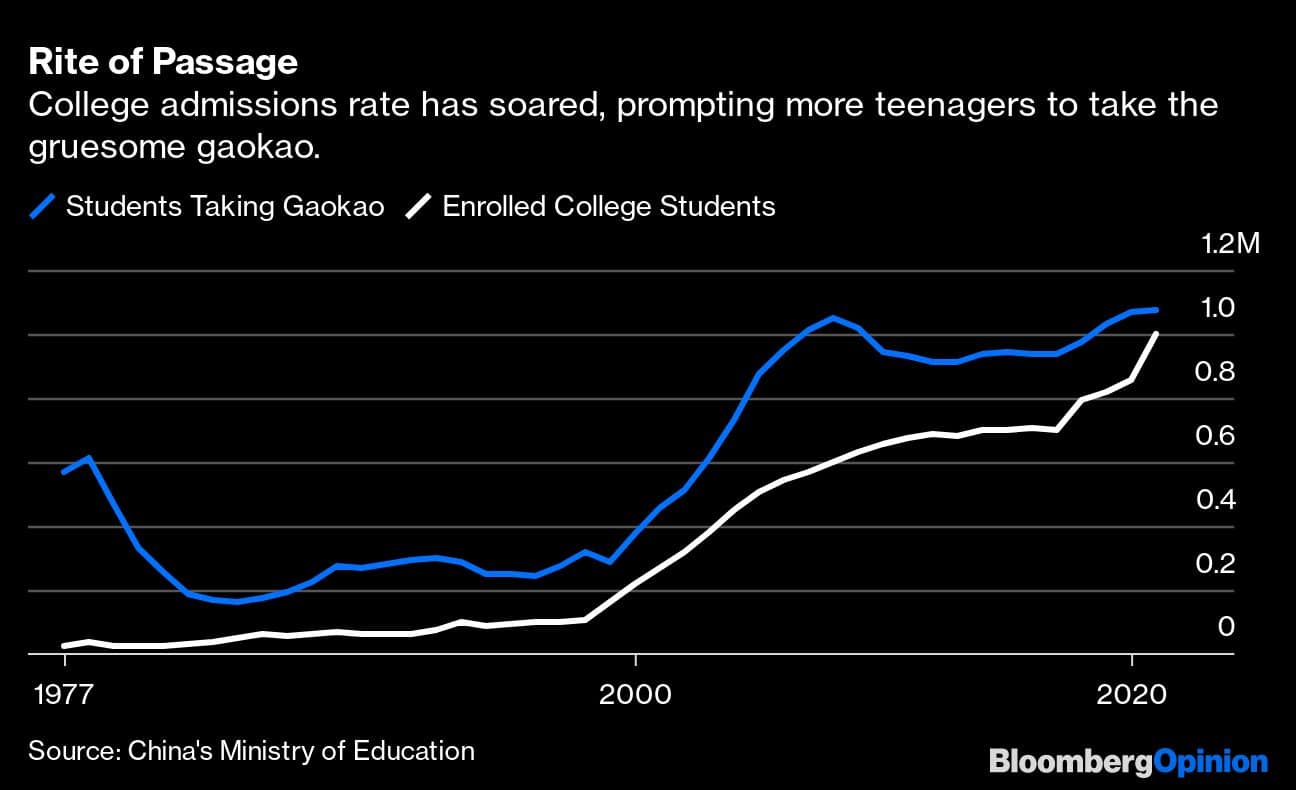
As such, most teenagers will give gaokao a shot. This year, a record 11.9 million are expected to take — or retake — the exam. China has roughly 15.9 million 18-year-olds.
This is creating a big social problem. A record 10.8 million college seniors are expected to graduate this summer, but China does not have enough good jobs for them. As of April, youth unemployment for those aged 16 to 24 was already 18.2 percent, due in part to COVID-19 lockdowns. By July, the rate could easily exceed 20 percent once college graduates enter the workforce. As of April, fewer than half received job offers, according to online recruitment platform Zhaopin Ltd.
It’s no longer clear a college degree brings financial benefits. According to the same Zhaopin survey, the average starting salary for those who got job offers will be 6,507 yuan per month ($974). By comparison, a delivery worker for the likes of Meituan could earn 10,000 yuan.
To make matters worse, with more than 10 million jobseekers on the street, employers are getting choosier. Many openings now require a postgraduate degree. Last year, at one high school, three of the four biology teachers it hired held PhDs.
As a result, this labour oversupply has prompted college seniors to delay their entry into the workforce. At the end of 2021, 4.6 million took the postgraduate entrance exam, an increase of about 21 percent. Graduate school still carries some weight. Last year, Chinese universities handed out about 8.3 million bachelor’s degrees; they graduated only about 773,000 with a masters and above.
None of this makes gaokao any easier, however. The acceptance rate for the so-called Project 985 schools — China’s most prestigious universities — was 1.7 percent last year. For Harvard University’s class of 2025, it was 4 percent. Rather, it’s the bottom of the pyramid that has expanded. The number of institutions that grant university degrees soared from just around 1,000 in the mid-1990s to above 2,700 in 2021.
To President Xi Jinping’s credit, he recognised the detriment of the gaokao frenzy early, denouncing profit-seeking educators in 2018. Last year, the government cracked down on the lucrative after-school tutoring industry, wiping billions of market capitalisation off investor darlings such as New Oriental Education & Technology Group Inc and TAL Education Group.
Beijing felt that it found a solution. In October, the State Council pushed for a second education track that resembles Germany’s successful ‘dual training’ model, in which students split their time between classrooms at a vocational school and on-the-job training at companies to develop practical skills. Some vocational schools may even grant a bachelor’s degree.
But most Chinese are unwilling to take the bait. The traditional Confucian culture of scholarship is deeply rooted — one needs to look no further than the character for the word ‘study’, which contains the strokes for vision, money and power. In ancient times, only children from wealthy families could afford to take the exam to become the emperor’s civil servants. During the Cultural Revolution in the 1960s and 1970s, universities were closed. So now that China’s middle class is getting richer, wouldn’t every parent want to send their children to college, even if it makes no commercial sense? In China, college education is not an investment; it’s a luxury good.
Of course, Beijing could call a stop and drastically reduce college enrolment. But that would result in nothing short of a widespread unhappiness in all levels of society. So year after year, the gaokao kabuki will carry on, creating a labour force increasingly incompatible with what the economy needs.
Shuli Ren is a Bloomberg Opinion columnist covering Asian markets. Views are personal, and do not represent the stand of this publication.Discover the latest Business News, Sensex, and Nifty updates. Obtain Personal Finance insights, tax queries, and expert opinions on Moneycontrol or download the Moneycontrol App to stay updated!
Find the best of Al News in one place, specially curated for you every weekend.
Stay on top of the latest tech trends and biggest startup news.