
Building up behind the scenes for decades, the climate crisis is now clearly upon us. Emission of greenhouse gases continues to increase.
As per the State of Global Climate Report (2021), the last seven years have been the warmest on record. Extreme events such as excessive heatwaves, floods, cyclones, severe storms are increasing, leading to humanitarian crises propelled by population displacement and food insecurity. Several regions around the globe, especially in food-deficient countries in Africa and West Asia, are feeling the brunt of high food prices. The poor in these regions will be highly-vulnerable to food inflation. As if COVID-19 pandemic and lower production of food due to climatic events was not enough, the Russian invasion of Ukraine has taken away almost 28 percent of global supply of wheat, 70 percent of sunflower oil, and 40 percent of potash.
As a result, the catastrophic effect of Russia’s war will be felt much after the actual war has ended. Sri Lanka, which was free of civil unrest and domestic conflict since 2009, is only an example of what a financial crisis can actually do to a nation.
Indian Agriculture Is VulnerableIndian Council for Agricultural Research (ICAR), in 2013 estimated the climate vulnerability index of Indian districts. Vulnerability to climate was calculated using an array of factors that among others, included the net sown area, area under waste lands, annual rainfall, proneness of districts to cyclones, and incidence of extremely hot days. The districts were then divided into five categories: very high, high, medium, low, and very low climate vulnerability.
Using this data, we found that Rajasthan (97 percent), Madhya Pradesh (75 percent), Bihar (74 percent), Uttar Pradesh (72 percent), Haryana (68 percent), Jharkhand (67 percent), Gujarat (64 percent), Uttarakhand (62 percent), Karnataka (61 percent), Maharashtra (56 percent), Tamil Nadu (53 percent), and Himachal Pradesh (50 percent) have more than 50 percent of districts under the category of very high, high, and medium vulnerability to Climate Change.
When mapped with data on agricultural value of output provided by the Ministry of Statistics and Programme Implementation (MOSPI) for Indian states, for the Triennium Ending (TE) 2017-18, these 12 states accounted for almost 70 percent of total value of output in agriculture (Graph below).
This points to the fact that a substantial part of India’s agriculture production is highly vulnerable to adverse impact of Climate Change.
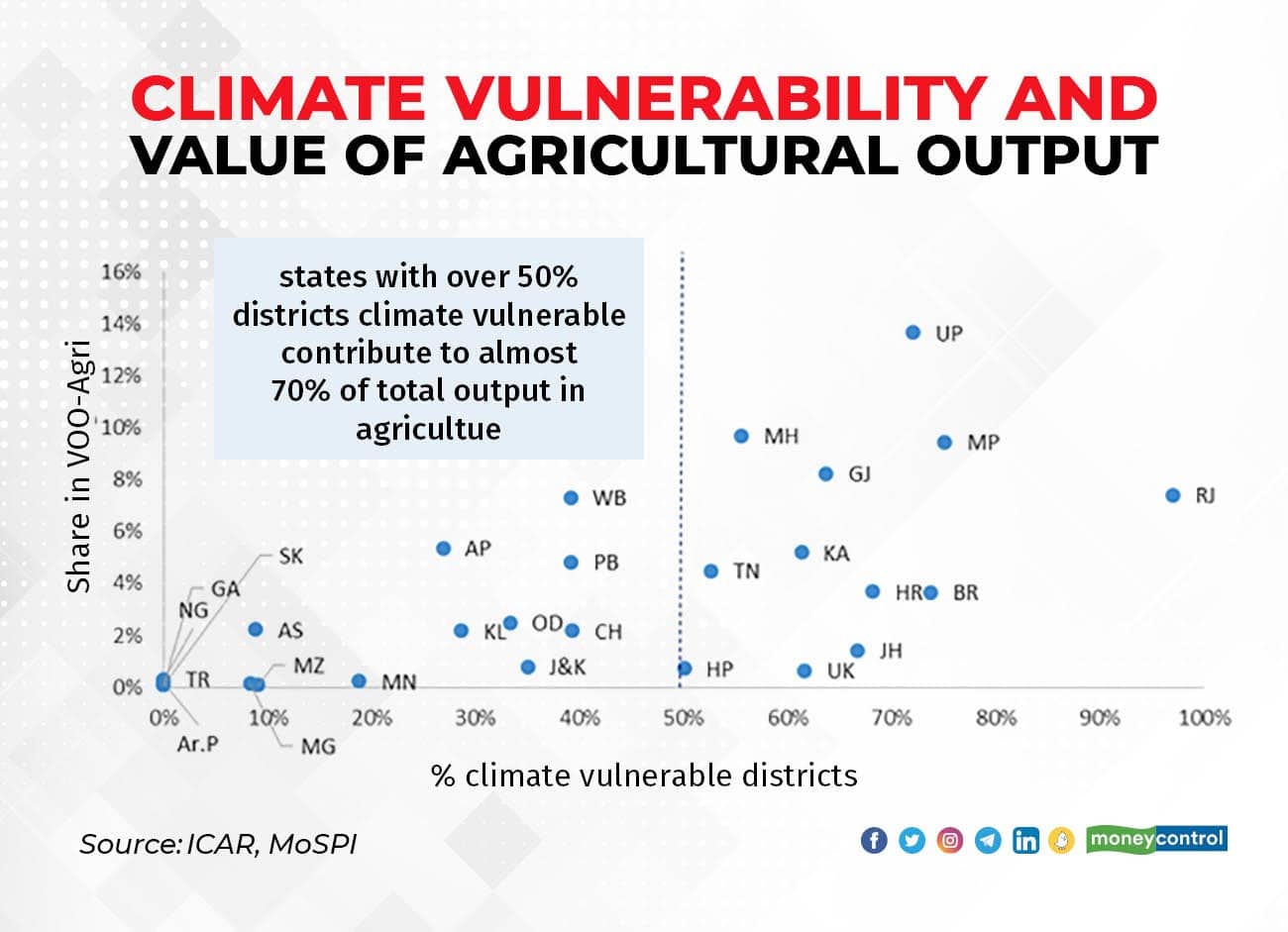
Source: ICAR (2013) and MOSPI (TE 2017-18).
Note: State-wise climate vulnerability is the share of very high, high, and medium climate vulnerable districts in the total number of districts in that state. Value of Output data only represents value of output from ‘agriculture’, and excludes value of output of allied activities such as livestock, fisheries, and forestry.
Climate Change And WheatThe latest impact of Climate Change is visible in the yield losses of wheat crop in 2021-22 rabi season. Somehow, the ICAR experts missed the adverse impact of high temperature on the wheat crop. On March 25, the Director of Indian Institute of Wheat and Barley Research (IIWBR) was quoted, “we are expecting a record production and are confident that it will cross 112 million tonnes”. On the other hand, the officers of the Haryana government had a better idea of impact of high temperature and the production was estimated to be lower.
For 2021-22 season, the government’s third advanced estimate pegs Indian wheat production at 106.4 million tonnes, suggesting a yield loss of about 4.4 percent from its second advanced estimate of 111.3 million tonnes. However, experts and the trade sources project lower production due to higher yield losses, ranging between 5.4 percent and 16 percent.
These losses are due to unusually high temperatures in March and early April in India’s north and north-western regions. As per the Indian Meteorological Department (IMD), the average maximum temperatures in March was the highest ever in the last 122 years. Wheat production data from the MOSPI suggests that in TE 2019-20, the 12 states (in the Graph above) accounted for 81 percent of India’s wheat production. Unfortunately, a recent study by UK’s meteorological department finds that instances of heat waves are 100 times more likely in India due to Climate Change.
Light At The End Of The Tunnel?Restricting global warming to 1.5 degree Celsius over the pre-industrial level temperature was adopted as the target by 196 countries under the Paris Agreement in 2015. However, the World Meteorological Organization finds that the probability of exceeding the 1.5-degree threshold has increased since 2015.
In the aftermath of Russia-Ukraine war, the biggest fossil fuel companies are likely to invest large amounts in fossil fuels. In most countries, public opinion against fossil fuel, especially in Europe, the United States, and Australia is not likely to be as strong as it was before this aggression. The war is not only causing a food crisis across poor countries, it may also enable higher emissions from fossil fuels in the years to come.
Considering the high vulnerability of essential crops such as wheat to Climate Change, there is dire need to acknowledge its impact, and act swiftly ensure India’s food security.
In 2011, the ICAR launched the National Innovations in Climate Resilient Agriculture (NICRA) project. The idea was to prepare Indian agriculture and allied sectors for disruptions caused by Climate Change. ICAR has developed several varieties of rice suitable for salt-affected soils. The NICRA needs to be provided with much larger resources to develop crop varieties which can withstand floods, and high temperatures. Climate-related interventions are equally important for animal husbandry, fisheries, and poultry.
Most of the state agriculture universities are starved of funds for research. State governments need to realise that they cannot depend only on the Centre for mitigating the challenges posed by Climate Change. States need to invest in research for new climate-resilient varieties.
Climate Change must be treated as a global emergency. Its impact may not hit the entire world at the same time, like COVID-19 did, but its impact on economies may be as disastrous.
Siraj Hussain is former Union Agriculture Secretary, and a co-promoter of Arcus Policy Research, and Pulkit Khatri is Consultant-Agriculture Policy with Arcus Policy Research. Views are personal, and do not represent the stand of this publication.Discover the latest Business News, Sensex, and Nifty updates. Obtain Personal Finance insights, tax queries, and expert opinions on Moneycontrol or download the Moneycontrol App to stay updated!
Find the best of Al News in one place, specially curated for you every weekend.
Stay on top of the latest tech trends and biggest startup news.