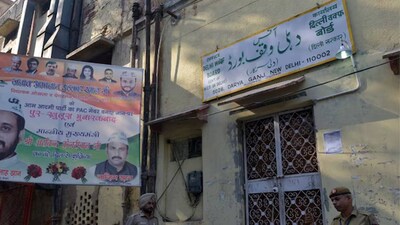
Land alienation is focal point of SC’s Waqf law hearing
Hearings in the Supreme Court in May on the amendments to the Waqf law witnessed engrossing arguments around alienation of tribal lands and government’s rights and powers when it is one of the interested parties in a land title dispute. A look at the essence of these amendments and nature of arguments around it follow

Criminalising minor offences is how legislature contributes to judicial backlog and unease of living
The State of the System report by Vidhi Centre exposes India's overcriminalisation of minor regulatory offences. Of central laws, 42 % contain criminal provisions. It leads to an overreliance on imprisonment and jails filled with undertrials. Finally, there are signs that the government is taking steps to undo the damage
AI in courtrooms and how it will change the landscape of litigation
AI is transforming Indian courtrooms by improving efficiency in translation, transcription, and case management, while facing challenges of cost, regulation, bias, and accessibility across all levels of the judiciary
Tareekh Pe Justice: A book on lower judiciary, the challenges it faces and the road ahead
This book examines systemic issues plaguing India’s district courts, highlighting judicial delays, lack of independence, and flawed oversight, while advocating structural reforms and accountability of higher judiciary to improve justice delivery
India justice report calls for reforms in judiciary through honest assessment
The India Justice Report 2025 highlights major challenges in India’s judiciary, including judge shortages, high caseloads, poor infrastructure, and inadequate legal aid, urging urgent reforms to improve access to justice and system efficiency
Police’s unjust mode of seeking justice
Civil and criminal laws are fundamentally different in their aim. Arbitrary usage of criminal law provisions by the police undermines the notion of justice. However, it’s commonly done and often results in scathing observations by constitutional courts
Can the judiciary ever be made accountable?
Official misconduct and impropriety are not rare in any branch of the state. What sets the judiciary apart is its lack of accountability. The judges of the higher judiciary, that is, the Supreme Court of India and High Courts, are accountable only to Parliament. However, enforcement of accountability through this mechanism is practically non-existent
Justice Chandrachud was his own man, a disadvantage in a world obsessed with pigeonholing
A judge’s most important qualification is impartiality and non-commitment to any particular idea or point of view. But, in a highly polarised world, neutrality can be seen as a lack of commitment rather than a principled stance. However, neutrality can also be a form of resistance—an assertion that one refuses to be manipulated into extreme positions
Goons in khaki and a timid government blight Punjab
Shubh Karman te Kabahun Na Tarun (never dread to tread the righteous path), the motto of Punjab Police, is alien to policing in the state. Assault of a serving army officer and his son by police personnel and the subsequent cover-up reveal the extent of rot in the system. Also, the deafening silence of the AAP government raise the question if the political executive in Punjab is in control of the state’s police force
There’s no case to create barriers between advocates and in-house counsels
Advocates (Amendment) Bill 2025 was withdrawn by the government following opposition from an influential section of lawyers. A revised version is expected soon. Two counsels argue that the earlier version of the Bill took an important step in eliminating rules which disfavour lawyers who take up full time employment. Mature legal markets offer the same statutory status to practicing lawyers and in-house counsels
Noble Yet Unequal: Gender inequality in India's legal profession
Women's participation in India's legal field remains severely limited due to systemic biases, work culture, and financial inequality. Despite challenges, ongoing reforms and advocacy signal hope for greater gender diversity and inclusion in the profession
Bail has to be the rule if clearing judicial backlog matters
The apex court has tilted in favour of privileging fundamental rights over statutory laws if the prosecution takes an inordinate time to finish investigation. In a related area, there are more than four million pending criminal cases which began over a decade ago. Many languish in jail as undertrials. Is there a way to clear the backlog without being more liberal about bail?
The consequential afterlife of judiciary’s oral observations
Oral observations may not find their way into a formal order. However, they can leave a lasting impression on people, even if they are made in an offhand way. They also run the risk of diluting judicial accountability
India’s online gaming boom is at risk and only a central law can save it
India's online gaming sector faces regulatory challenges, offshore gambling issues, and tax evasion. A uniform national policy and stronger regulations are crucial for protecting domestic businesses, boosting innovation, and positioning India as a global gaming hub with economic potential
Tackling litigation delays to boost India’s economic growth
Litigation delays in India hinder investment, economic growth, and infrastructure development. Addressing these inefficiencies requires judicial reforms, improved court infrastructure, and proactive government action to create a predictable business environment that fosters innovation, entrepreneurship, and sustainable growth
Can the Supreme Court become an interim Parliament?
This month the Supreme Court will hear a matter examining the scope of Article 141 of the Constitution which says that the law declared by the apex court shall be binding on all courts. The underlying issue centers on a test of legitimacy of legislative power or the Supreme Court’s power under Article 141.
Former CJI Khehar earns government’s appreciation despite taking contrarian positions
He was awarded Padma Vibushan this year. One of the noteworthy aspects of his tenure at the apex court is that his judgements, particularly in the NJAC case, ran counter to what the government argued. The Padma award is a measure of his credibility
All about India’s tryst with defamation law
Jurisprudence favours a balance between free expression and the right to protection of one’s reputation. A Law Commission recommended that in India defamation be retained within the scheme of criminal laws. The tricky part still remains the search for the line of demarcation between acceptable speech and damage to one’s reputation
As Supreme Court turns 75, a look at some of its milestones
Created by the Constitution, the Supreme Court in the words of the first Chief Justice HJ Kania has 'goodwill and sympathy for all, but is allied to none.'
Fali Nariman’s acute observations are a launch pad for research on Constitutional issues
An anthology of writings and speeches of the eminent jurist, who passed away last year, contain insightful observations on perennial issues such as corruption and contempt of court. They will continue to be a reference point of many a debate on legal issues
An Indian judge whose work left its mark on judiciary in other lands
Justice AN Grover was one of three judges superseded after having been a part of the majority in the landmark ‘Basic Structure’ judgement. He was also part of the bench which decided on the ‘Bank Nationalisation’ and ‘Privy Purses’ cases. Of the three it is ‘Basic Structure’ which left its imprint in other jurisdictions as brought out in an insightful biography of Justice Grover
2024 in Supreme Court: Eight judgements which will reverberate
It was an eventful year with consequential verdicts delivered by constitutional benches. We pick eight of them which impact events down the line. Other than judgements, there were other decisions at the apex court which evoked strong reactions from stakeholders
Weaponisation of Section 498A
In 1983, IPC added Section 498A to protect married women from harassment at the hands of her husband. A law introduced with good intentions has been over the years turned in it's head. It has become in many instances of a breakdown in the marriage, a tool to harass not just the husband but also his relatives
Judicial independence is ultimately in the hands of judges
The rule of law is undisputedly one of the most fundamental requirements of the democratic state. And, one ingredient that is essential for enforcing the rule of law is an independent judiciary. That independence can be realised by judges and no one else. As Justice BV Nagarathna said, it’s the “personality” of judges which will determine the extent of judicial independence and autonomy
ANI vs OpenAI: Copyright, AI, and the future of text data mining
The ongoing legal dispute between ANI and OpenAI raises critical issues around copyright infringement, data mining, and AI's use of copyrighted materials in India, highlighting the tension between content ownership and technological innovation