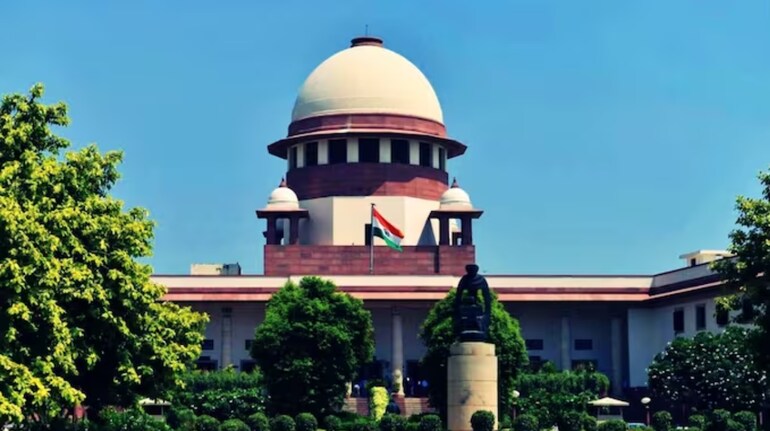
Supreme Court comes into existence with the enactment of the Constitution
The Constitution of India came into force on 26 January 1950, and Article 124, which states that “There shall be a Supreme Court of India,” created India’s apex judicial body.
Inauguration of Supreme Court
Two days later, on 28 January 1950, after India became the Sovereign Democratic Republic, the Supreme Court was inaugurated at the Chamber of Princes in the old Parliament building, where the Federal Court of India functioned for more than 12 years from 1937 to 1950.
Justice Harilal J. Kania, the first Chief Justice of India, in the inaugural session of the Supreme Court of India, said: "The Supreme Court, an all India Court, will stand firm and aloof from party politics and political theories. It is unconcerned with the changes in the Government. The Court stands to administer the law for the time being in force, has goodwill and sympathy for all, but is allied to none."
SC moves to a new building
The Supreme Court moved into a new building on 4th August 1958. The building was shaped to project the image of scales of justice.
Dr. Rajendra Prasad, the first president of India, while inaugurating the new building of the Supreme Court spoke about what the new building of the Supreme Court symbolizes. He said, "Traditionally we look upon justice as a pair of scales the two pans of which have to be held evenly without allowing the beam from which they hang to incline to one side or the other. We see two wings on the two sides. They will accommodate the offices and the records. At the end of each wing is a semi-circular structure. They represent the pans that are attached to the beam at the top. This beam will accommodate the courtrooms wherein the Hon’ble Judges will sit and dispense justice without inkling either to the right or to the left."
Supreme Court motto
The motto of the Supreme Court of India is 'Yato Dharmastato Jayaḥ', which is a Sanskrit phrase that means "Where there is Dharma, there will be Victory'
First Chief Justice of India
Justice Harilal Jekisundas Kania was the first Chief Justice of India who had also served as the judge of the Federal Court that preceded the Supreme Court of India as India’s highest court. The puisne judges were Saiyed Fazl Ali, Mundakulathur Patanjali Sastri, Mehr Chand Mahajan, Bijan Kumar Mukherjea, Sudhi Ranjan Das, Nagapudi Chandrasekhara Aiyar, Vivian Bose.
Supreme Court expands over time
Initially, the Constitution of India had provisions for Chief Justice and seven puisne Judges. Later Parliament increased the number of Judges from eight in 1950 to 11 in 1956, 14 in 1960, 18 in 1978, 26 in 1986, 31 in 2009 and 34 in 2019 which is the current strength.
George H. Gadbois, Jr in his seminal book Judges of the Supreme Court of India (1950-1989) writes: “The Government of India Act 1935, had provided for Chief Justice and as many as six associate judges, but the strength of the Federal Court from 1937 to 1947 never exceeded three, including the CJI. Having decided only 135 decisions and rendered only four advisory opinions during its entire existence, three were sufficient. The transition from the Federal Court to the SCI was seamless-Kania on 26 January became the first CJI under the 1950 Constitution and the five other Federal Court judges became SCI judges. The authorized strength of the Court at this time was eight, including the CJI. After the appointments of N. Chandrasekhara Aiyar in 1950 and Vivian Bose in 1951, the Court reached its full strength.”
Two cases and the Constitution’s first amendment
The two most important constitutional cases that the Supreme Court heard and decided on were AK Gopalan v. State of Madras and Champakam Dorairajan v. State of Madras. In Gopalan's case, A K Gopalan, who was a member of the Indian Communist Party and was detained under the Preventive Detention Act of 1950. He contended that principles of natural justice were not followed in his case and that he was not given a fair hearing. However, the apex court held that if personal liberty is taken away by the State in accordance with the procedure established by law, then the challenge to it will fail.
In Champakam Dorairajan, the issue of reservation came up, and the Supreme Court held that providing for reservations in educational institutions violates Article 15(1). The case was one of the major reasons behind the First Amendment to the Constitution.
Longest serving Chief Justice
Justice Yeshwant Vishnu Chandrachud - the 16th Chief Justice of the Supreme Court (1978 to 1985) was the longest-serving Chief Justice in India's history as he was in office for seven years and four months.
Shortest serving Chief Justice
Justice Kamal Narain Singh was the 22nd Chief Justice of India and had the shortest tenure of just 17 days from 25 November 1991 until 12 December 1991.
The first judge to be elected directly from the bar.
Justice Sarv Mittra Sikri was the first Judge to be directly elevated from the Bar. He had a tenure of a little over 9 years in the apex court. On May 19th, 2023, Justice KV Viswanathan became the tenth Judge to be appointed directly from the Bar.
First woman judge of the Supreme Court
On October 6, 1989, Justice Fathima Beevi took oath as the first woman judge of the Supreme Court. She rose from the rank of Munsiff in the Kerala Subordinate Court to become the first woman judge of the Supreme Court.
First Dalit CJI
On January 14th, 2007, Justice K.G. Balakrishnan became the first Dalit to be appointed as the Chief Justice of India. He served for ten years at the Supreme Court, including over three years as the Chief Justice.
First supersession of senior judges
It was on April 26, 1973, when Justice AN Ray superseded three senior judges, Justice KS Hegde, Justice AN Grover and Justice JM Shelat to be appointed as the CJI. Subsequently, Justices Hegde, Grover and Shelat resigned in protest.
Discover the latest Business News, Sensex, and Nifty updates. Obtain Personal Finance insights, tax queries, and expert opinions on Moneycontrol or download the Moneycontrol App to stay updated!
Find the best of Al News in one place, specially curated for you every weekend.
Stay on top of the latest tech trends and biggest startup news.