






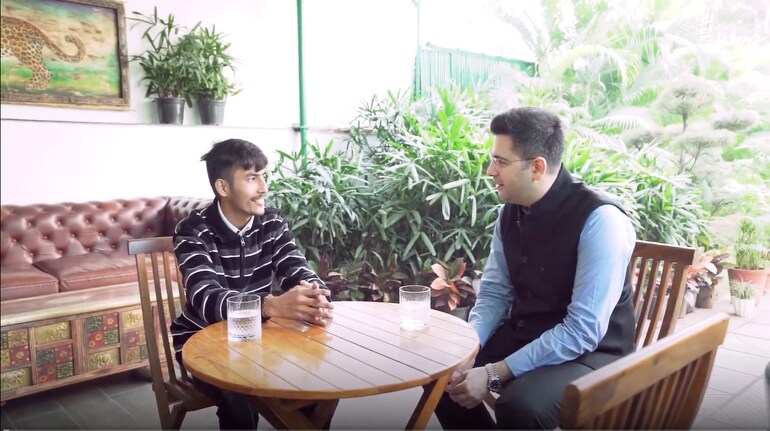
Rajya Sabha MP Raghav Chadha has brought renewed political focus to the working conditions of app-based delivery workers after meeting a Blinkit delivery partner whose viral video highlighted low earnings despite long hours on the job.
The interaction comes weeks after Chadha raised similar concerns in Parliament, questioning wages, work hours and the absence of social security in India’s fast-growing gig economy.
The MP met the delivery partner, Himanshu, at his residence following the Winter Session. Chadha referred to a widely shared video in which the rider said he earned just Rs 763 after completing 28 deliveries over nearly 15 hours.
“I saw your news and the photo showing 28 deliveries for Rs 763 in 18 hours. I raised this issue,” Chadha told the rider.
I invited Himanshu, a Blinkit delivery boy, over for lunch. Through his social media post, he had recently shared the harsh realities and miseries faced by riders/delivery boys. We spoke at length about the high risks, long hours, low pay, and no safety net. These voices deserve… pic.twitter.com/pTiDOLtr3m— Raghav Chadha (@raghav_chadha) December 27, 2025
Pressure of 10-minute delivery
Himanshu said the promise of ultra-fast deliveries often works against riders’ earnings rather than improving them.
Also Read | India's gig economy’s stress test: Why delivery workers are striking on Christmas and New Year’s Eve
“There is an incentive issue. Sometimes when we reach a location, the customer doesn’t pick up the call for half an hour. Our time is wasted and incentives are lost,” he said.
Chadha said he had specifically flagged the 10-minute delivery model in Parliament and argued it should be stopped, citing safety and fairness concerns.
Physical strain inside housing societies
The rider also described the physical toll of deliveries inside residential complexes.
“If the customer is on the 14th floor and the service lift is not working, society lifts often don’t allow delivery workers. Riders end up climbing 10–14 floors,” Himanshu said.
He added that delivery partners frequently feel disrespected and unsafe, especially during late-night shifts.
Declining per-delivery pay
Himanshu said per-delivery payments have steadily fallen. Nearby orders that once paid Rs 17 now fetch Rs 12–13, while deliveries of around 5 km that earlier paid Rs 70–80 are now closer to Rs 60.
“Earlier, riders could make Rs 1,000–2,000 in 12–13 hours. Now many can’t even cross Rs 1,000,” he said.
The pressure to meet incentives, he added, often leads riders to rush, increasing accident risks. He cited personal experiences of slipping on basement ramps while trying to complete orders faster.
No safety net
On social security, Himanshu said delivery partners remain excluded from basic protections.
“There is no PF. If you deliver, you get paid. Companies talk about earning Rs 60,000 a month, but that’s only possible if you do 50–60 deliveries every day,” he said.
Protests reflect wider discontent
The concerns echo recent protests by the Gig & Platform Service Workers Union, which observed a nationwide strike on December 25.
The strike disrupted services in parts of Gurugram, while impact in Delhi and Noida remained limited.
Discover the latest Business News, Sensex, and Nifty updates. Obtain Personal Finance insights, tax queries, and expert opinions on Moneycontrol or download the Moneycontrol App to stay updated!
Find the best of Al News in one place, specially curated for you every weekend.
Stay on top of the latest tech trends and biggest startup news.




