



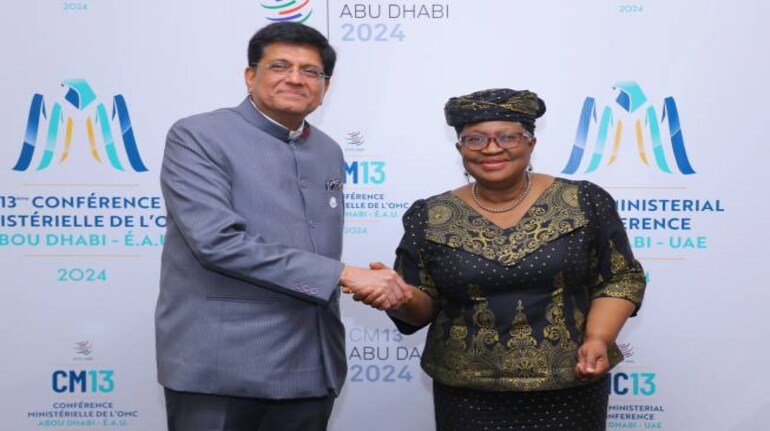
The World Trade Organisation's 13th Ministerial Conference (MC13) decided to resolve issues around WTO's dispute resolution mechanism by 2024, and agreed to maintain the current practice of not imposing customs duties on electronic transmissions for two more years, after which it will expire.
Both of these decisions did not go India's way. While the South Asian nation was pushing for a resolution on WTO's dispute resolution mechanism by MC13, initially, it also wanted an end to the moratorium on levying customs duties on digital goods.
"We agree to maintain the current practice of not imposing customs duties on electronic transmissions until the 14th Session of the Ministerial Conference. The moratorium and the Work Programme will expire on that date," according to a statement on the Draft Ministerial decision of March 1, 2024.
India reiterated her ask to re-examine the implications of the moratorium on customs duties on electronic transmissions, particularly for the developing nations and the least-developed countries (LDCs) at a session on e-commerce during the World Trade Organisation’s (WTO) 13th Ministerial Conference (MC13) on February 28.
New Delhi believes that a country should be free to levy such duties given that developing nations are losing around $10 billion in revenues due to this moratorium.
Since 1998, WTO members have periodically agreed to extend the moratorium on the imposition of these customs duties. The last extension was agreed in June 2022 at the WTO's MC12 until MC13. In the previous ministerial conference members, including India had also agreed to intensify discussions on the scope, definition, and impact of the moratorium.
Members at MC13 also agreed to hold further discussions and examine additional empirical evidence on the scope, definition, and impact that a moratorium on customs duties on electronic transmissions might have on development, and how to level the playing field for developing and least-developed country Members to advance their digital industrialisation.
India is of the view that the country needs to levy customs duties to protect its nascent digital industry. And since the difference between digital goods and digital services isn't well defined, New Delhi is not in favour of extending the moratorium further.
Meanwhile, on the goal of having a fully functional dispute settlement system, the draft statement said, that discussions will be accelerated by officials in an inclusive and transparent manner to achieve this objective by 2024 as set forth at the previous 12th Ministerial Conference (MC12).
At the Ministerial Conference-13 in Abu Dhabi, India reiterated its long-standing call for restoring the WTO's Appellate Body, a dispute-settlement entity that has been out of action since December 2019. New Delhi also sought the immediate and effective formalisation of the informal dispute settlement reform process by rectifying existing defects.
A decision by the United States to block appointments of new members to the Appellate Body has stalled this entity's functioning. This has called into question the WTO’s overall credibility and the rules-based trade order it upholds.
The body was established in 1995 under Article 17 of the Understanding on Rules and Procedures Governing the Settlement of Disputes. It is a standing body of seven persons that hears appeals in disputes brought by WTO members. The appellate body can uphold, modify, or reverse the legal findings and conclusions of a panel, and appellate body reports are adopted by the Dispute Settlement Body (DSB), unless all members decide not to do so.
The WTO's MC13, which began in Abu Dhabi, United Arab Emirates (UAE) on February 26, concluded on March 2.
Discover the latest Business News, Sensex, and Nifty updates. Obtain Personal Finance insights, tax queries, and expert opinions on Moneycontrol or download the Moneycontrol App to stay updated!
Find the best of Al News in one place, specially curated for you every weekend.
Stay on top of the latest tech trends and biggest startup news.