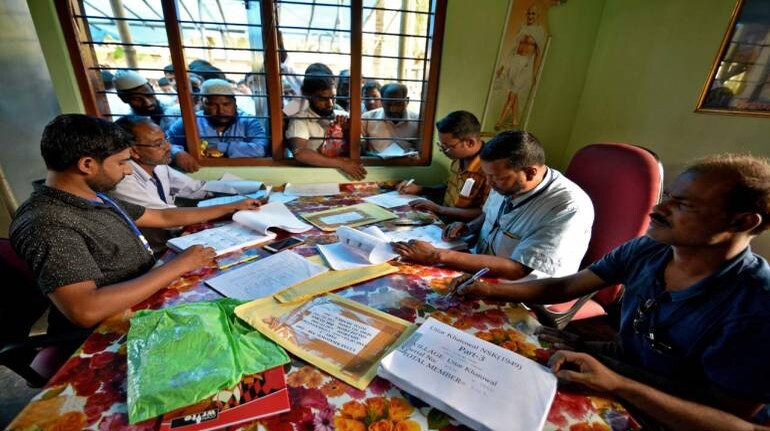
At the stroke of noon on July 30, 2018, the Assam government rolled back the years to bring to fruition the second and final draft of the National Register of Citizens (NRC) which has been hanging fire since the Assam Accord was signed in 1985.
Of the 3.29 crore applicants who had submitted proof of nationality, the list contains only 2.89 crore names, rendering 40 lakh people stateless, roughly the population of Croatia. From August 7, those whose names are not in the list will be able to determine the reason for their non-inclusion. They are reserved the right to apply again between August 7 and September 28, following which they face the risk of deportation.
The polity of Assam has been long fraught with the question of nativity, and the NRC signals a progression in the State's efforts at identifying foreigners who may have illegally entered the State. Those who have migrated after the midnight of March 24, 1971, face the threat of deportation, according to the Assam Accord which was signed 32 years ago by the central government, then under the helm of Rajiv Gandhi, and the All Assam Students' Union (AASU).
The first draft of the NRC listed 1.9 crore names out of 3.29 applications received. The Assam government called for calm, assuring citizens whose names have been excluded from the preliminary draft, that subsequent revision to the registry will encompass the entire populace. The final draft was prepared by combing through data collated from population surveys undertaken across Assam’s diverse topography. However, the final estimate of the State’s legitimate residents is underwhelming.
The government's ongoing efforts at identifying illegal migrants is not the first such attempt. Data collected in previous rounds of the census throw considerable light on the influx of migrants into Assam. Here is what we know about the migratory trends in the demographic of the State from existing data.
According to a World Bank-Development Indicators Group report published in 2013, the Bangladesh - India corridor is the third largest migration corridor in the world by volume. The total number of people crossing the international border between the two countries estimated at 3.2 million.
This is comparable with the Russia-Ukraine corridor, where migrants numbered 3.5 million. However, the Mexico - United States border remains the most porous, with 13 million migrants making their way across the border.
The India Bangladesh border spans 4,156km, and is the fifth-longest international border in the world. Assam, Tripura, Meghalaya, Mizoram, and West Bengal share a border with Bangladesh.
There are 27 districts in Assam, four of which were created between the 2011 and 2001 rounds of the Census. According to data from the census of 2011, Nalbari and Nagaon are the two most populous districts. The major religions practiced in the State are Hinduism and Islam.
While the Muslim population has been historically targeted in the State and equated with Bangladeshi migrants, these claims have not been verified owing to political expediency since many migrants - both legal and illegal - are on the electoral rolls. Dhubri district, which shares a border with Bangladesh, has the highest Muslim population in the State, amounting to 79.67% of the population.
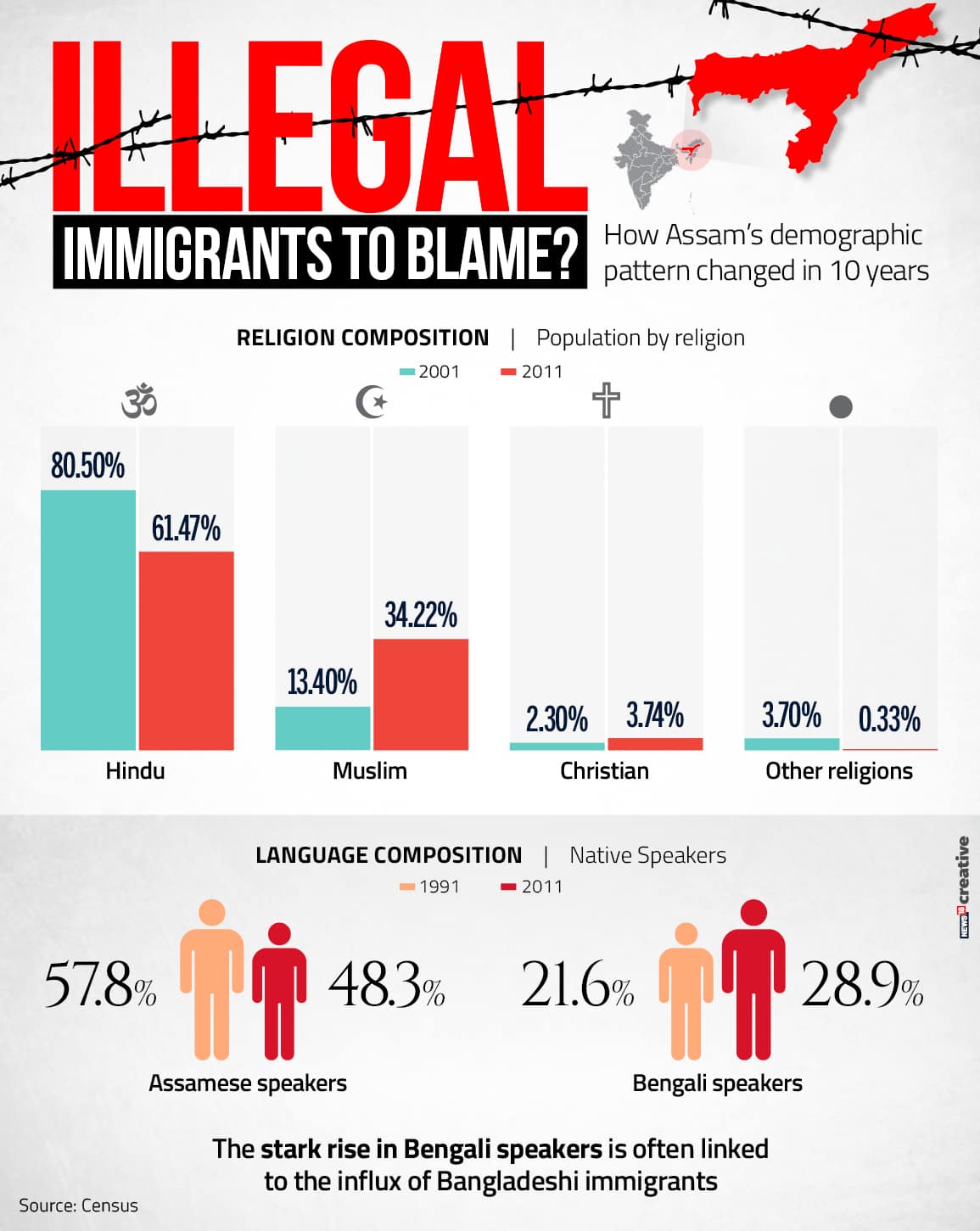
Those who contend that illegal migrants from Bangladesh have altered the demographic of the State claim that there was a spurt in inflow refugees after the Bangladesh Liberation War in 1971. Since there has been no comprehensive effort at demographic accounting as yet, these fears remain unsubstantiated.
However, census data reveals that between 1971 and 1991, the decadal growth rate of the Muslim population in the State grew at 77.41% while the corresponding rate for Hindus stood at 41.89%, dipping behind the national average for the first time since independence.
Another cause for this anomaly could be the migration of non-Assamese Hindus from the State in the aftermath of the students' movement, which was a period where the assertion of Assamese ethnicity was on the rise. The Assam movement, which culminated in the signing of the Assam Accord was led by student groups who demanded the expulsion of illegal migrants.
Since 1911, there is documentary evidence that the decadal growth of population in Assam was far greater than the national average. After hitting a plateau between 1921 and 1951, the population of the State increased rapidly in the 1960s and 1970s, with the population growing at 35% in each of the two decades. This period of enhanced fertility coincides with civil war in Bangladesh and the ascent of the Assamese identity among the polity.
MigrationAs of 2001, there were 5,15,924 migrants from other states who were residing in Assam. The migrant contingent from Bihar and West Bengal accounted for 1,72,825 and 99,034 of the population of Assam. There was also a sizeable number of people from the neighbouring states of Tripura and Meghalaya who had made Assam their domicile.
The district-level data from the 2001 Census reveals that districts on the western border of Assam have the highest share of migrants. Kamrup has the highest number of migrants with 1,08,217 people who hail from outside the State. The trend reverses towards the eastern part of the State, which is home to less migrants.
The number of migrants from outside the country amount to 1,90,588, or 37% the number of domestic migrants according to the 2001 Census. The majority of foreigners in Assam were from Bangladesh, which accounted for 86.14% of the total number of expatriates who had made the state, legally or illegally.
The district-wise distribution of foreigners reveals that those districts which border Bangladesh have the highest share of migrants from outside the country. Cachar, followed by Karimganj had the highest proportion of foreign migrants to the total population, at 1.63% and 1.61% respectively.
However, contrary to expectations, Dhubri, which has the highest Muslim population in the State, has one of the smallest population of migrants from Bangladesh. In absolute terms, Nagaon had the highest tally of migrants at 26,131, with 24,258 hailing from Bangladesh.
Government actionIn answer to Unstarred Question no. 1966 raised in the Rajya Sabha on 11th May, 2016, Kiren Rijiju, the Minister of State for Home Affairs clarified that the central government was taking measures to seal all international borders and check migration from neighbouring countries, especially Bangladesh.
Rijiju stated that the Ministry classified migrants into two broad categories - those that have entered the country without valid travel documents, and those that entered on valid travel documents but were found to be overstaying after the expiry of their visa. He conceded that since the entry of "Bangladeshi nationals into the country is clandestine and surreptitious," the accuracy of the data would be compromised.
According to the data presented in the Upper House, 24,364 Bangladeshi nationals were found to be overstaying, of which 6,761 were deported. This number has reduced drastically over the years. The Ministry of Home Affairs stated that 116 individuals from Bangladesh were found to be overstaying in 2015. The number of deportations stood at 474.
The power to identify, detain, and deport foreign nationals who are illegally staying in India has been delegated to the State governments and the Union Territory Administrations under Section 3(2)(c) of the Foreigners Act, 1946. The National Registry of Citizens being compiled by the Assam government will seek to remove the blind spots in demographic accounting.
However, the social and political ramifications could be manifold. The State government will be empowered to act against individuals who may have arrived in the country before the cut-off date set in the Assam Accord, but might not have been able to acquire documents to prove their domicile.
Discover the latest Business News, Sensex, and Nifty updates. Obtain Personal Finance insights, tax queries, and expert opinions on Moneycontrol or download the Moneycontrol App to stay updated!
Find the best of Al News in one place, specially curated for you every weekend.
Stay on top of the latest tech trends and biggest startup news.