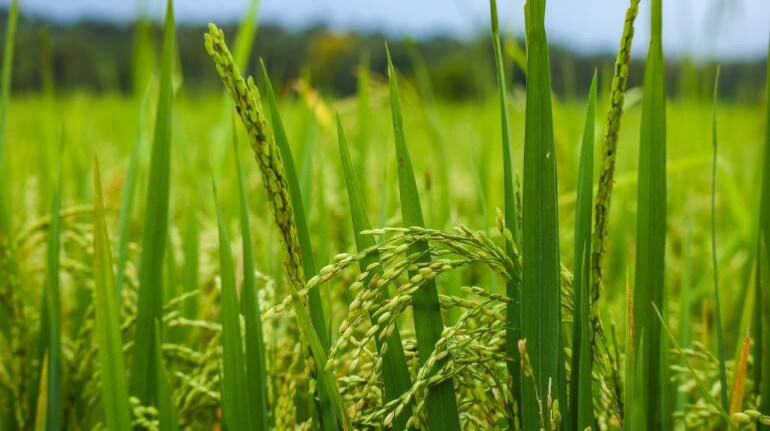
Paddy farmers in Kerala have something to cheer amidst the ongoing row between the Kerala government and the rice millers over procurement.
Rice production in the state has witnessed a resurgence in the last five years after a steady decline over the last few decades, thanks to several measures taken by the government.
Though paddy farming has never been a strong point of the state, well known for its cash crops, shrinking rice production in tandem with rising population has raised its dependence on rice from other states, particularly Andhra Pradesh and Tamil Nadu.
In a state where land is in perennial short supply, dwindling profitability from paddy farming due to the rising cost of production, combined with the increasing shortage of labour, has paved the way for a marked shift in agriculture to cash crops from the 1970s, according to experts.
Cash crops, such as rubber, pepper, coconut, cardamom, cashew, tea and coffee currently constitute around 70 percent of the food production.
Further, conversion of paddy fields for construction activities rose as the state began to grow economically.
Area under paddy cultivation improvesAs per the economic review of Kerala for 2020-21, the area under paddy cultivation improved by 5.7 percent from a year ago to 2.02 lakh hectares while rice production jumped by 6.8 percent to 6.27 lakh tonnes. Paddy area and production have been steadily going up in small measures in the last five years.
The government has initiated many incentives schemes. “Earlier, the benefits were available only to below poverty line (BPL) households. But the paddy farming schemes implemented through the local administration departments were available to all those who were interested in paddy farming,’’ said Dr K N Harilal, former member of the Kerala State Planning Board.
Government initiatives include assistance to undertake fallow land cultivation, upland cultivation, conversion of single crop to double crop and promotion of specialty rice.
In addition, paddy farmers were provided an input assistance of Rs 5,500 per hectare, production bonus of Rs 1,000 per hectare per season and free electricity. The Subiksha Keralam scheme, launched to meet food scarcity following COVID-19, also coincided with these efforts.
According to Harilal, another factor for the success of the schemes was that the panchayats were able to provide the incentives at the right time instead of the usual practice of bunching them towards the end of the year.
Under fallow land cultivation, the government intends to identify and cultivate arable land of 25,000 hectares lying barren within the limits of each local body, mainly paddy, vegetables, fruit crops, tuber, pulses and millets.
Against a target of 5,000 hectares of fallow land cultivation with a grant of Rs 40,000 per hectares in 2020-21, 9,070 hectares were cultivated.
Area under paddy cultivation in the state slumped by 78 percent from 8.75 lakh hectares in 1970-71 to 1.89 lakh hectares in 2017-18. Kerala’s rice production was the highest, at 12.98 lakh tonnes, in 1970-71. It nosedived 66 percent to 4.36 lakh tonnes in 2016-17, according to the data in Kerala economic review.
State’s overall share in national production risesAt 6.27 lakh tonnes in 2020-21, it is only 0.51 percent of the total rice production of 122.27 million tonnes in the country. But compared to the situation 10 years ago, the overall share in the national production has increased by 27 percent.
Despite a marginal increase in paddy acreage, Kerala has been able to achieve better production because of higher productivity. Paddy productivity has zoomed by over 100 percent from the 1970s to reach the current level of 3,105 kg per hectare.
“About 97 percent of the seeds used in the state now are high-yielding varieties. With these seeds, technically, it is possible to achieve a productivity of 6,000-7,000 kg per hectare. Had we continued with the traditional paddy varieties used four decades ago, we would still be getting 1,000-2,000 kg per hectare,’’ said Dr P Indira Devi, Emeritus Professor, Agricultural Economics, Kerala Agricultural University.
A rough estimate of Kerala’s rice demand is around 38-40 lakh tonnes a year. The local production currently meets over 16 percent of the requirement, marginally up from five years ago.
Wetland cultivation dominatesWetland paddy cultivation dominates in the state, which receives copious rainfall for half the year.
“Increasing wetland cultivation has other ecological benefits like ground water recharge and promotion of bio-diversity. The government has come out with a scheme for the payment of Rs 3,000 per hectare as royalty to the land owners of cultivable paddy lands for just conserving it,’’ she said.
In addition to wetland cultivation, Kerala also has upland paddy cultivation on a limited scale. In 2020-21, about 3,175.5 hectares of upland cultivation yielded 6,846 tonnes, with a comparatively lower productivity of 2,156 kg per hectare. The area under upland rice decreased by 55 percent, compared to the previous year.
The state government has launched the Kerala State Agricultural Mechanisation Mission to address the issue of labour shortage by providing trained youths and farm equipment for hire.
But can the success in the last few years be sustained and will production reach the level attained in the 1970s? Experts are not very optimistic though they feel it can be improved further. “It is difficult to regain the paddy land converted for other purposes. But there is more fallow land left in the key paddy-producing districts of Palakkad, Alappuzha and Thrissur, which can be converted for paddy farming. Productivity can be increased though changing climate is a huge challenge. Besides production of pesticide-free rice, which has good demand now, can also be encouraged,’’ said Harilal, who is also a professor at Centre for Development Studies.
Discover the latest Business News, Sensex, and Nifty updates. Obtain Personal Finance insights, tax queries, and expert opinions on Moneycontrol or download the Moneycontrol App to stay updated!
Find the best of Al News in one place, specially curated for you every weekend.
Stay on top of the latest tech trends and biggest startup news.