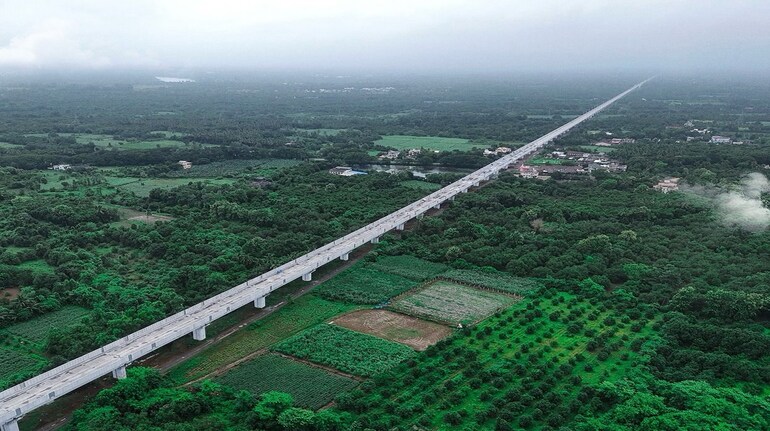

Karnataka government on February 1 said Bengaluru should be connected to Pune or Mumbai through a high-speed rail corridor, expressing disappointment with the routes announced in the Union Budget 2026-27.
Union Finance Minister Nirmala Sitharaman proposed the development of seven high-speed rail corridors between cities as ‘growth connectors’: (i) Mumbai-Pune, (ii) Pune-Hyderabad, (iii) Hyderabad-Bengaluru, (iv) Hyderabad-Chennai, (v) Chennai-Bengaluru, (vi) Delhi-Varanasi, and (vii) Varanasi-Siliguri.
Also, read: India’s first indigenous high-speed train set to enter manufacturing phase soon
CM says proposed corridors favour neighbouring states
Chief Minister Siddaramaiah said high-speed rail must strengthen the economic position of the regions it touches, not weaken it. He argued that proposed Hyderabad-Bengaluru and Chennai-Bengaluru corridors would largely benefit Telangana, Andhra Pradesh and Tamil Nadu by giving their residents faster access to Bengaluru’s economic ecosystem, while offering very little reciprocal advantage to Karnataka.
“Our genuine requirement was a Bengaluru-Mumbai or Bengaluru-Pune high-speed corridor, which would have integrated technology, finance, manufacturing and global trade in a way that truly benefits both Karnataka and the national economy. Under the current proposal, Karnataka risks losing its competitive edge, as people from other states can more easily tap into Bengaluru’s opportunities, while opportunities for people within Karnataka to expand outward are not equally strengthened. Infrastructure should create balanced growth and shared prosperity; otherwise, it ends up advantaging some states while unfairly burdening others,” he said.
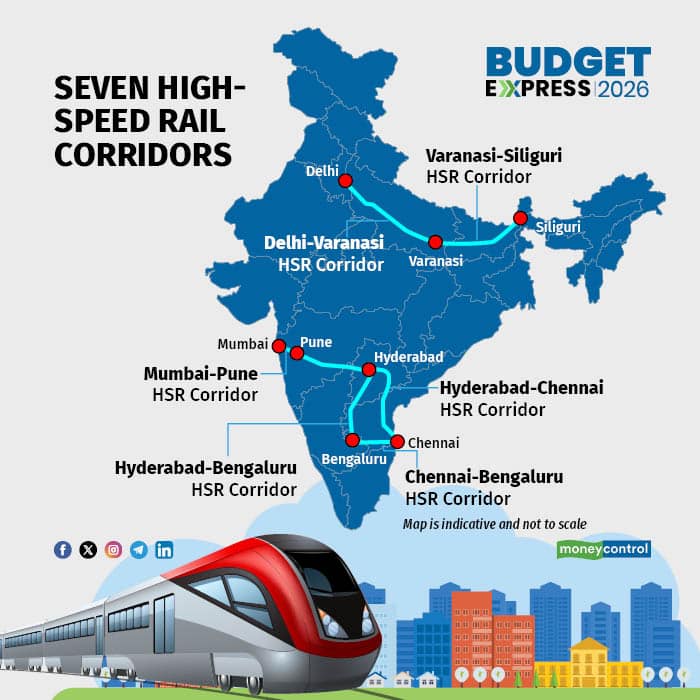
Limited benefit to Karnataka: MB Patil
Minister for Large and Medium Industries MB Patil said, “While Union Budget’s announcement on developing high-speed rail corridors between Bengaluru-Hyderabad and Bengaluru-Chennai is welcome, it offers limited benefit to Karnataka. Instead, a similar corridor should have been taken up between Bengaluru and Pune.”
He urged MPs from Karnataka and Maharashtra to raise the issue collectively and in a non-partisan manner. Patil was speaking to the media after the Union budget for 2026-27 was presented.
Also, read: Germany to study Chennai-Bengaluru-Mysuru rail route
Patil said that in both announced routes, high-speed trains would operate for less than 100 km within Karnataka, an aspect he said had not been adequately considered by the Modi government.
Basavaraj Rayareddy, economic advisor to Karnataka Chief Minister, said a high-speed rail corridor between Bengaluru and Mumbai would have significantly boosted business activity in both cities.
India's tech capital Bengaluru and financial capital Mumbai are about 985 km by road, taking 14-18 hours via NH-48. By rail, Udyan Express is now the only daily direct train, covering roughly 1,136 km in 23 hours 35 minutes with 31-33 stops, averaging under 50 km/h. Proposals to introduce superfast trains between the two cities remain on paper.
Bengaluru-Mysuru corridor left out
National High-Speed Rail Corporation Ltd (NHSRCL) had earlier identified the 435-km Chennai-Bengaluru-Mysuru high-speed rail project to connect Chennai, Bengaluru, and Mysuru. However, Bengaluru-Mysuru stretch is not part of the corridors announced in the Union budget.
Also, read: Budget 2026: 7 high-speed rail corridors to connect cities, 'growth corridors'
High-speed rail push
Union Railways Minister Ashwini Vaishnaw said that, together, the seven high-speed rail corridors span nearly 4,000 km and are expected to attract investments of about Rs 16 lakh crore, positioning the railways as a central pillar of future mobility.
“Travel time on Chennai-Bengaluru corridor will be about 1 hour 13 minutes, Bengaluru-Hyderabad around 2 hours, and Chennai-Hyderabad approximately 2 hours 55 minutes. The upcoming Mumbai-Pune high-speed corridor will reduce travel time to around 48 minutes, with further connectivity from Pune to Hyderabad in about 1 hour 55 minutes. Delhi–Varanasi high-speed corridor will enable travel in around 3 hours 50 minutes. Further, high-speed rail corridor from Varanasi via Patna to Siliguri in West Bengal will enable travel between Varanasi and Siliguri in about 2 hours 55 minutes,” he said.
Also, read: Karnataka minister backs Bengaluru-Mumbai high-speed rail project
While the maximum speed for high-speed trains is likely to be 350 kmph, the operational and average speeds may be 320 kmph and 250 kmph, respectively.
Status of high-speed rail projects in India
National High Speed Rail Corporation Limited (NHSRCL) officials said Mumbai-Ahmedabad HSR project is now the only sanctioned high-speed rail project in the country, being implemented with Japanese technical and financial assistance. Surveys and DPRs have been identified for seven corridors: Delhi-Varanasi, Delhi-Ahmedabad, Mumbai-Nagpur, Mumbai-Hyderabad, Chennai-Bengaluru-Mysuru, Delhi-Chandigarh-Amritsar, and Varanasi-Howrah.
According to the National Rail Plan, Hyderabad was slated to get bullet train connectivity to Bengaluru by 2041, while the Chennai–Bengaluru–Mysuru high-speed rail corridor was planned for 2051. However, these timelines could be advanced or revised based on the progress of the Mumbai–Ahmedabad project and the corridors announced in the 2026–27 Union Budget.
Also, read: Chennai-Bengaluru-Mysuru high-speed rail project likely to be a game-changer
Phased start to commercial operations
Commercial services using the first two indigenous trainsets on Mumbai–Ahmedabad corridor are likely to begin on the Surat–Bilimora section, subject to successful trials and statutory approvals. Railways Minister Ashwini Vaishnaw has said the project will be commissioned in phases starting in 2027, with Surat–Bilimora section opening on August 15, 2027.
The 508-km Mumbai–Ahmedabad High-Speed Rail corridor will connect Maharashtra and Gujarat through 12 stations. While Japanese Shinkansen E5 trains were initially planned, high procurement costs led the Centre to pursue an indigenous high-speed train programme.

Discover the latest Business News, Sensex, and Nifty updates. Obtain Personal Finance insights, tax queries, and expert opinions on Moneycontrol or download the Moneycontrol App to stay updated!
Find the best of Al News in one place, specially curated for you every weekend.
Stay on top of the latest tech trends and biggest startup news.