






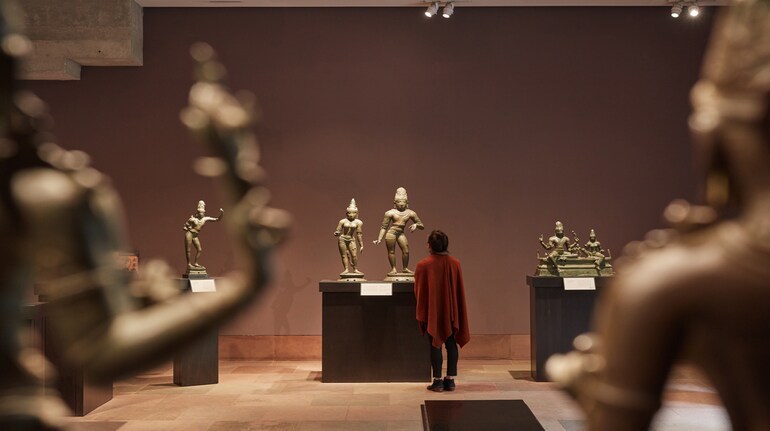

The US will return three ancient bronze sculptures to India that were illegally removed from the country’s temples.
The Smithsonian’s National Museum of Asian Art in Washington DC said Wednesday that three sculptures will be returned to the Government of India, following "rigorous provenance research” that documented the sculptures had been removed illegally from temple settings. A statement issued by the museum said that the Indian government has agreed to place one of the sculptures on long-term loan, an arrangement that will allow the museum to publicly share the full story of the object’s origins, removal and return, and to underscore the museum’s commitment to provenance research.
The sculptures are ‘Shiva Nataraja’ belonging to the Chola period, circa 990; ‘Somaskanda’ of the Chola period, 12th century; and ‘Saint Sundarar with Paravai' of the Vijayanagar period, 16th century.
The sculptures “exemplify the rich artistry of South Indian bronze casting” and were originally sacred objects traditionally carried in temple processions. The ‘Shiva Nataraja’, which is to be placed on long-term loan, will be on view as part of the exhibition ‘The Art of Knowing in South Asia, Southeast Asia, and the Himalayas’, the statement said.
The museum and the Embassy of India are in close contact, finalising arrangements to mark the agreement.
The return was made possible by the National Museum of Asian Art’s dedicated provenance team and curators of South and Southeast Asian Art, with support from the Photo Archives of the French Institute of Pondicherry and numerous organisations and individuals around the world, it said.
As part of a systematic review of its South Asian collections, the National Museum of Asian Art undertook a detailed investigation into the provenance of the three sculptures, scrutinising each work’s transaction history.
In 2023, in collaboration with the Photo Archives of the French Institute of Pondicherry, museum researchers confirmed that the bronzes had been photographed in temples in Tamil Nadu, India, between 1956 and 1959.
The Archaeological Survey of India subsequently reviewed these findings and affirmed that the sculptures had been removed in violation of Indian laws.
“The National Museum of Asian Art is committed to stewarding cultural heritage responsibly and advancing transparency in our collection,” Chase Robinson, the museum’s director, said.
“Because we aim to understand the objects in our collection in their full complexity, we carry out a robust programme of research that seeks to trace not just how they came to the museum, but the history of their origins and movements across time,” Robinson said.
The return of these sculptures, the result of rigorous research, “shows our commitment to ethical museum practice,” Robinson said, voicing appreciation to the Indian government for enabling the museum to continue exhibiting the “long-admired Shiva Nataraja for the benefit of our visitors.” The ‘Shiva Nataraja’ belonged to the Sri Bhava Aushadesvara Temple in Tirutturaippundi Taluk, Tanjavur District, Tamil Nadu, where it was photographed in 1957.
The bronze sculpture was later acquired by the National Museum of Asian Art from Doris Wiener Gallery in New York in 2002. In addition to photographic evidence confirming the sculpture’s presence in the temple in 1957, a provenance researcher at the museum determined that the Doris Wiener Gallery had provided falsified documentation to facilitate the sale to the museum.
The ‘Somaskanda’ and ‘Saint Sundarar with Paravai' entered the collection of the National Museum of Asian Art as part of a gift of 1,000 objects in 1987.
Research led by the museum’s team at the Photo Archives of the French Institute of Pondicherry confirmed that the ‘Somaskanda’ was photographed at the Visvanatha Temple in Alattur village, Mannarkudi taluk, Tamil Nadu in 1959, and the ‘Saint Sundarar with Paravai' at the Shiva Temple in Veerasolapuram village, Kallakuruchchi Taluk, Tamil Nadu in 1956.
The Smithsonian’s National Museum of Asian Art opened in 1923 as America’s first national art museum and the first Asian art museum in the United States.
It now stewards one of the world’s most important collections of Asian art, with works dating from antiquity to the present from China, Japan, Korea, South Asia, Southeast Asia, the pre-Islamic Near East and the Islamic world (inclusive of Central Asia, the Middle East and North Africa).
Discover the latest Business News, Sensex, and Nifty updates. Obtain Personal Finance insights, tax queries, and expert opinions on Moneycontrol or download the Moneycontrol App to stay updated!
Find the best of Al News in one place, specially curated for you every weekend.
Stay on top of the latest tech trends and biggest startup news.





