






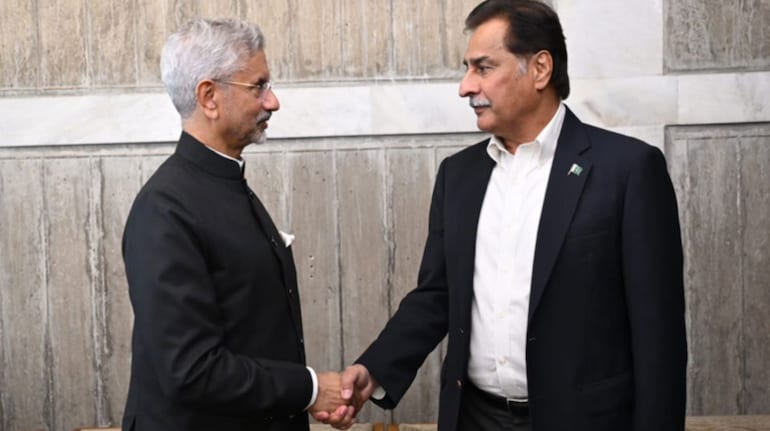

It was a brief and curt handshake between the representatives of India and Pakistan attending the funeral of Bangladesh's former Prime Minister Khaleda Zia. Yet, the Pakistani side tried to make a diplomatic spectacle out of a routine gesture.
On Wednesday, external affairs minister S Jaishankar met Pakistan National Assembly Speaker Ayaz Sadiq in Dhaka ahead of Zia's funeral. Government sources in India called the brief exchange customary, saying that there was nothing to read into it since it does not amount to any bilateral engagement between India and Pakistan.
However, media and commentators in the neighbouring country described the exchange as a diplomatic opening and added their own spin to the handshake.
A press release issued by Pakistan’s National Assembly Secretariat claimed the handshake occurred when Jaishankar approached Sadiq at the event and recognised him. “Indian External Minister Dr S Jaishankar approached the Speaker [of the] National Assembly and shaked hands,” the press release read.
During Speaker NA Sardar Ayaz Sadiq's visit to the Parliament of Bangladesh to inscribe remarks in the condolence book placed for the Late Begum Khaleda ZIa, in the presence of foreign ministers and delegates of different countries, the Indian External Minister Dr. S. Jaishankar… pic.twitter.com/kBi6vnOIIC— National Assembly 🇵🇰 (@NAofPakistan) December 31, 2025
In the same statement, the NA Secretariat sought to frame the moment as a sign of Islamabad’s purported openness to engagement, saying Pakistan has “consistently emphasised dialogue, restraint and cooperative measures, including proposals for peace talks and joint investigations ... to prevent unprovoked aggression and escalation.”
However, sources in India clarified that the exchange was protocol-driven and such brief interactions are customary at multilateral events like state funerals and do not reflect any diplomatic outreach or dialogue.
“This was not part of any bilateral engagement. There was no formal meeting, discussion or agenda scheduled or held between the two sides," sources told CNN-News18.
The amplification of the routine gesture in Islamabad comes at a time when India-Pakistan relations remain severely strained in the months following Operation Sindoor.
Following the Pahalgam attack, India scaled down diplomatic engagement and initiated a series of calibrated policy measures, reiterating its long-standing position that dialogue cannot coexist with terrorism. PM Modi said repeatedly that "blood and water" cannot flow together after the suspension of the Indus Waters Treaty (IWT), the 1960 World Bank-brokered agreement.
The move triggered panic in Pakistan, with Islamabad seeking resumption of dialogue with India even as New Delhi maintains that it needs to first clamp down on terror groups operating on its soil.
India also restricted cross-border transit and other bilateral engagements, repeatedly stressing that any engagement requires demonstrable action against terrorism and accountability for attacks targeting civilians.
On May 7, 2025, India launched Operation Sindoor against terror camps in Pakistan and Pakistan-occupied Jammu and Kashmir in response to the Pahalgam attack.
The Indian forces carried out precision strikes against terror camps operated by Jaish-e-Mohammed and Lashkar-e-Taiba in Pakistan and Pakistan-occupied Jammu and Kashmir (PoK). India subsequently repelled Pakistani escalation and targeted its airbases.
India has maintained that any engagement with Pakistan must be rooted in mutual respect, verifiable security assurances and a terrorism-free environment, while firmly safeguarding its national interests.
Discover the latest Business News, Sensex, and Nifty updates. Obtain Personal Finance insights, tax queries, and expert opinions on Moneycontrol or download the Moneycontrol App to stay updated!
Find the best of Al News in one place, specially curated for you every weekend.
Stay on top of the latest tech trends and biggest startup news.





