






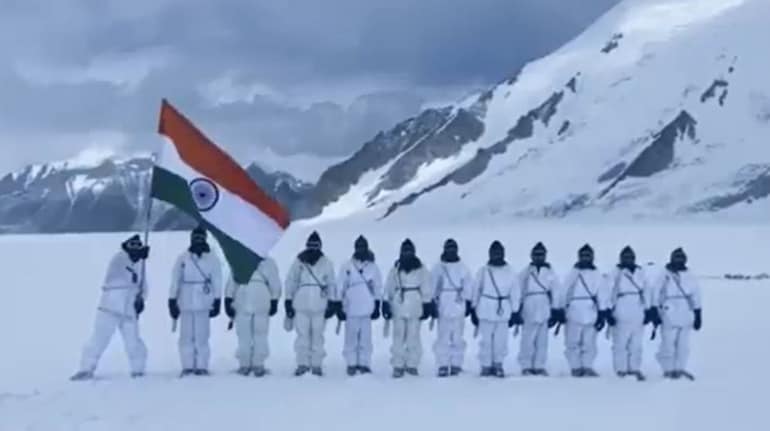

In the early 1980s, the Siachen Glacier was not yet the shorthand it later became for endurance, frostbite, and silent fatalities. It was a blank, inhospitable expanse at the top end of the Kashmir dispute, where maps ran out at a single point and arguments began. The ceasefire line drawn after the first India Pakistan war stopped at NJ 9842, and what lay beyond was left to interpretation. Over time, that cartographic vagueness turned into strategic temptation, and then into a race. In April 1984, India chose to move first.
Operation Meghdoot, launched on 13 April 1984, was a secretly planned, pre-emptive operation in which the Indian Army, with decisive support from the Indian Air Force, occupied key passes and heights on and around the Siachen Glacier, particularly along the Saltoro Ridge. It was timed to deny Pakistan the advantage of getting there first and to lock in the vertical geography that decides outcomes in high-altitude conflict. Forty years on, the operation remains a watershed not just for the India Pakistan rivalry, but for how modern armies think about sustaining combat power where survival itself is a daily tactical problem.
The map that ended at NJ 9842
To understand why Meghdoot happened, you have to begin with a line that did not. The Karachi Agreement of 1949 demarcated the ceasefire line only up to NJ 9842, after which the phraseology and map depiction created room for competing readings about where the boundary should run. In the decades that followed, both sides sought to reinforce their claims through patrols, permissions for mountaineering activity, and what Indian accounts have described as a steady campaign of “cartographic aggression”. Over time, the argument shifted from paper to presence, because in this terrain, physical occupation becomes the most persuasive form of law.
Signals that a race was underway
By the late 1970s and early 1980s, Indian military-linked mountaineering and reconnaissance activity began to build a picture of the region that had long been missing from official maps and common knowledge. One name that recurs in multiple accounts is Col Narendra “Bull” Kumar, associated with reconnaissance and the broader push to understand routes, passes, and the feasibility of deployment in glaciated terrain. Over time, India also mounted long-range patrols that could extend for months, an approach that was as much about intelligence and signalling as it was about geography.
On the Pakistani side, Indian sources and later commentary describe preparations that suggested an intention to occupy key features first. The basic logic was straightforward: whoever controlled the Saltoro heights would dominate approaches to the glacier, watch movement, and impose costs on any challenger operating below. As the Indian Express recounts in its 40-year retrospective, Meghdoot was planned as a surprise, “lightning strike” designed to catch Pakistan off guard and secure the commanding ground for the long haul.
Why the Saltoro ridge mattered more than the glacier
Siachen is often spoken of as a glacier, but in military terms the decisive terrain is the ridge line and passes that overlook it. Control is vertical. If you hold the heights, you control observation, fields of fire, and the ability to interdict movement. The operation’s immediate aim was to secure the critical passes and heights that would deny an adversary the ability to establish itself on the ridge line first.
In the accounts available from Indian official and semi-official sources, the key passes repeatedly highlighted are Sia La, Bilafond La, and Gyong La. Securing these meant that India did not merely step onto the glacier; it anchored itself on the dominant features around it. The USI paper marking 40 years of Meghdoot underlines that the operation was conceived as a pre-emptive counter-operation and that holding the heights would make dislodgement extraordinarily difficult once troops were acclimatised and supplied.
The planning logic of a pre-emptive strike
Meghdoot was not a single climb, but a coordinated act of timing, secrecy, and logistics. It relied on getting trained troops onto the right features before the other side could contest them, and then sustaining them long enough that the position became permanent.
Indian accounts identify senior commanders associated with the operation’s leadership and sector-level execution, and they also stress the degree of secrecy involved. The Indian Express “Explained” piece frames it as a carefully planned operation that achieved surprise and created a new status quo on the glacier. A USI publication describing the operation as a “saga” emphasises that it was mounted under senior leadership and aimed to pre-empt the seizure of key passes.
The Indian Air Force and the problem of access
If the Army was the fist, the Indian Air Force was the bloodstream. The decisive constraint in Siachen has always been access. Roads are few, gradients are unforgiving, and weather can shut down movement for days. The logistical challenge is not simply transporting men and materiel upward, but doing so repeatedly and reliably enough to keep posts alive.
The Press Information Bureau’s note on “IAF in Operation Meghdoot” describes how the operation involved airlifting soldiers and placing them onto glacial peaks, and also points out that IAF helicopters had been operating in the Siachen region since 1978, with an early helicopter landing on the glacier in October that year. In other words, Meghdoot’s success rested on earlier learning about how to fly, land, evacuate, and supply at altitude, long before the operation’s formal launch date.
This is where glacier warfare rewrote familiar rules. Traditional planning assumptions about supply lines, reinforcement timelines, casualty evacuation, and even the shelf-life of equipment are different when temperatures plunge, engines struggle, and basic items can freeze and fail. Over time, that air bridge became the enabling factor that allowed posts to be sustained across a vast, hostile expanse.
13 April 1984 and the creation of a new reality
On 13 April 1984, Indian troops moved to occupy the dominating heights. Retellings differ in their granular detail, but they converge on the central point: India moved before Pakistan could execute its own plan to occupy key features. Times of India reporting around the 40th anniversary describes Indian troops occupying heights from roughly 15,000 to 22,000 feet in
April 1984 to pre-empt a similar attempt by Pakistan. The Indian Express piece marks 13 April as the moment the Army mounted the operation and “took control of the Siachen Glacier”.
The outcome was not a dramatic, decisive battle in the conventional sense. It was something more enduring: a positional advantage that, once established, would be punishingly hard to reverse. In mountain warfare, the first principle is that a trained, acclimatised defender on the heights has a built-in advantage over an attacker below. The USI paper makes that point directly, arguing that once the heights are held and supplied, dislodging such positions becomes close to impossible.
The early clashes and the long shadow of permanence
After the initial occupation, the conflict moved into a grim pattern of counter-moves, attempts to outflank posts, and periodic assaults, all under conditions that made the environment a combatant in its own right. The USI account refers to Pakistani firing and early attacks later in 1984 and describes the operational reality that followed: a contested, militarised ridge line where tiny features could have outsized significance because they dominated routes and posts in the ice valleys below.
Over time, this standoff produced a new line on the map, the Actual Ground Position Line, which tracks the reality of where troops are physically deployed. That line is not merely descriptive. It is the military fact that makes diplomatic disengagement difficult, because vacating high ground without ironclad verification risks allowing the other side to take it, and retaking it would be vastly costlier than holding it.
What “glacier warfare” really meant
Meghdoot’s deeper legacy is that it institutionalised a form of warfare where logistics and physiology can outweigh firepower. At these altitudes, casualties are often driven less by bullets and more by avalanches, exposure, altitude sickness, and the slow deterioration of the body. Times of India has reported that most deaths on Siachen have not been due to combat but to natural hazards, underscoring that the battlefield punishes in ways that standard war reporting often misses.
Even individual tragedies illustrate the scale of that danger. A Times of India report on a soldier recovered decades later notes that in May 1984, an avalanche killed multiple soldiers during operations linked to Meghdoot, a reminder that the earliest months themselves carried lethal costs unrelated to enemy action.
This is also why Siachen became a laboratory of adaptation. Over decades, the armed forces built specialised clothing, improved habitat, refined acclimatisation protocols, upgraded communications, and learnt how to sustain men and machines in oxygen-starved conditions. Official and semi-official narratives marking four decades of presence describe this as a story of logistical improvement and technological adaptation that changed what was thought possible in such terrain.
The strategic meaning of holding the heights
Why did India choose to bear the cost? Because Siachen sits at the junction of critical geographies. Holding the Saltoro ridge blocks adversarial movement across the approaches and shapes the wider security picture in northern Ladakh. It also affects how the India Pakistan and India China theatres are visualised, because the region is adjacent to areas tied to the larger
Karakoram geography and historic transfers of territory. The dominant military logic has been that giving up the heights would mean giving up a hard-won advantage that could not be cheaply regained.
At the political level, this logic has repeatedly surfaced when demilitarisation has been discussed. Past reporting in Times of India has described the state’s reluctance to concede the tactical advantage of the Saltoro heights without strong guarantees. That recurring debate shows how Meghdoot is not just an operation frozen in 1984, but a continuing strategic posture with diplomatic implications.
A decision that changed military thinking
Operation Meghdoot did more than occupy a ridge. It normalised the idea that a state could commit to year-round deployment in terrain once considered nearly uninhabitable for sustained military presence. It forced the Indian military system to evolve in three directions at once: high-altitude tactics, high-altitude logistics, and high-altitude medicine and human performance. It also demonstrated a timeless mountain warfare lesson: in extreme terrain, initiative and speed are not optional virtues, they are the difference between possession and permanent disadvantage.
The Indian Express portrayal of the operation as a surprise seizure of key ground, and the IAF’s institutional account of airlift-enabled occupation, together point to why Meghdoot rewrote the rules. It was an operation where a few days, even a few hours, could decide decades.
Coda: a victory measured in altitude, not headlines
Meghdoot is often narrated as a tale of grit, and it is that. But it is also a story about how states convert ambiguity into advantage, how militaries use logistics as strategy, and how the map can be changed without a treaty if you can hold the heights long enough.
Four decades later, the Indian flag on the Saltoro ridge is not merely a symbol. It is the visible marker of a decision taken in April 1984, when India climbed first, dug in, and made the world’s highest battlefield a permanent feature of South Asia’s security landscape.
Discover the latest Business News, Sensex, and Nifty updates. Obtain Personal Finance insights, tax queries, and expert opinions on Moneycontrol or download the Moneycontrol App to stay updated!
Find the best of Al News in one place, specially curated for you every weekend.
Stay on top of the latest tech trends and biggest startup news.





