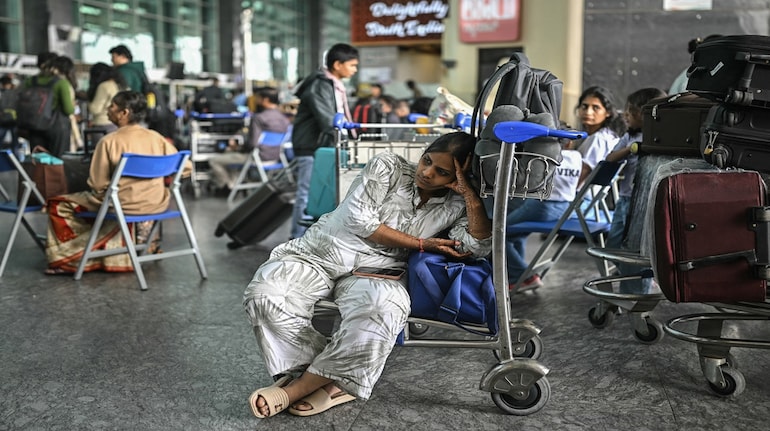
IndiGo’s operational chaos continued into its sixth day on Sunday, leaving thousands of passengers stranded across India despite the airline’s assurances that 95 percent of its network connectivity has been restored. Over 100 flights from Hyderabad alone were cancelled early Sunday morning, while major hubs including Mumbai, Delhi, Kolkata, and Ahmedabad also reported significant disruptions.
Scheduled to fly on IndiGo? Track live updates here.
The crisis, triggered by inadequate preparation for new flight duty regulations and acute pilot shortages, has drawn regulatory scrutiny, government intervention, and political criticism.
A quick look at the top developments so far:
DGCA's action against IndiGo leadership: The Directorate General of Civil Aviation (DGCA) on Saturday issued show-cause notices to IndiGo CEO Pieter Elbers and COO Isidro Porqueras, demanding explanations within 24 hours for the airline’s large-scale operational failures.
The regulator cited “significant lapses in planning, oversight, and resource management” as the primary causes of the ongoing disruption.
Flight Duty Time Limitations (FDTL) implementation at the core: DGCA officials have attributed the crisis largely to IndiGo’s failure to adequately prepare for the newly approved Flight Duty Time Limitations (FDTL), which regulate pilot duty hours and rest periods.
The airline’s inability to adjust crew rosters and resources in line with the new norms, coupled with existing pilot shortages, triggered cascading delays and cancellations.
Over the past week, IndiGo’s punctuality plummeted, with Mumbai and Delhi witnessing 109 and 86 flight cancellations, respectively.
Network reboot and partial recovery: In response to the disruption, IndiGo deliberately reduced operations on December 5, flying just over 700 services across 113 destinations as part of a large-scale system reset. The airline described the move as essential to stabilise schedules, recalibrate crew and aircraft deployment, and prepare for a stronger network rollout.
On December 7, IndiGo announced on social media that it plans to operate more than 1,500 flights, covering 135 of its 138 destinations, and confirmed “early signs of improvement” in operational stability.
Centre's action | Refunds, support cells, and baggage delivery: The Ministry of Civil Aviation (MoCA) has directed IndiGo to clear all pending passenger refunds by 8 pm on December 7 and mandated a full waiver of rescheduling or cancellation charges for affected travellers between December 5-15.
The airline must also establish dedicated passenger support and refund facilitation cells and ensure that misplaced baggage is traced and delivered within 48 hours. The Centre emphasised that any delay or non-compliance would invite regulatory action.
Centre forms review team: Union Minister of State for Civil Aviation, Murlidhar Mohol, also announced the formation of a four-member DGCA committee to review systemic issues, including crew planning, operational preparedness, and compliance with revised FDTL norms, to prevent future disruptions.
Railways launches emergency support for stranded passengers: To mitigate passenger distress, Indian Railways announced 89 special trains across all zones over the next three days, making over 100 trips in major cities including Delhi, Mumbai, Chennai, Bengaluru, Patna, and Howrah. The trains are aimed at helping thousands of travellers stranded due to flight cancellations, particularly those impacted by last-minute schedule changes.
Passenger experience | Delays, stranded travellers, and frustration: Reports from airports highlight widespread frustration among passengers. Long queues, lack of timely information, unavailability of food and water, and delayed baggage added to the chaos. IndiGo staff themselves struggled to manage passenger expectations, as confusion spread across terminals.
Political backlash over 'monopoly and duopoly' in aviation: The IndiGo crisis has drawn sharp criticism from opposition leaders, who attribute the chaos to a monopolistic or duopolistic structure in the aviation sector.
Congress MP Shashikant Senthil questioned why DGCA and the Ministry of Civil Aviation failed to ensure airline preparedness despite having over two years to enforce FDTL guidelines. Veteran Congress leader P. Chidambaram and Lok Sabha leader Rahul Gandhi also highlighted the risks of a two-player market, warning of “baneful consequences” for travellers.
Other leaders, including Karnataka Deputy CM DK Shivakumar, CPI General Secretary D Raja, Shiv Sena MP Priyanka Chaturvedi, and NCP MP Supriya Sule, echoed concerns, describing the situation as the worst aviation meltdown in India’s history and urging government accountability.
Discover the latest Business News, Sensex, and Nifty updates. Obtain Personal Finance insights, tax queries, and expert opinions on Moneycontrol or download the Moneycontrol App to stay updated!
Find the best of Al News in one place, specially curated for you every weekend.
Stay on top of the latest tech trends and biggest startup news.