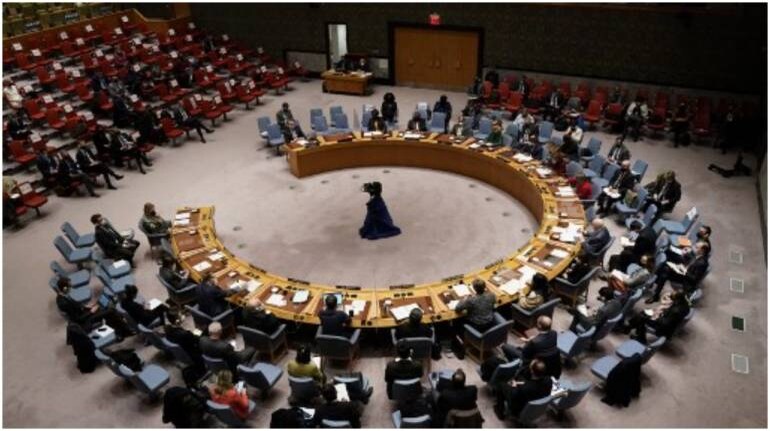
India and four other countries, whose two-year tenure on the Security Council ended in December, have outlined challenges faced in conducting the Council's work amid restrictions imposed by the COVID-19 pandemic during their term and made recommendations to improve the working methods of the UN organ if faced with similar difficulties in the future.
India, Ireland, Kenya, Mexico and Norway completed their 2021-2022 tenure as elected members of the 15-nation Security Council on December 31.
The UN and its bodies, including the Council, had to implement alternate working arrangements during the two years, necessitated by the pandemic and restrictions imposed in its wake across New York, the host city of the UN Headquarters.
The Permanent Representatives of the five UN member states have jointly written a note in their personal capacities based on their experience as elected members of the Security Council in 2021 and 2022, when the 'Council was still operating under modified procedures, and, for part of that time, unable to conduct its work in person owing to the COVID-19 pandemic.'
The envoys outlined difficulties they faced while carrying out the work of the Council during the past two years and made recommendations, expressing hope that the note will "serve as a reference on some of the lived challenges and limitations of the period and inspire changes should there be a future disruption of the Council's ability to hold in-person meetings."
The note has been jointly written by the Permanent Representative of India to the United Nations Ambassador Ruchira Kamboj, Permanent Representative of Ireland Fergal Mythen, Kenya's UN envoy Martin Kimani, Mexico's Ambassador Juan Ramón de la Fuente and Norwegian envoy Mona Juul.
They noted that while the Security Council was able to quickly adapt and find new ways of working to continue to fulfil its mandate, some of the 'most problematic challenges' stemmed from the lack of agreement among Security Council members to consider virtual meetings as formal meetings of the Council.
Due to COVID-19-related restrictions, meetings of the Council were held virtually.
The envoys highlighted that there was no agreement to consider the discussions of the Council held on the virtual platform as 'formal meetings', and the videoconferences of the Council were agreed to be conducted only 'in the spirit' of the provisional rules of procedure of the Council.
"The procedural decisions to be taken by the Council, therefore, became subject to whatever agreement could be reached for each monthly presidency, with the provisional rules of procedure serving only as guidelines," they said in the note on the working methods of the Security Council during the pandemic, issued this week.
Further, without meeting in person, it was necessary, for the continuation of the work of the Security Council, to agree on an alternative procedure for adopting resolutions.
The procedure agreed was outlined in a letter dated March 2020 from the President of the Council during the presidency of China, allowing for the written submission of votes during a 24-hour period.
"This process proved lengthy and difficult to implement, both for successive presidencies and the Secretariat," they said.
During the virtual equivalent of open debates, the broader UN membership could not participate in the same manner as Security Council members owing to technical limitations of the videoconferencing system used.
This, the envoys said, ran counter to the established practice under rule 37 of the provisional rules of procedure, which allows any Member of the United Nations who is not a Security Council member to be invited to participate in the Council's discussion.
The envoys said the broader membership could only submit their statements in writing to form part of a compilation of statements issued as a letter from the President of the Council.
"As members who experienced working in the Security Council during this time and felt the direct impact of these chosen working methods, we would highly recommend that, if faced with a similar situation, consideration be given to rethinking the previously agreed working methods to learn from the challenges that the Council faced during this time," the envoys said.
In a series of recommendations for future consideration in the event it again becomes impossible to hold physical meetings in the UN, the envoys said the Security Council should agree on parameters for virtual meetings to be considered as formal meetings of the Council.
Further, technological solutions must be found to allow for the full participation of the broader membership as closely aligned as possible to the usual application of rule 37.
Methods for voting in real-time should be reconsidered, including voting by show of hands during virtual meetings.
Discover the latest Business News, Sensex, and Nifty updates. Obtain Personal Finance insights, tax queries, and expert opinions on Moneycontrol or download the Moneycontrol App to stay updated!
Find the best of Al News in one place, specially curated for you every weekend.
Stay on top of the latest tech trends and biggest startup news.