






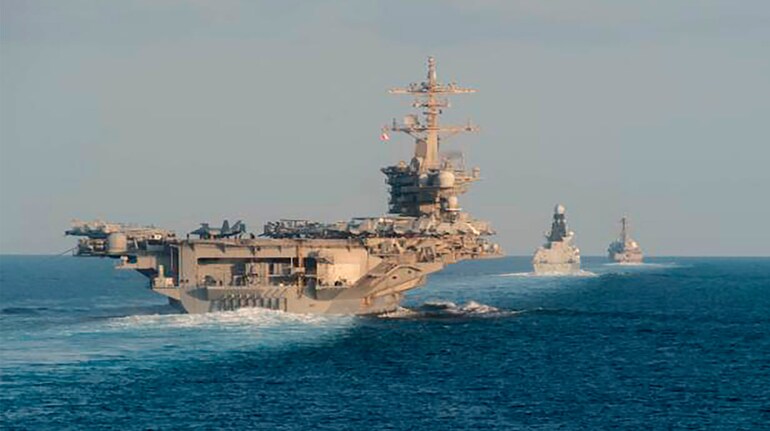

A crisis in the global maritime insurance market has effectively halted tanker traffic through the Strait of Hormuz, one of the world’s most critical energy chokepoints.
According to NDTV, within hours of the launch of Operation Epic Fury on February 28, war-risk underwriters began cancelling insurance policies for ships transiting the strait.
On March 1, seven members of the International Group of Protection and Indemnity (P&I) Clubs issued 72-hour cancellation notices. Within days, all twelve clubs in the group followed suit.
The International Group insures around 90% of the world’s ocean-going fleet, covering liabilities such as cargo damage, crew injury and environmental pollution. Without such cover, ships cannot dock at most ports, secure financing, or obtain cargo contracts.
By March 3, maritime tracking platforms showed no active tanker transits inside the Strait of Hormuz. The shutdown did not occur because of naval blockades or mines, but because insurers withdrew cover.
Strait of Hormuz and global trade
The strait lies between Oman and Iran and links the Gulf north of it with the Gulf of Oman to the south and the Arabian Sea beyond. It is 21 miles (33 km) wide at its narrowest point, with the shipping lane just 2 miles (3 km) wide in either direction.
About a fifth of the world's total oil consumption passes through the strait. According to analytics firm Vortexa, over 20 million barrels of crude, condensate and fuels passed through the strait daily last year on average.
Various reports suggest that about 50–55% of India's crude oil and LNG imports transit through the Strait of Hormuz.
According to the NDTV report, war-risk insurance premiums surged rapidly after the first strikes. Rates that previously stood at around 0.25% of a ship’s hull value, roughly $250,000 per voyage, rose to about 1% within 48 hours, or nearly $1 million per transit. For tankers linked to the United States or Israel, insurers reportedly refused coverage entirely.
Energy markets reacted quickly. LNG production at Qatar’s Ras Laffan and Mesaieed facilities was halted after Iranian strikes. European benchmark gas prices jumped nearly 50%, while Asian spot LNG prices rose 39%.
At the same time, around 150 vessels were reported waiting offshore near Iraq, Saudi Arabia and Qatar as shipping companies delayed voyages amid the uncertainty.
Power of insurance system
The disruption highlighted the influence of the International Group of P&I Clubs. It is a tightly coordinated network of twelve mutual insurers headquartered largely in London. These clubs pool liabilities above $10 million and rely on a global reinsurance system.
However, the reinsurance layer — worth roughly $41 billion — generally excludes war risks. When insurers began withdrawing coverage amid escalating hostilities, there was no financial backstop to sustain the market.
European regulations such as Solvency II also incentivise insurers to cut exposure during geopolitical crises, as rising uncertainty requires firms to hold larger capital reserves.
As one of the clubs, Skuld, noted in its notice to clients, reinsurers’ appetite for war-risk exposure had tightened sharply, leading to a rapid withdrawal of capacity.
The strait effectively shut down not through military action but through financial risk calculations.
Lessons from history
The situation contrasts with the 1980s “Tanker War” during the Iran-Iraq conflict. Roughly 500 merchant ships were attacked in the Persian Gulf. However, shipping continued because war-risk insurance remained available.
In the current crisis, insurers withdrew entirely, demonstrating how financial systems can exert strategic control over global trade routes.
Labour rules add pressure
Shipping companies also faced labour constraints. According to the NDTV opinion piece, the International Transport Workers’ Federation and the Joint Negotiating Group designated the Arabian Gulf, Gulf of Oman and the Strait of Hormuz as a high-risk warlike operations area.
Under these rules, seafarers are entitled to additional wages for every day spent in the zone, double compensation in case of injury or death, and the legal right to refuse sailing into the area.
A strategic tool
The crisis has also drawn attention to the growing use of financial systems as strategic instruments.
US President Donald Trump announced on March 4 that the United States International Development Finance Corporation would backstop political risk insurance for maritime trade passing through the Gulf, while also offering US Navy escorts.
The move underscored how insurance coverage can shape the movement of global commerce as much as naval power.
Why India is watching closely
India is the world’s third-largest importer of crude oil, and much of its energy supply passes through the Strait of Hormuz. Yet the country does not host a single member of the International Group of P&I Clubs.
Following sanctions on Russian oil after 2022, Indian officials had already warned that reliance on foreign insurance systems could leave the country exposed to geopolitical pressure.
Impact on India
With a coastline stretching over 7,500 kilometres and a large merchant fleet, India remains heavily dependent on insurance networks headquartered abroad.
The latest Hormuz disruption suggests that control over maritime trade may increasingly lie not only with naval forces, but also with the financial institutions that insure global shipping.
As global tensions rise, policymakers in New Delhi may face a growing question: whether a major trading power can afford to have its maritime lifeline governed by institutions it does not control, stated the NDTV report.
Discover the latest Business News, Sensex, and Nifty updates. Obtain Personal Finance insights, tax queries, and expert opinions on Moneycontrol or download the Moneycontrol App to stay updated!
Find the best of Al News in one place, specially curated for you every weekend.
Stay on top of the latest tech trends and biggest startup news.





