






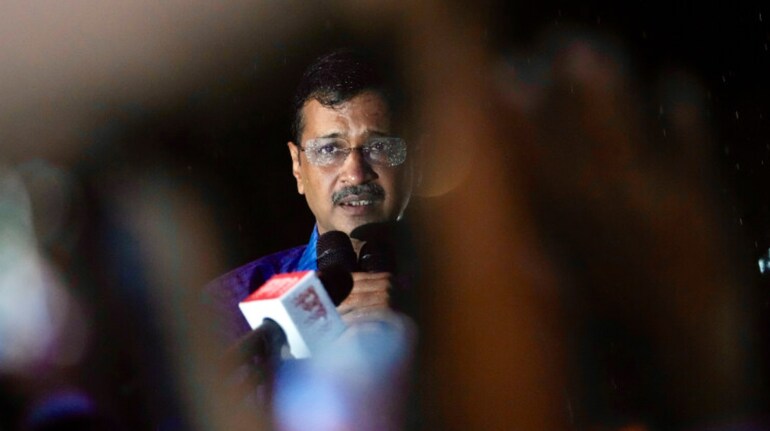

As Delhi's Rouse Avenue Court on Friday acquitted former Delhi chief minister Arvind Kejriwal, Manish Sisodia and several others of all charges related to liquor policy case by refusing to take cognisance of the Central Bureau of Investigation (CBI) charge sheet, a pertinent question doing the rounds now is what happens to the case -- being parallelly pursued by the Enforcement Directorate (ED) against Kejriwal.
The Delhi court did not explicitly mention anything about the ongoing ED case while dismissing the corruption charges in the CBI case. However, the verdict is likely to significantly weaken the ED case as it is tied to the main excise policy case dismissed by the court.
The Enforcement Directorate is pursuing a separate case under the Prevention of Money Laundering Act, probing alleged hawala transfers and shell companies linked to the main case. Kejriwal was arrested by the ED in March 2024 and later by the CBI, before the Supreme Court granted bail in both cases. He spent over five months in jail.
The ED arrested Kejriwal in March on money laundering charges. This was the only charge against Kejriwal — the generation of alleged tainted funds and its use. Section 3 of the Prevention of Money Laundering Act (PMLA), which criminalises money laundering, lists concealment, possession, acquisition, use, projecting as untainted property, or claiming as untainted property as crimes.
Careful reading of Friday's verdict
A careful reading of Friday's verdict reveals that the court's principal emphasis was on the case pursued by the CBI. Special Judge Jitendra Singh declined to frame charges against any of the 23 accused, finding no prima facie material to establish criminal conspiracy or criminal intent in the now-scrapped policy. The ruling marked a major setback for the CBI, which had filed its first chargesheet in 2022, followed by supplementary filings, alleging that Rs 100 crore was paid by a “south lobby” to influence the policy.
Court’s observations on CBI probe
While pronouncing the order, Judge Singh reportedly observed that the investigation appeared to be built more on conjecture and narrative than on concrete evidence. He raised serious concerns about the reliance on statements of an approver who was previously an accused, cautioning that such dependence could violate constitutional principles.
CBI's brisk reply on the verdict
Moments after the verdict, the CBI said that the agency will submit an appeal to the High Court challenging the order issued by the Rouse Avenue court on Friday, which acquitted former Chief Minister Arvind Kejriwal and former Deputy CM Manish Sisodia, along with others, in connection with the 2022 Delhi excise policy case.
The agency added that several aspects of the investigation were either ignored or not adequately considered in the trial court’s judgment. The CBI had registered an FIR on August 17, 2022, against the then Deputy Chief Minister Manish Sisodia, excise officials, and liquor businessmen based on a complaint from the Union Ministry of Home Affairs.
Discover the latest Business News, Sensex, and Nifty updates. Obtain Personal Finance insights, tax queries, and expert opinions on Moneycontrol or download the Moneycontrol App to stay updated!
Find the best of Al News in one place, specially curated for you every weekend.
Stay on top of the latest tech trends and biggest startup news.





