




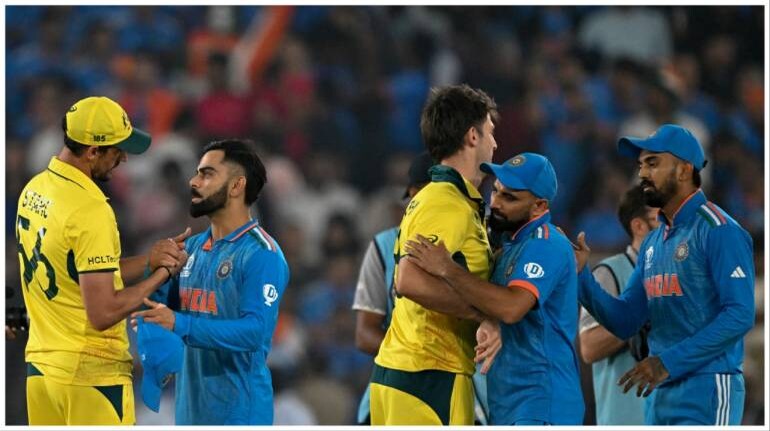
In the theatre of an ICC Cricket World Cup, where triumph and heartbreak share the same stage, Team India's unbeaten run until the grand finale was nothing short of a captivating drama.
On the back of 10 thumping wins back-to-back, Rohit Sharma and Co stepped onto the grandest stage of the mega finale at the Narendra Modi stadium on Sunday carrying the hopes and aspirations of 1.4 billion Indians. Against what looked like a not-so-settled Australian side, the ’Men in Blue’ seemed as the firm favourites to finally get their hands on the much-eluded ICC Trophy following a decade-long wait.
However, destiny had other plans.
What unfolded on that fateful day, ever since both Rohit Sharma and Pat Cummins went out to the middle for the toss, left the Indian fans grappling with questions, seeking to unravel the puzzles behind this unexpected setback.
A World Cup final is more than a battleground for supremacy; it is a crucible where skill, strategy, and nerves of steel are tested under the unforgiving gaze of a global audience. But Team India faltered on a majority of these aspects on the most important day of this World Cup. Perhaps, the law of averages caught up to them. And unfortunately, it happened in the final.
Unsuitable pitch
First and foremost, the dry and slow-low Ahmedabad pitch certainly didn’t suit the newly adapted counter-attacking approach of Rohit’s men. Throughout this World Cup the ultra-aggressiveness of this team, especially with bat in hand has been a huge X-factor. However, on Sunday when India batted in the afternoon, runs were utterly difficult to come by once the ball got a little bit older.
Thanks to their skipper’s onslaught in the first powerplay, India scored 80 in the first 10 overs. But in the next 40, they managed to get only 160 more and kept on losing wickets at regular intervals. This drastic change in scoring rate from their previous games of this World Cup shows how much the Indian stroke-players found it difficult to get going on that pitch.
Meanwhile, the hosts expected the surface to keep getting slower and offer more turn, which happened in the Kolkata semi-final. However, under lights, it became much better to bat on, as predicted by Cummins at the toss. And honestly, it has been a pattern of this Ahmedabad pitch throughout this World Cup.
As a result, despite playing some dominating brand of Cricket throughout this championship, India were found to be chasing the eight ball for the major part of the decider in front of a sea of blue. It seemed ever since Cummins won that toss on that sluggish dry surface and opted to chase, nothing went in favour of the home side.
Lacklustre middle order
Questions are also being raised about some of the Indian middle-order batters' lack of intent to get things moving in the middle phase. Especially, someone like KL Rahul could have taken a bit more risks to up the scoring rate. Yes, at one point after a fall of two quick wickets he alongside Virat Kohli was trying to provide some solidity to the middle-order. Although Kohli kept scoring at the strike rate of 80 to 90, Rahul at the other end seemed to get tied down a little. In fact, by the time the Indian keeper-batter reached his half-century off 86 balls, he had just one boundary to his name.
Someone like Suryakumar Yadav too had failed miserably to perform the role of finisher when his team needed the most. India’s No.7 came at the crease in the 36th over and when he got out to Josh Hazlewood, the Indian innings had only 15 deliveries left. In between Suryakumar faced only 28 balls in which he scored just 18. Even while batting with the tail, he was guilty of giving away the strikes to the lower-order batters quite often.
Bowlers failed to capitalise
In the second half, while defending a below-par 240, India had their new ball plans spot-on. They got Mohammed Shami to open the bowling because of his superior numbers against left-hand batters. The move worked as well when Shami got Warner in his first over. At the other end Jasprit Bumrah also got two quick scalps as Australia were wobbling at 47 for 3. However, neither Mohammed Siraj nor the two left-arm spinners, Kuldeep Yadav and Ravindra Jadeja, built on that start.
Under lights the spinners hardly got any alarming purchase from the wicket, which allowed the likes of Travis Head and Marnus Labuschagne to milk them for easy runs without taking any risk whatsoever. Siraj, on the other hand, was flat and his lack of tactical prowess of containing a batter once the ball doesn’t move in limited-overs format was clearly exposed yet again. In the end it turned out to be a pretty easy chase for the Aussies.
As the final chapter of Team India's World Cup campaign closes, the echoes of this defeat linger, leaving us with a profound sense of introspection.
While the puzzles behind this unexpected setback may not have straightforward answers, but as the team is staring at their next voyage for an ICC Trophy in six months’ time (ICC T20 World Cup in the US and the West Indies in June 2024), they need to find a path to redemption.
Discover the latest Business News, Sensex, and Nifty updates. Obtain Personal Finance insights, tax queries, and expert opinions on Moneycontrol or download the Moneycontrol App to stay updated!
Find the best of Al News in one place, specially curated for you every weekend.
Stay on top of the latest tech trends and biggest startup news.