






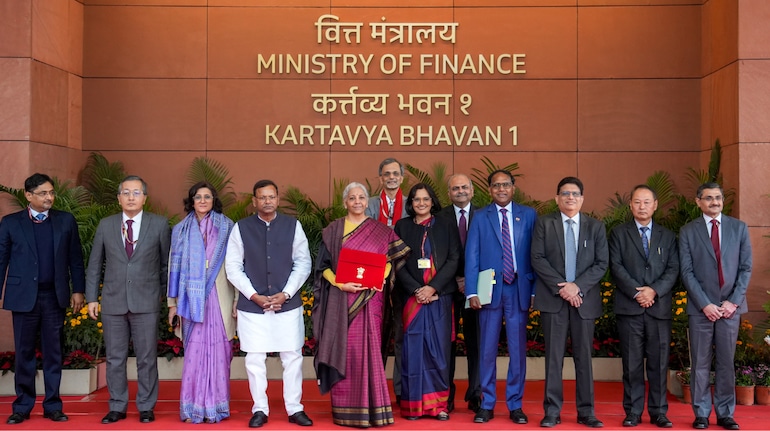

Union Finance Minister Nirmala Sitharaman is set to present the Union Budget for 2026-27 at 11 am today, marking her ninth consecutive budget presentation and the country’s 88th since Independence. During her speech, the Finance Minister will outline proposed spending plans and revenue projections for the next financial year.
The budget is being presented amid a challenging global environment marked by geopolitical tensions, economic volatility and trade war pressures. Several sectors, particularly export-oriented industries, are watching closely for relief measures, as they have faced strain from higher US tariffs imposed last year by the Trump administration.
This year’s budget also assumes significance as it is the third full budget of the Modi 3.0 government, and is being framed against what officials describe as a phase of steady domestic growth alongside persistent global uncertainty.
Economic Survey sets the tone
Ahead of the budget, Sitharaman tabled the Economic Survey 2025-26 in Parliament on January 29. The document offers a detailed assessment of India’s macroeconomic position and outlines the government’s broad roadmap for the coming year.
The survey stated that India’s economy is expected to grow between 6.8% and 7.2% in FY27, reflecting resilience despite headwinds in the global economy. According to the government, the survey provides a comprehensive snapshot of current conditions and serves as the analytical foundation for budgetary decisions.
The survey aims at setting the stage for the budget and showing the government’s roadmap.
Officials behind the numbers
While attention focuses on the Finance Minister’s speech, a small but influential group of senior bureaucrats across departments under the Finance Ministry has been working behind the scenes.
These officials are overseeing different components of the budget, ranging from taxation and expenditure planning to disinvestment strategy and financial sector policy. The exercise is unfolding against what has been described as a backdrop of 7.4 per cent economic growth, global uncertainty, and shifting geopolitical equations.
A small but influential group of officials across departments under the Finance Ministry is steering different components of the Budget, highlighting the collective effort that shapes the final document.
Anuradha Thakur, Economic Affairs Secretary
Heading the Department of Economic Affairs, Anuradha Thakur is widely seen as the central figure in shaping the overall Budget architecture.
Often referred to as the “principal architect of the Budget,” she leads the Budget Division, which drafts the core documents and frames the macroeconomic strategy for FY2026–27.
Thakur took charge of the department on July 1, 2025, making this her first Budget in the top role. She is also the first woman IAS officer to head the Department of Economic Affairs and belongs to the 1994 batch of the Himachal Pradesh cadre.
Her responsibilities include guiding resource allocation, assessing fiscal space, and ensuring that growth priorities align with overall economic stability.
Arvind Shrivastava, Revenue Secretary
The tax proposals that form Part B of the Budget Speech fall under the purview of Revenue Secretary Arvind Shrivastava. He supervises both direct taxes such as income tax and corporate tax, and indirect levies including GST and customs duties.
Budget 2026–27 will be his first as Revenue Secretary. His portfolio is especially significant at a time when there are expectations of rationalisation in customs duties and TDS provisions, along with measures aimed at improving revenue mobilisation.
Earlier in his career, Shrivastava worked in the Budget Division as a Joint Secretary and later served in the Prime Minister’s Office (PMO), where he handled finance-related subjects, giving him a broad view of fiscal policy-making.
Vumlunmang Vualnam, Expenditure Secretary
Known within government circles as the “guardian of the purse,” Vumlunmang Vualnam oversees public spending, subsidy reforms, and the rollout of major central schemes.
His department plays a key role in maintaining fiscal discipline and managing the fiscal deficit.
Vualnam also provides the broad expenditure framework for the upcoming financial year, ensuring that government priorities are reflected in allocations while keeping overall finances on a sustainable path.
M Nagaraju, Financial Services Secretary
M Nagaraju heads the Department of Financial Services, which supervises public sector banks, insurance companies, and pension institutions. His department is deeply involved in pushing financial inclusion, expanding credit, and strengthening social security programmes.
It also contributes to policy measures related to digital finance and the overall stability of the financial system, making Nagaraju’s role crucial in supporting growth through a healthy banking and insurance sector.
Arunish Chawla, Secretary, Department of Investment and Public Asset Management
Disinvestment and privatisation plans are handled by Arunish Chawla, who leads DIPAM. The department is responsible for managing non-tax revenue targets arising from the sale of government stakes in central public sector enterprises.
Chawla’s inputs feed directly into Budget estimates for asset monetisation and help shape the government’s broader public asset management strategy.
K Moses Chalai, Secretary, Department of Public Enterprises
K Moses Chalai oversees the Department of Public Enterprises, which monitors the financial performance of CPSEs and their capital expenditure plans. The department also ensures that budgetary support to state-owned enterprises is used effectively and aligns with national priorities.
V Anantha Nageswaran, Chief Economic Adviser
Beyond departmental inputs, the Office of the Chief Economic Adviser, led by V Anantha Nageswaran, provides the analytical backbone for the Budget.
The CEA’s office assesses global risks, projects economic growth, and evaluates sectoral trends across agriculture, industry, and services.
It also advises the Finance Minister on major reforms, fiscal policy choices, and long-term financial strategy.
Budget 2026 live updates: Reforms, Atmanirbhar push in focus as FM Sitharaman presents her ninth Budget today

Discover the latest Business News, Sensex, and Nifty updates. Obtain Personal Finance insights, tax queries, and expert opinions on Moneycontrol or download the Moneycontrol App to stay updated!
Find the best of Al News in one place, specially curated for you every weekend.
Stay on top of the latest tech trends and biggest startup news.





