






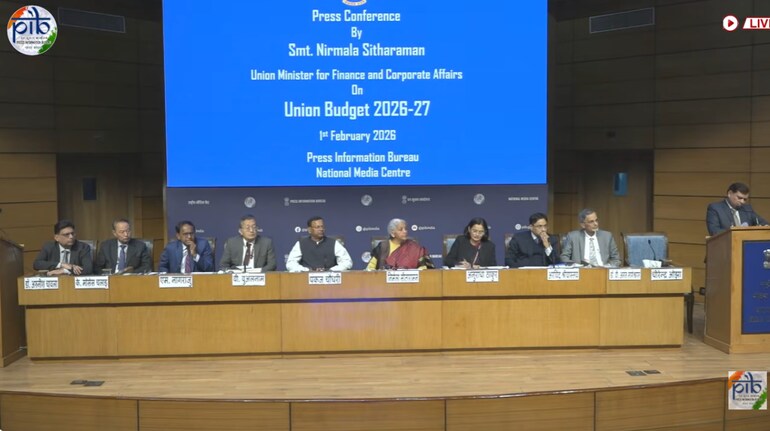

India’s Union Budget 2026-27 has placed public capital expenditure (capex) at the centre of its growth strategy, with Finance Minister Nirmala Sitharaman announcing an allocation of Rs 12.22 lakh crore for FY27 -- about 9-10 per cent higher than the Rs 11.11 lakh crore budgeted for FY26 and equivalent to 4.4 per cent of GDP.
At a post-Budget briefing, she described this as “the highest at least in the last 10 years, it could even be the highest if you were to take data of earlier period”.
The government’s intent is clear: sustain infrastructure momentum and crowd in private investment. But economists see a more nuanced picture -- one that mixes continuity, cautious optimism and some pointed concerns.
The scale and the trajectory
Public capex has risen sharply over the past decade, from Rs 2 lakh crore in FY2014-15 to Rs 11.2 lakh crore in Budget Estimates for FY26, and now Rs 12.2 lakh crore for FY27. As a share of GDP, capex stood at 2.5 per cent in 2021-22 and around 4 per cent in 2024-25, before climbing further this year.
The Budget also reiterates support for infrastructure in Tier-2 and Tier-3 cities, proposes a risk guarantee fund for the infrastructure sector, and introduces a scheme to enhance construction and infrastructure equipment to strengthen domestic manufacturing. The Centre will also provide Rs 1.4 lakh crore to states in FY27 as Finance Commission grants after accepting the 16th Finance Commission’s recommendation to retain the vertical devolution share at 41 per cent.
Continuity with a reform-first approach
Indranil Pan, Chief Economist, YES BANK, said the Budget “almost continues from where she left off in the previous Budget, with the focus being squarely on the continuation of the reform process.” He noted that instead of big-bang announcements, the thrust is on harnessing economic potential and maintaining an inclusive growth structure.
“The capital expenditures have been boosted by INR 1 trn compared to last year's budget, while it targets the spending towards waterways, coastal cargo, high-speed rail corridors, etc.,” Pan said, adding that higher outlays for electronics components manufacturing, rare earth corridors, hi-tech tool rooms, and enhancement of construction equipment reflect attempts at self-reliance. He expects the yield curve in FY27 to remain steep, with 10-year yields anchored around 6.65-6.80 per cent.
Fiscal math: credible, but borrowing looms large
Upasna Bhardwaj, Chief Economist, Kotak Mahindra Bank, pointed out that “the government has continued to focus on fiscal consolidation. The FY27 fiscal deficit at 4.3% and net borrowing is in line with our expectations.” However, she cautioned that “the sharply higher than expected gross borrowing of Rs 17.2tn is expected to weigh heavily on market sentiments. No buybacks or switches have led to the surprise upside to the gross borrowing.”
Sakshi Gupta of HDFC Bank echoes this concern, noting that demand-supply imbalances have already been pressuring bond yields and that 10-year yields could open higher.
Madan Sabnavis, Chief Economist, Bank of Baroda, is more sanguine. He said the Budget “has delivered good fiscal numbers” and that gross and net borrowing programmes have been maintained almost at last year’s level, which should assuage bond markets. He also argued that higher capex “should help to bring in private investment too especially in the infra space.”
From physical assets to productive capacity
Debopam Chaudhuri, Chief Economist, Piramal Finance, interpreted the strategy as a shift in emphasis. “The Union Budget FY27 is an all-round policy document that signals a strategic pivot in public capital expenditure -- from a decade-long focus on building physical infrastructure such as roads, railways, and multimodal connectivity to enabling productive manufacturing and employment generation,” he said. The focus on biopharma, electronics, and textiles is meant to maximise the growth multiplier from the upgraded infrastructure base.
Anitha Rangan of RBL Bank described it as “a realistic budget with focus on fiscal consolidation and stability,” adding that continuity of reforms and steady capex spending point to a growth-oriented but cautious stance.
A sharper critique: demand versus investment
Development economist Jayati Ghosh offered the most critical counterpoint. “Private investment is not picking up because mass consumption demand is low, because wage incomes are low. The government policies are making that worse,” she told Moneycontrol. According to her, the state is “trying to increase its own capex to compensate and somehow deliver growth, instead of focusing on social spending and smaller enterprises, both of which would increase employment and mass demand.” She also cautioned that “we don't know how much capex will actually get delivered ultimately.”
Economists broadly agree that the Rs 12.22 lakh crore capex number underscores policy continuity and faith in public investment as a growth engine. Yet, beneath the “highest-ever” headline lies an ongoing debate: whether infrastructure-led growth alone can revive private investment and jobs, or whether stronger support for consumption, MSMEs, and social spending is equally essential to make that growth durable.
(With inputs from PTI)
Discover the latest Business News, Sensex, and Nifty updates. Obtain Personal Finance insights, tax queries, and expert opinions on Moneycontrol or download the Moneycontrol App to stay updated!
Find the best of Al News in one place, specially curated for you every weekend.
Stay on top of the latest tech trends and biggest startup news.





