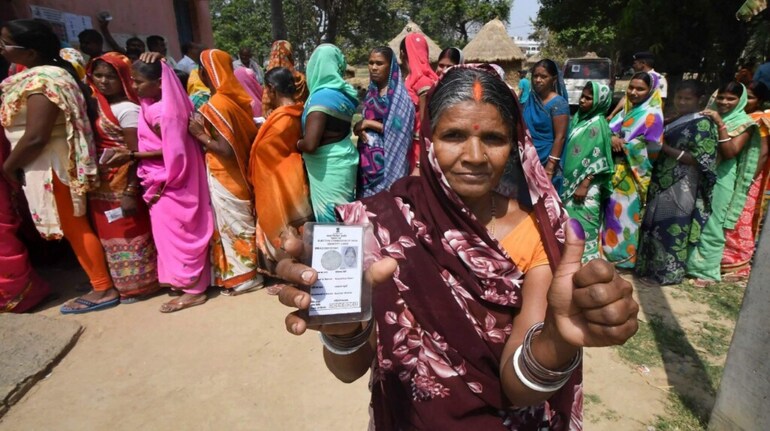
The one unmistakable pattern emerging as counting trends firm up on the Election Commission's dashboard is that the new M-Y axis of Mahila (women) and Yuva (youth) appears to have delivered the Bihar Assembly election to the Nitish Kumar–led NDA, reshaping the state's electoral map and decimating all hopes of a Mahagathbandhan resurgence.
As per the trends and results made available by the EC at the time of filing this report, the NDA was ahead in 204 seats (BJP-91, JDU-83, LJP-21, HAM-5 and RLM-4). The Mahagathbandhan, on the other hand, trailed far behind at 33 seats (RJD-25, Congress-4 and Left-4).
For months, the RJD, the primary constituent of the Opposition alliance had banked on the traditional 'MY' (Muslim–Yadav) consolidation to maintain its heft in the region as well as the national stage. But the 2025 results show that a more decisive demographic comprising women and young voters turned up in unexpectedly high numbers and backed the NDA enough to offset MGB's core vote advantage.
A Turnout Wave
The biggest signal came from the turnout data. Across the 32 Muslim-dominated constituencies analysed by Moneycontrol, voting surged from an average of 60.2% in 2020 to 74.5% in 2025 — an extraordinary 14.2 percentage-point rise.
Yet, despite this heavy mobilisation in areas expected to favour the Mahagathbandhan, the NDA still opened up a clear lead in statewide counting trends. The analysis also showed that the NDA was leading in over 71.9% of the 32 Muslim-dominated seats as compared to 56.3% in the 2020 assembly election.
The explanation also lies in how women and youth voters delivered a counter-wave that neutralised the gains the Mahagathbandhan hoped to extract from minority-heavy constituencies.
NDA's Firewall
Women voters have been central to Nitish Kumar's electoral coalition for nearly two decades. Pre-poll turnout data in Phase 1 and Phase 2 showed a consistent pattern where female turnout either matched or exceeded male turnout in several districts, and surged the most in NDA-leaning EBC and rural belts.
This "silent vote" has long been considered Nitish's invisible strength, driven by welfare schemes targeted at women. Measures such as liquor prohibition, free uniforms and scholarships, and direct benefit transfers into women's accounts appear to have driven women in large numbers to voting centres to caste their vote in Nitish's favour.
Exit Polls, and now the leads on counting day, confirm that Mahila voters once again rallied behind Nitish even more sharply than before, forming the single biggest bulwark against any anti-incumbency.
Youth Vote Consolidation
The Mahagathbandhan had heavily centred its messaging on jobs, unemployment and Tejashwi Yadav's promise of a government job in every household. But ECI turnout sheets and booth-level reports showed two critical patterns.
Youth turnout rose, but it did not cluster behind the MGB as strongly as pre-poll surveys predicted. In fact, in high-youth-density urban and semi-urban seats like Patna, Muzaffarpur, Bhagalpur, and Darbhanga, the NDA either held its ground, or registered substantial leads, especially through BJP candidates.
This suggests a fragmentation in the youth vote, with a portion pulled away by Jan Suraaj, AIMIM, and independents, thus diluting the MGB's anticipated edge.
Collapse of the M-Y Wall
Even in minority-heavy constituencies like Purnia (+21.14 points), Kishanganj (+19.07 points), Balrampur (+18.05 points), Kasba, Kadwa, and Bahadurganj (+14–16 points), where turnout surged dramatically, the Mahagathbandhan did not gain proportionately in the seats tally.
This indicates that minor shifts within the Muslim vote, especially to AIMIM in Seemanchal, and strong consolidation of women and EBC voters behind the NDA, blunted the impact of the MGB's core MY base.
The Mahagathbandhan's strategy rested on four pillars -- Muslim consolidation, Yadav consolidation, anti-incumbency, and youth anger over unemployment. However, the results show that the NDA managed to effectively counter it with a massive women voter firewall, EBC–OBC consolidation, BJP's urban and upper-caste base, JD(U)'s welfare architecture, and the division of votes caused by AIMIM and Jan Suraaj.
The result is that even a strong showing in minority belts could not compensate for the structural advantage Nitish managed to retain across Bihar's gender and caste lines.
Discover the latest Business News, Sensex, and Nifty updates. Obtain Personal Finance insights, tax queries, and expert opinions on Moneycontrol or download the Moneycontrol App to stay updated!





Find the best of Al News in one place, specially curated for you every weekend.
Stay on top of the latest tech trends and biggest startup news.