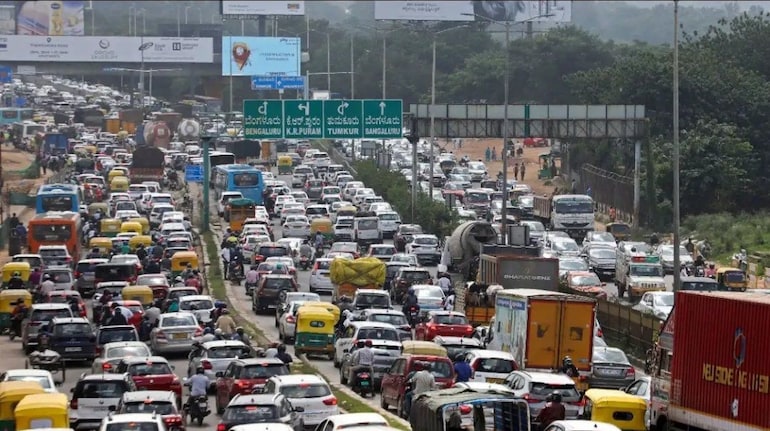

Bengaluru ranked as the second most congested city in the world after Mexico City in 2025, according to the traffic index released by TomTom, a Dutch location technology specialist, on January 21
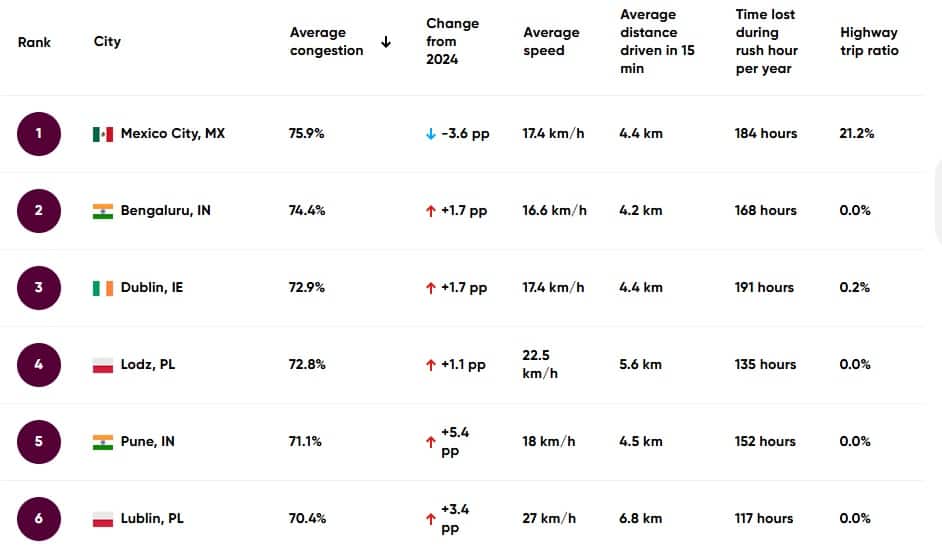
India’s tech capital recorded an average congestion level of 74.4 percent in 2025, marking a 1.7 percentage point rise from 2024. Bengaluru’s average commuting speed stood at 16.6kmph, with commuters covering an average distance of 4.2km per trip. Mexico City topped the list with a 75.9 percent score, despite a 3.6 percentage point decline compared to 2024.
Also, read: Tech hub Bengaluru ranks 6th most congested city globally in 2023: TomTom report
In 2025, Bengaluru experienced significant traffic congestion throughout the year. The average distance covered in 15 minutes was 4.2 km, slightly lower than the previous year. The worst day for travel was May 17, 2025, a Saturday, when congestion spiked to 183 percent at 6pm, with drivers covering just 2.5 km in 15 minutes.
During rush hours, travel times and speeds were heavily impacted. Morning commutes took an average of 41 minutes 6 seconds to cover 10 km, with an average speed of 14.6 kmph and congestion at 94.2 percent. Evening rush hours were slower, with the same 10 km taking 45 minutes 27 seconds at 13.2 kmph and 115.2 percent congestion. Overall, Bengaluru commuters lost 168 hours- equivalent to over 7 days 40 minutes-to traffic delays in 2025, 12 hours 46 minutes more than in 2024.
Other Indian cities also featured in the global rankings. Pune secured fifth position with a 71.1 percent average congestion level, up 5.4 percentage points, while Mumbai ranked 18th at 63.2 percent, down 3.3 percentage points. Globally, cities such as Dublin (72.9 percent), Lodz, Poland (72.8 percent), and Bogota, Colombia (69.6 percent) made it to the top 10.
In Bengaluru, Metro network covers only 96 km, suburban rail is yet to be operational, and the city has just 7,000 buses against a requirement of 12,000, reflecting an abysmally poor public transport system.
Also, read: Bengaluru suburban rail deadline extended from October 2026 to March 2030
According to TomTom, it calculated global congestion levels by aggregating driving speeds over more than 2.2 trillion miles (3.6 trillion km) driven worldwide. The results confirm a clear upward trend: global congestion has increased by 5 percentage points, rising from 20 percent to 25 percent.
“Beyond driver frustration, rising congestion has serious societal implications, including higher emissions, increased fuel consumption, reduced productivity, and mounting pressure on urban infrastructure. While traffic can indicate economic activity, excessive congestion can hamper overall economic efficiency”, it said.
“As cities grow and adapt, we must address the multifaceted challenges that lead to increasing traffic congestion,” said Ralf-Peter Schäfer, vice president for Traffic and Travel Information, TomTom. “The upward trend we see necessitates urgent action in smarter mobility planning, investments in public and shared transport, improved traffic management technologies, and coordinated policies. Our traffic data enables urban planners and policymakers to better understand these interconnected issues and make well-informed decisions that ensure cities remain livable, efficient, and sustainable in the face of growing congestion.” he adds.
Also, read: Kolkata is India’s most congested city in 2024, Bengaluru ranks 2nd: TomTom report
Discover the latest Business News, Sensex, and Nifty updates. Obtain Personal Finance insights, tax queries, and expert opinions on Moneycontrol or download the Moneycontrol App to stay updated!
Find the best of Al News in one place, specially curated for you every weekend.
Stay on top of the latest tech trends and biggest startup news.