






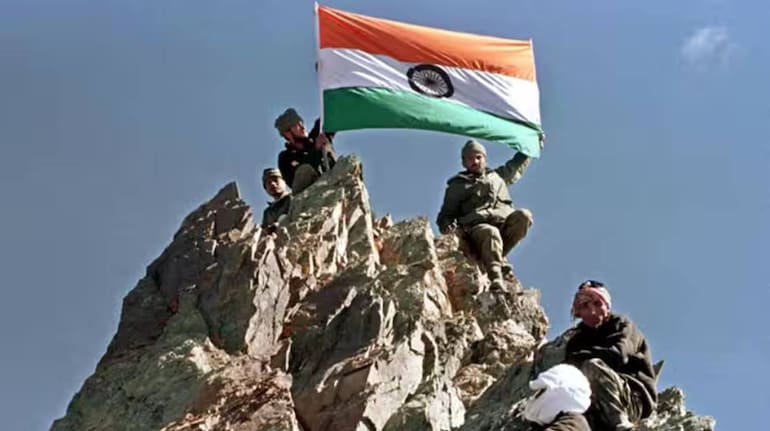

When people think of Kargil, they picture soldiers scaling cliffs or the tricolour going up on Tiger Hill. What often gets left out is the sound that never really stopped that summer — the sound of artillery.
Before every climb, before every bunker was cleared, the guns spoke first.
The battlefield was vertical
The conflict in 1999 was not fought across wide plains. Pakistani regulars and intruders were dug into narrow, rocky heights overlooking the Srinagar–Leh highway. From those positions, they could observe movement and, in some cases, direct fire onto key supply routes.
To push them out, Indian infantry had to climb uphill, often in darkness, with little cover. But sending men straight at fortified sangars without preparation would have been suicidal. Artillery became the blunt instrument that made the impossible at least survivable.
As reported in the Indian Express and The Hindu, later detailed, India moved a massive number of guns into the Dras, Kargil, and Batalik sectors. The scale surprised even seasoned observers. Hundreds of artillery pieces were brought forward. At peak intensity, thousands of shells were being fired daily.
For a limited war confined to a narrow belt along the Line of Control, that was enormous.
Guns dragged into the mountains
Nothing about deploying artillery in Kargil was easy. Guns had to be hauled up winding mountain roads, often under enemy observation. Ammunition convoys moved mostly at night. Gun positions were carved out of rock and mud, exposed to counterfire.
Altitude changes everything. Shell trajectories shift in thinner air. Winds funnel unpredictably through valleys. Fire control calculations had to account for steep angles and the risk of friendly troops advancing close to targets.
And the other side was firing back.
Pakistani artillery shelled Dras town and stretches of the highway in the early weeks. Counter-battery duels followed. Indian gunners worked to locate enemy positions and silence them, using radar and sound-ranging methods.
Gradually, the weight of Indian fire began to tell.
The Bofors moment
The 155 mm FH-77B Bofors howitzer, controversial for political reasons in the 1980s, found vindication in Kargil. Its range and rate of fire suited the terrain. It could deliver sustained, accurate bombardment against small targets perched on ridgelines.
There are accounts, widely discussed in post-war reporting, of Bofors guns being used in near-direct firing roles in some sectors — barrels lowered to engage visible bunkers. That tells you how steep and close some of these fights were.
Before major assaults on Tololing, Tiger Hill and Point 4875, artillery barrages pounded Pakistani positions for hours. Infantry officers later said openly that without that preparation, casualties would have been far higher.
Artillery did not win peaks on its own. But it made them winnable.
Volume as pressure
The sheer volume of fire mattered as much as accuracy. Shelling was not occasional. It was constant. Guns fired through the night. The echo of explosions rolled across valleys.
For troops sitting in exposed sangars at 15,000 feet, this was exhausting. Even well-built stone bunkers degrade under sustained 155 mm fire. Supply routes get cut. Ammunition stocks are destroyed. Sleep becomes impossible.
In mountain warfare, you cannot manoeuvre easily. You endure. And endurance breaks under pressure.
Indian artillery created that pressure.
Working with air power
As the Indian Air Force intensified its campaign under Operation Safed Sagar, precision air strikes began hitting logistics nodes and hardened positions. But aircraft could not loiter endlessly, and weather often intervened.
Artillery had no such limitation. If visibility dropped, the guns still fired. If night fell, they kept firing. If infantry requested suppression before a climb, they answered.
This steady rhythm — shelling, pause, climb, clear, hold — defined much of the war.
The hidden effort
Artillery crews rarely appear in dramatic retellings. Yet their work was relentless. Handling heavy shells at high altitude is punishing. Recoil systems must be maintained. Barrels overheat. Positions have to be camouflaged quickly after firing to avoid retaliation.
The men on the gun lines lived under the same threat as the infantry — exposed to counter-shelling, operating in freezing conditions.
By the time Pakistani forces withdrew under diplomatic and military pressure in July 1999, artillery had done much of the shaping work. Peaks did not fall because of one spectacular assault. They fell after days of systematic pounding that weakened defences and confidence.
What Kargil reinforced
Kargil reminded the Indian Army of something it already knew but had not tested at that scale since 1971: in mountains, artillery is not a supporting arm. It is central.
Tanks are useless on narrow ridgelines. Mobility is limited. Infantry moves slowly. Firepower does the heavy lifting.
Discover the latest Business News, Sensex, and Nifty updates. Obtain Personal Finance insights, tax queries, and expert opinions on Moneycontrol or download the Moneycontrol App to stay updated!
Find the best of Al News in one place, specially curated for you every weekend.
Stay on top of the latest tech trends and biggest startup news.





