






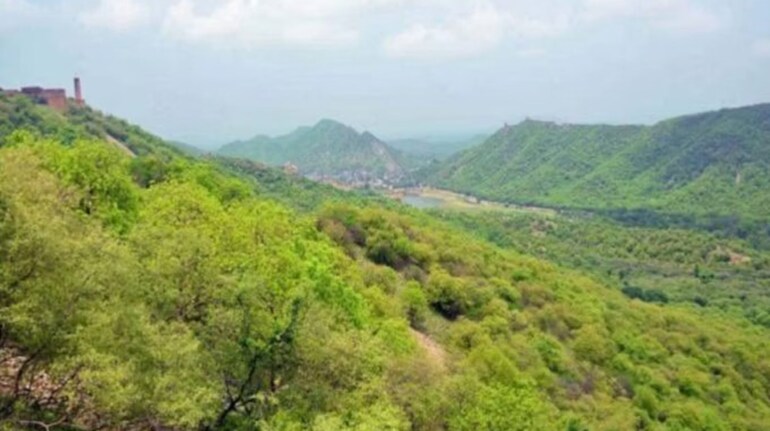
Environmental activists took to the streets in Haryana and Rajasthan to protest the Supreme Court–approved, elevation-based definition of the Aravalli Hills, warning that it could open the door to mining, construction and commercial activity in one of India’s oldest and most fragile mountain ranges.
In Gurugram, activists, members of social organisations and local residents gathered outside the residence of Haryana cabinet minister Rao Narbir Singh, holding placards and raising slogans such as “Save Aravalli, Save the Future” and “No Aravalli, No Life”. The protesters stated that they were alarmed by the Supreme Court’s November 20, 2025, order accepting a new definition of the Aravalli Hills and Ranges, based on the recommendations of a committee constituted under the Ministry of Environment, Forests, and Climate Change (MoEF&CC).
According to the approved definition, an “Aravalli Hill” is any landform in designated Aravalli districts with an elevation of 100 metres or more above its local relief, while an “Aravalli Range” comprises two or more such hills located within 500 metres of each other. Activists fear this technical definition could leave several ecologically sensitive landforms vulnerable.
“This decision could encourage mining, construction and commercial activities, increasing the risk of destruction of the natural beauty of the Aravalli Range. We believe this decision could be detrimental to its ecological balance,” a protester said.
Activists said that the Aravalli range acts as a natural shield for the Delhi-NCR region, helping curb pollution, prevent desertification and mitigate water scarcity. They demanded that the Aravallis be declared a completely protected area with a strict and unambiguous conservation policy.
“Nature cannot be compromised in the name of development, as the conservation of Aravalli is linked to the secure future of coming generations. Toxicity of air is gradually becoming widespread,” said Sanjiti, one of the protesters.
Similar concerns were echoed in Udaipur, where a large number of lawyers marched from the court premises to the district collectorate, submitting a memorandum addressed to the President and the additional district magistrate. “The government should take immediate and concrete measures to ensure conservation of the mountain range,” said lawyer Manish Sharma, adding that Rajasthan’s future depends on protecting the Aravallis.
What the Supreme Court ruling actually says
The Supreme Court has framed its order as a move to strengthen, not dilute, protection of the Aravallis. In its November 20, 2025 judgment, the court accepted a science-backed framework proposed by the MoEF&CC-led committee to bring uniformity and clarity to how the Aravalli Hills and Ranges are identified across states.
The apex court underscored the Aravallis’ ecological importance, calling them a critical barrier against desertification, a major groundwater recharge zone and an important biodiversity habitat, and warned that unregulated mining poses a “great threat to the ecology of the nation”.
Why the Aravallis matter
Stretching from Delhi through Haryana and Rajasthan into Gujarat, the Aravalli Hills are among the world’s oldest geological formations and span 37 districts. They play a key role in regulating climate, recharging groundwater, preventing the spread of the Thar Desert and sustaining wildlife. Fragmented definitions and uneven enforcement across states had earlier allowed mining pressures to grow, prompting judicial intervention.
What the committee found
The MoEF&CC-led committee, comprising forest secretaries from Delhi, Haryana, Rajasthan and Gujarat, and experts from the Forest Survey of India, Geological Survey of India and the Central Empowered Committee , found that Rajasthan was the only state with a formal mining-related definition for the Aravallis. That definition, in force since January 9, 2006, treats any landform rising 100 metres above local relief as a hill and bans mining on the hill and its supporting slopes.
After consultations, all states agreed to adopt this 100-metre criterion uniformly, while making it more objective, transparent and conservation-focused.
Clear definitions, tighter safeguards
Under the accepted framework:
Aravalli Hills include any landform rising 100 metres or more above local relief, along with all supporting slopes and associated landforms, closing loopholes that earlier allowed mining on foothills.
Aravalli Ranges are defined by grouping hills within 500 metres of each other, ensuring valleys, slopes and smaller hillocks between them are also protected.
The committee also recommended mandatory marking of hills and ranges on Survey of India maps, identification of core or inviolate zones where mining is strictly prohibited, and stronger measures to curb illegal mining.
*With Agency Inputs
Discover the latest Business News, Sensex, and Nifty updates. Obtain Personal Finance insights, tax queries, and expert opinions on Moneycontrol or download the Moneycontrol App to stay updated!
Find the best of Al News in one place, specially curated for you every weekend.
Stay on top of the latest tech trends and biggest startup news.




