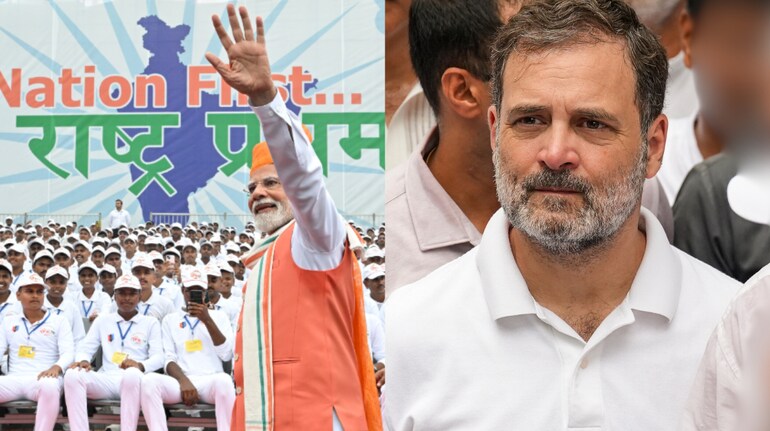
Marked by decisive electoral verdicts, shifting alliances, and a sharpening ideological battle, the year 2025 proved to be one of political churn and recalibration in India. From sweeping mandates to the NDA in the Delhi and Bihar Assembly elections to growing fault lines within the Opposition's INDIA bloc, the year steadily redrew political equations across states and parties.
Delhi boost for BJP
The year began with a political jolt as the BJP stormed back to power in Delhi, ending the Aam Aadmi Party's decade-long rule. The BJP won a decisive majority, winning 48 of the 70 seats in the capital in an election that saw the AAP restricted to 22 seats with even its leader Arvind Kejriwal losing the coveted New Delhi seat.
The BJP picked Rekha Gupta as the legislative party leader while the NDA termed the victory as a referendum on governance, welfare delivery and leadership stability. For the Opposition, the defeat exposed cracks in the urban middle-class support that had once powered AAP's rise, while reinforcing Prime Minister Narendra Modi's appeal in metropolitan India.
Operation Sindoor: Focus on national security, and Shashi Tharoor
India's cross-border counterterror operation following the Pahalgam terror attack, codenamed Operation Sindoor, dominated political discourse in March-April period. While the government's projection of the operation as a calibrated but firm response to terror infrastructure and in the interest of national security, the focus soon shifted to Thiruvananthapuram MP Shashi Tharoor who emerged as a prominent pro-India voice during this phase.
Tharoor backed the armed forces while simultaneously urging diplomatic restraint. His nuanced stance at forums abroad, where he was deputed by the Centre as part of several multi-party delegations abroad, drew widespread praise from sections of the strategic community.
However, Tharoor's involvement triggered discomfort within his own party where some leaders accused him of blurring the Opposition's line against the government. The developments were projected as a widening rift between Tharoor and his party's central leadership.
Jadgeep Dhankhar's shock exit as V-P
Mid-year, New Delhi witnessed an unusual constitutional development when Jagdeep Dhankhar stepped down as Vice President of India in July, citing health reasons, bringing his tenure to an abrupt end. Dhankhar's exit came amid sustained friction with the Opposition in the Rajya Sabha, where his strict interpretation of parliamentary procedure and repeated clashes over disruptions had drawn sharp criticism.
While the government maintained that the resignation was purely personal, the timing fuelled political speculation, and attacks from the Opposition over the manner of the exit.
The vacancy set in motion the constitutional process for electing a new Vice President, with the ruling NDA moving swiftly to nominate veteran party leader CP Radhkrishnan from Tamil Nadu for the post. Despite numbers stacked against it, the Opposition fielded retired Supreme Court judge B Sudershan Reddy as its candidate for the post in a bid to force a contest.
The NDA eventually sailed through with its numerical advantage in the electoral college comprising MPs from both Houses.
SIR turns political flashpoint
The Election Commission's Special Intensive Revision (SIR) of electoral rolls, first announced for Bihar, triggered sharp political battles across states. In Bihar where polls were due in October-November, the exercise sparked allegations of disenfranchisement from Opposition parties, while the BJP framed it as a routine clean-up of voter lists.
The issue soon transcended administrative procedure, becoming a proxy war over demographic shifts, migration, and political trust in institutions. Congress leader and Leader of Opposition Rahul Gandhi's continued focus on electoral integrity and "vote chori" began to emerge as a central theme that eventually set the stage for the Congress' entire Bihar polls campaign.
Nitish Kumar and the collapse of Opposition arithmetic
Nitish Kumar returned as the Chief Minister of Bihar for the tenth time after the NDA registered a landslide victory in the Assembly elections, winning over 200 of 243 seats in the state. The BJP emerged as the single-largest party while the JD(U) posted one of its best strike rates.
The Mahagathbandhan collapsed to a historic low, with the RJD reduced to 25 seats and the Congress winning just six despite contesting over 60. Seemanchal, long seen as fertile ground for the Opposition, delivered one of the starkest verdicts, with Muslim votes splitting between the Mahagathbandhan and AIMIM, eventually allowing the NDA to make gains.
Cracks widen in INDIA bloc
Following the decimation in Bihar, the Congress stared at increased isolation as allies posed tough questions on Rahul's strategy of turning the polls into a referendum on the integrity of the poll process. While the RJD is learnt to have internally blamed the Congress completely for the defeat, key Opposition leaders in other states including Mamata Banerjee and Akhilesh Yadav voiced frustration at Congress' demand for greater seats despite failing to convert them into seats state after state.
The developments pose a bigger question on Congress and Rahul's role and ability as the leader of the Opposition bloc and could reflect in alliances in key states that go to polls in 2026 and 2027. Internal Congress reviews flagged weak booth-level machinery, poor vote transfer and excessive reliance on allies, but no clear course correction emerged, deepening perceptions of drift within the party.
Karnataka: DK Shivakumar vs Siddaramaiah again
In Karnataka, the uneasy coexistence between Chief Minister Siddaramaiah and Deputy CM DK Shivakumar resurfaced as the Congress grappled with questions of succession and power-sharing. Shivakumar’s supporters renewed demands for a rotational chief ministership, while Siddaramaiah’s camp dug in, citing governance stability and electoral arithmetic.
The high command’s reluctance to intervene decisively exposed the Congress' broader leadership dilemma in balancing generational change with caste equations. The stalemate reinforced perceptions of a drift at a time when the party was struggling nationally.
The big picture
Seen broadly, 2025 marked a year in which the electoral machinery, alliance management and narrative control mattered more than headline vote shares. The BJP emerged stronger, not just electorally but structurally, converting support into seats with remarkable precision.
For the Opposition, the year exposed unresolved issues, leadership questions, fragile alliances and the cost of fighting on multiple fronts without a coherent strategy.
Discover the latest Business News, Sensex, and Nifty updates. Obtain Personal Finance insights, tax queries, and expert opinions on Moneycontrol or download the Moneycontrol App to stay updated!
Find the best of Al News in one place, specially curated for you every weekend.
Stay on top of the latest tech trends and biggest startup news.