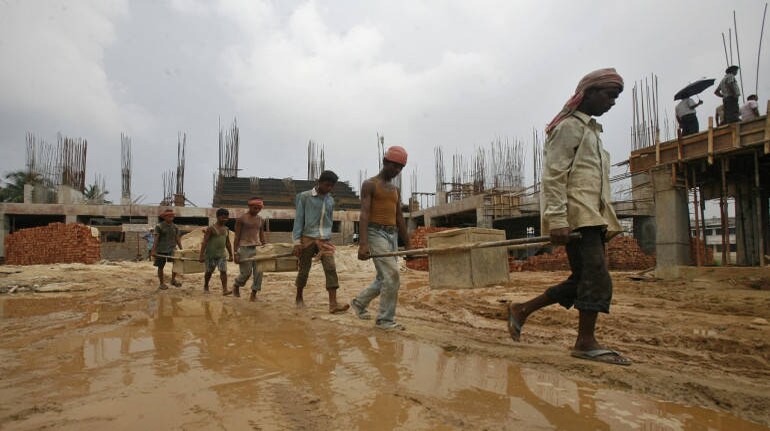
Inarguably, while many of us are now confronted with an uncertain future, for the millions of Indians engaged in the unorganised sector, the scenario is infinitely grimmer.
As the nationwide lockdown has extended till May 3, it is clear as the scorching summer sky that it is the weak who will bear the biggest burden of the fallouts of COVID-19. Whether it is the daily-wager, small vendor, or the self-employed (skilled or unskilled) worker in the unorganised sector, it is those who have less who will get poorer.
One of the steps that the government has announced is the speedy implementation of a pending national-level exercise to create a database of workers in the unorganised sector. This database is expected to determine the process and extent of the relief that the central government would provide to such workers.
On March 22, when well-heeled Indians stocked up and prepared to work from home, these invisible millions who form the backbone of India’s largely informal economy, packed their meagre rations and began to walk home. Since then without access to work and a daily-wage, they have been forced to dip into the little savings, and food to survive.
It is not clear what will be the course of action after May 3, but even after the lockdown is lifted, a return to ‘normal’ economic activity may take at the least six months. The limited resumption of work in select sectors is welcome, but this good news has been overshadowed by the proposed ordinance to increase the number of working hours per week without a commensurate increase in the wage.
If the idea is to enable businesses to stand on their own feet, why can’t the government step in and support workers by covering the cost of extra wages?
Similarly, while both state and the Centre are taking urgent measures — such as cash transfers to women, releasing food stocks, providing insurance cover to frontline health workers and exemption of bank loans — the unorganised sector worker is yet to receive substantive support from either. In the immediate aftermath of the lockdown it was perhaps necessary to prioritise the elderly, disabled and women; now it is critical that the government focus on the plight of those who have been rendered jobless overnight, and without any hope of getting a job in the foreseeable future.
In the absence of meaningful government support in the form of a basic minimum income such workers will become even more vulnerable than they already are to both economic and social exploitation. Already considered ‘invisible’ by many in society, they now stare at the virtual evisceration of their basic human rights as well as access to livelihood and employment.
In fact, the evidence on the existential threat faced by nearly 90 percent of our total workforce is already building up. According to the International Labour Organisation’s (ILO’s) latest report, “about 400 million workers in the informal economy are at risk of falling deeper into poverty during the crisis”. Even if this forecast turns out to be partially true, we are looking at a catastrophic regression in India’s growth story.
Over the last decade, India managed to pull nearly 271 million people out of multi-dimensional poverty, according to the UNDP’s 2019 Multidimensional Poverty Index. Our response to COVID-19 and its economic fallout will determine how many fall back into poverty again.
While the shutdown has helped contain the spread of the virus, it has also created a crisis which is likely to be bigger than the pandemic itself. The economy, which was in a slowdown already, has now virtually come to a grinding halt, and global rating agencies have revised India’s growth rate estimates to around 2 percent.
The creation of a database of workers is a step in the right direction, but its implementation bears risks of poor data-collection, and consequently ineffective targeting and distribution of relief.
It has been more than two weeks since India locked down, and its cities emptied out of millions of workers as they rushed back to their villages in sheer desperation. To most the familiar deprivation was better than starving and suffering in India’s metros. Hundreds of thousands more remain in temporary shelters, and many more depend on public kitchens for survival.
Unless, the government takes urgent measures to create a safety net for workers, an economic cushion on the lines of European countries such as Germany, France, Spain or indeed the United Kingdom across the channel, a spectre of mass deprivation and even social unrest hangs over India — one which will not be exorcised by ignoring the toiling masses and serving them platitudes and good intentions alone.
Valay Singh is a freelance journalist. Views expressed personal.
Discover the latest Business News, Sensex, and Nifty updates. Obtain Personal Finance insights, tax queries, and expert opinions on Moneycontrol or download the Moneycontrol App to stay updated!
Find the best of Al News in one place, specially curated for you every weekend.
Stay on top of the latest tech trends and biggest startup news.