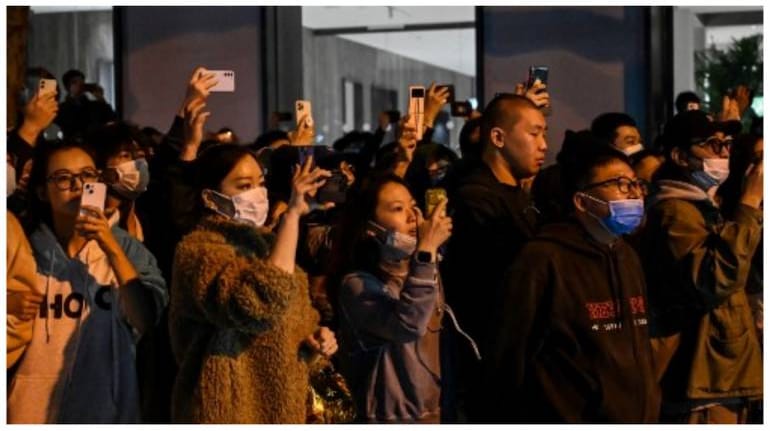
Chinese universities are sending students home as the ruling Communist Party tightens anti-virus controls and tries to prevent more protests after crowds angered by its severe zero COVID restrictions called for President Xi Jinping to resign in the biggest show of public dissent in decades.
With police out in force, there was no word of protests Tuesday in Beijing, Shanghai or other major cities.
Some anti-virus restrictions were eased Monday in a possible effort to defuse public anger following the weekend protests in at least eight cities. But the ruling party affirmed its zero COVID strategy, which has confined millions of people to their homes in an attempt to isolate every infection.
Tsinghua University, Xis alma mater, where students protested Sunday, and other schools in Beijing and the southern province of Guangdong said they were protecting students from COVID-19. But dispersing them to far-flung hometowns also reduces the likelihood of more activism following protests at campuses last weekend.
Some universities arranged buses to take students to train stations. They said classes and final exams would be conducted online.
We will arrange for willing students to return to their hometowns, Beijing Forestry University said on its website. It said its faculty and students all tested negative for the virus.
Authorities have ordered mass testing and imposed other controls in areas across China following a spike in infections. But the move to disperse students was unusual at a time when many cities are telling the public to avoid travel and imposing controls on movement.
In Hong Kong, about 50 students from mainland China protested Monday at the Chinese University of Hong Kong in a show of support for people on the mainland. They lit candles and chanted, No PCR tests but freedom! and Oppose dictatorship, dont be slaves!
The gathering and a similar one in Hong Kongs business district were the biggest protests in the Chinese territory in more than a year under rules imposed to crush a pro-democracy movement.
Zero COVID has helped keep Chinas case numbers lower than those of the United States and other major countries. But public acceptance has eroded as people in some areas have been confined at home for up to four months and say they lack reliable access to food and medicine.
The Chinese Communist Party promised last month to reduce disruption by changing quarantine and other rules. But a spike in infections has prompted cities to tighten controls, fueling public frustration.
Most protesters complain about excessive restrictions, but some turned their anger at Xi, Chinas most powerful leader since at least the 1980s. In a video that was verified by The Associated Press, a crowd in Shanghai on Saturday chanted, Xi Jinping! Step down! CCP! Step down!
On Monday, the city government of Beijing announced it would no longer set up gates to block access to apartment compounds where infections are found.
It made no mention of a fire last week in Urumqi that killed at least 10 people. That prompted angry questions online about whether firefighters or victims trying to escape were blocked by locked doors or other anti-virus controls.
Urumqi and another city in the Xinjiang region in the northwest announced markets and other businesses in areas deemed at low risk of infection would reopen this week and public bus service would resume.
Discover the latest Business News, Sensex, and Nifty updates. Obtain Personal Finance insights, tax queries, and expert opinions on Moneycontrol or download the Moneycontrol App to stay updated!
Find the best of Al News in one place, specially curated for you every weekend.
Stay on top of the latest tech trends and biggest startup news.