








A year after implementing a steep fare hike of up to 71 percent, Bengaluru Metro Rail Corporation Limited (BMRCL) is set to increase fares again by 5 percent from February 9.
BMRCL has justified the move by citing the recommendations of the Fare Fixation Committee (FFC), which provides for an automatic annual fare revision mechanism. According to the corporation, these recommendations are binding and must be implemented until a new committee is constituted.
Also, read: Bengaluru Metro charges should not exceed 1.5 times non-AC bus fare: E Sreedharan
However, an examination by Moneycontrol shows that Delhi Metro Rail Corporation (DMRC) had received similar approval from its Fourth Fare Fixation Committee, constituted in 2016 - but chose not to enforce annual fare hikes for several years.
Delhi had an annual hike provision but didn’t use it
The FFC report for Delhi Metro, available on DMRC’s website, clearly states that fares should be adjusted annually from January 1, 2019, with increases capped at 7 percent or as per the prescribed formula, whichever is lower. It further specifies that this automatic revision should continue every year until the next Fare Fixation Committee’s recommendations come into effect.
Despite this explicit provision, Delhi Metro did not implement annual fare hikes. There was only one fare revision - in August 2025 - since the FFC’s recommendations came into force.
This contrast has brought the debate into focus: are FFC recommendations mandatory in practice, or does the operating company retain discretion over their implementation?
Also, read: Bengaluru Metro fares to go up 5% from February 9, BMRCL kicks off annual revision
Anuj Dayal, principal executive director (corporate communications) at DMRC, told Moneycontrol that fares in Delhi are not revised automatically every year.
“Delhi Metro is one of the cheapest modes of transport in the world. Fare increases are implemented when the Fare Fixation Committee meets and recommends a revision. Last year, there was an increase,” he said.
Ironically, Bengaluru Metro is now the costliest metro system in the country. BMRCL managing director J Ravishankar did not respond to calls.
‘Binding doesn’t mean compulsory implementation’
Several commuters and transport experts argue that while FFC recommendations are binding in principle, their implementation is not necessarily compulsory. Satya Arikutharam, a mobility expert, said the claim that annual hikes are mandatory is misleading. “The recommendation is binding in the sense that the operator cannot seek a revision beyond what the panel has approved. But whether to implement it every year is still at the discretion of the operating company. If it was truly compulsory, why did Delhi Metro not implement it for so many years?” he asked.
Also, read: Travellin' Blues: Congested Bengaluru now has the costliest Metro fare in India
He pointed out that DMRC had the same automatic annual hike provision but chose not to enforce it until 2025, citing affordability concerns.
BMRCL cites structural differences
A senior BMRCL official, however, pointed to structural differences between the two metro systems. “In Delhi, CISF security expenses are borne by the Central government, which significantly reduces DMRC’s financial burden. In Bengaluru, we have to bear these costs, and land acquisition costs are also much higher,” the official said.
Also, read: Why Karnataka govt’s flawed decisions are adding to Bengaluru’s traffic crisis
He added that under Section 37 of the Metro Railways (Operation and Maintenance) Act, 2002, the recommendations made by the Fare Fixation Committee are binding on the metro railway administration.
BMRCL maintains that the annual revision mechanism is intended to avoid sharp, infrequent fare hikes and ensure financial sustainability.
What BMRCL’s Fare Fixation Committee said
According to BMRCL, FFC report mandates that fares be revised annually using an automatic formula linked to operating and maintenance (O&M) costs, capped at 5 percent per year or as per the formula, whichever is lower.
The mechanism applies from the date of implementation of the FFC-recommended fares and remains valid until the next committee submits its report.
Also, read: Bengaluru Metro cites Karnataka's financial strain for recent fare revisions of up to 71 percent
“The fare revision announced for February 9 is based on audited financial data for 2024-25, which showed a cost increase of 10.2 percent. However, the hike has been restricted to 5 percent in line with the FFC cap. The increase ranges from a minimum of Rs 1 to a maximum of Rs 5 across 10 fare zones” a statement from BMRCL said.
Also, read: Why Bengaluru Metro's fare hike of up to 71% has raised hackles
Commuter anger after last year’s steep hike
Commuters remain upset that the new increase comes barely a year after last February’s sharp fare revision. On February 9, 2025, BMRCL revised fares, triggering widespread outrage as some ticket prices doubled. The agency later said technical issues had inflated the hike and capped it at 71 percent from February 14. Even after the rollback, commuters say fares remain disproportionately high.
Network size
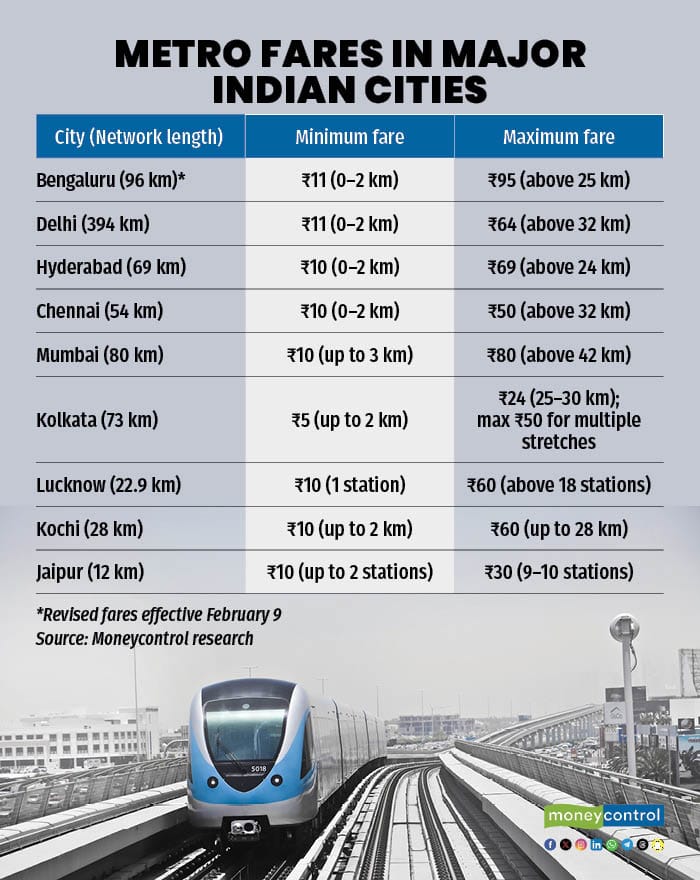
Delhi Metro now operates a 394-km network, compared with Bengaluru Metro’s 96 km. Despite the larger system, Delhi Metro’s maximum fare is Rs 64 for journeys beyond 32 km on weekdays and Rs 43 on Sundays and national holidays. Bengaluru Metro’s maximum fare will rise to Rs 95 for trips beyond 25 km from February 9.
Bengaluru Metro’s slower construction pace has added to revenue pressure. Since operations began in 2011, the network has expanded to just 96 km - an average of 6-7 km per year. Delhi Metro, operational since 2002, has expanded at an average pace of 16-17 km annually.
Also, read: Bengaluru Metro's Yellow Line: 19-km took 8 years to complete; cost escalated to around Rs 400 crore per km

Discover the latest Business News, Sensex, and Nifty updates. Obtain Personal Finance insights, tax queries, and expert opinions on Moneycontrol or download the Moneycontrol App to stay updated!
Find the best of Al News in one place, specially curated for you every weekend.
Stay on top of the latest tech trends and biggest startup news.





