






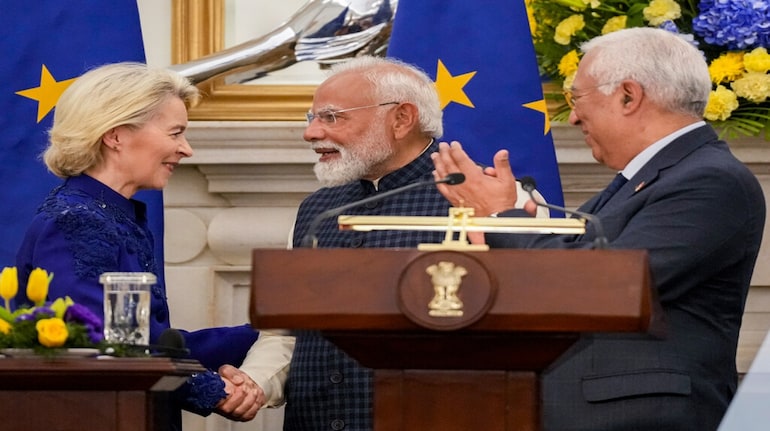

India and the European Union, on January 27, sealed what both sides have described as the most ambitious free trade agreement ever concluded by New Delhi, reshaping economic ties between two major democracies at a time of global trade disruption.
The pact links India to a 27-nation European bloc worth nearly $20 trillion, creating a combined free trade zone spanning close to a quarter of global GDP and a consumer base of about two billion people.
The agreement comes amid rising protectionism, tariff wars and supply-chain realignments, and is being positioned as a long-term anchor for rules-based trade, economic openness and strategic cooperation between India and Europe.
What the India-EU FTA Changes
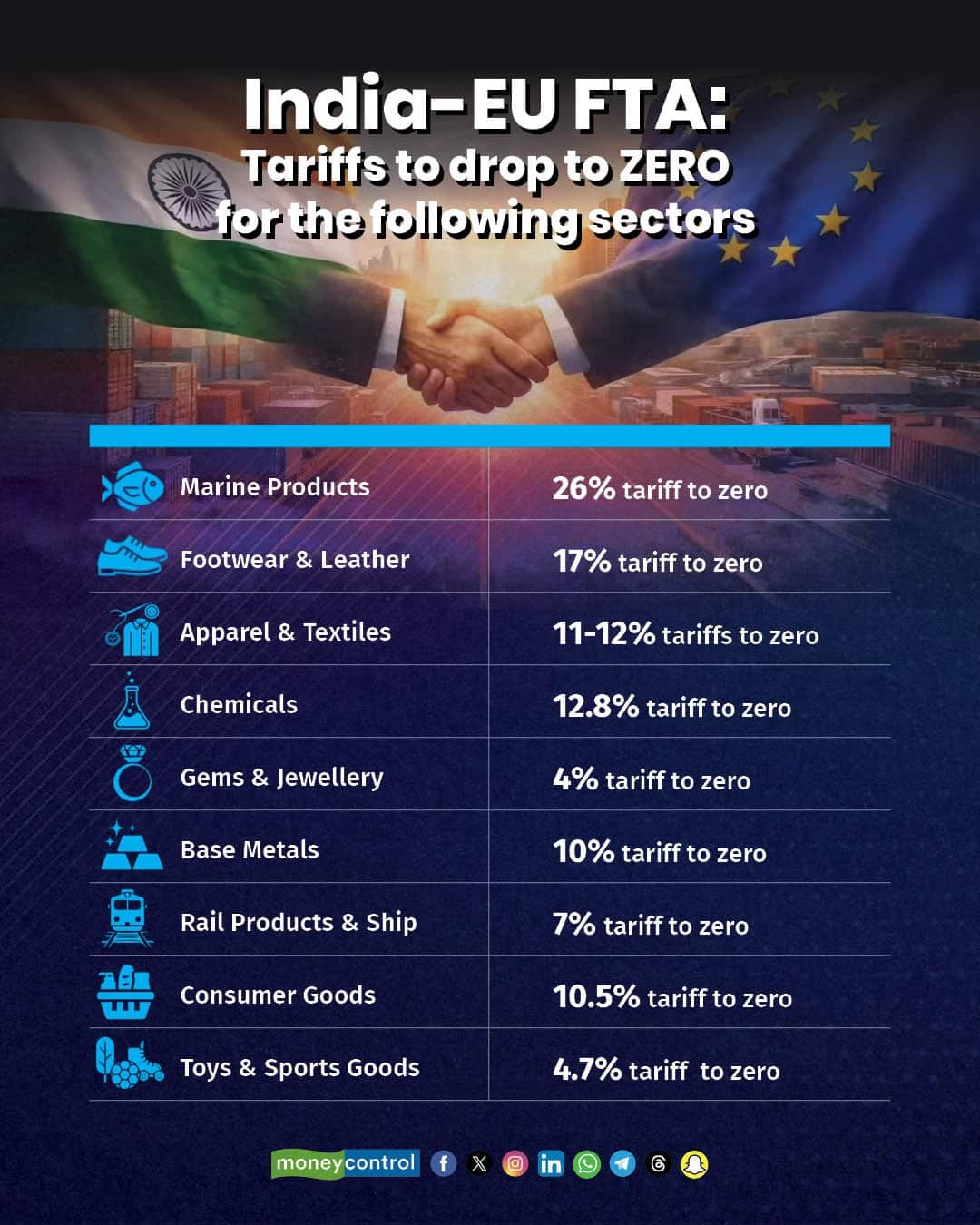
At the heart of the agreement is a sweeping reduction or elimination of tariffs on 9,425 tariff lines for Indian exports. This grants Indian goods preferential access to one of the world’s most regulated yet high-value markets, significantly improving India’s competitive position against global rivals.
Services Take Centre Stage
Unlike traditional trade deals focused largely on goods, the India-EU FTA places services and professional mobility at its core. India’s services sector, spanning IT, education, financial services and tourism, emerges as a primary beneficiary, gaining structured and predictable access to European markets.
The EU's investment into Indian service sectors is expected to bring advanced technology, innovation and global best practices, reinforcing India’s position as a global services hub built on scale, talent and trust.
In services, the pact opens more than 144 European service subsectors to Indian professionals and firms, while India will allow EU companies entry into 102 domestic service sectors. The two-way opening is designed to accelerate investment flows, technology transfer and deeper supply-chain integration.
Defence, Security and Strategic Alignment
Alongside the FTA, India and the EU signed a strategic defence and security partnership. The framework provides for regular dialogue, cooperation on maritime security, cyber threats and counterterrorism, and closer defence-industrial coordination, including supply chains.
As per New Delhi, India’s defence industry could play a role in European initiatives aimed at diversifying suppliers and reducing dependence on the US and China.
Healthcare and Medical Devices
The agreement opens new opportunities for India’s healthcare ecosystem by cutting tariffs on Indian-made medical devices and creating pathways for recognition of Indian medical qualifications in Europe. Manufacturing hubs in Maharashtra, Gujarat, Andhra Pradesh and Telangana are expected to emerge as key suppliers to the EU’s $572 billion healthcare market.
A New Mobility Architecture for Professionals
The agreement establishes a dedicated professional mobility framework. Contractual Service Suppliers from India will receive assured market access across 37 sectors, including IT, research and development, education and professional services. Independent Professionals will benefit from specific commitments in 17 high-skill areas aligned with India’s strengths.
For the first time, family members of Intra-Corporate Transferees will be allowed to accompany professionals on EU assignments, addressing a long-standing concern around the sustainability of overseas postings.
Social Security and Worker Protection
The FTA commits both sides to work towards bilateral social security arrangements over the next five years. These agreements are expected to reduce double social security contributions and improve long-term income security for Indian professionals working in Europe, an issue repeatedly raised by India’s services industry.
Youth Mobility and the Talent Pipeline
Recognising the role of young professionals in driving future services exports, the pact introduces a youth mobility framework. Indian students graduating from EU institutions will be granted a nine- to twelve-month window to seek employment in Europe.
By enabling early integration of Indian talent into the EU workforce, policymakers expect long-term gains in knowledge-based exports and stronger institutional links between Indian and European firms.
Farmers Protected, Exports Opened
India has kept politically sensitive agricultural sectors such as dairy, poultry, rice and sugar outside the scope of liberalisation, ensuring that rural livelihoods remain protected.
At the same time, Indian farm and food exports gain new momentum. Products such as tea, coffee, spices, fruits, vegetables and a range of processed foods will receive zero-duty access to the EU, improving competitiveness in premium global markets.
MSMEs and Labour-Intensive Manufacturing Gain
The agreement delivers a significant boost to India’s MSMEs and labour-intensive industries. Tariffs on leather goods, currently as high as 17%, will be eliminated, opening access to an EU market estimated at over $100 billion. Duties on gems and jewellery will also drop to zero, allowing Indian exporters to compete on equal terms across all EU member states.
Dedicated provisions aim to help MSMEs navigate regulatory requirements and fully utilise the agreement’s benefits.
Green Transition and CBAM Preparedness
Recognising the EU’s tightening climate regulations, the FTA includes financial and technical cooperation to help Indian manufacturers transition to greener production processes. This support is aimed at helping exporters comply with the EU’s Carbon Border Adjustment Mechanism, which is expected to reshape global trade in carbon-intensive sectors.
Traditional Sectors and Employment
Textiles, apparel and traditional crafts are expected to see renewed export momentum. Reduced barriers for man-made fibre apparel, cotton yarn and home textiles are likely to generate employment, particularly for women and rural artisans embedded in traditional value chains.
What India Will Import Cheaper from Europe
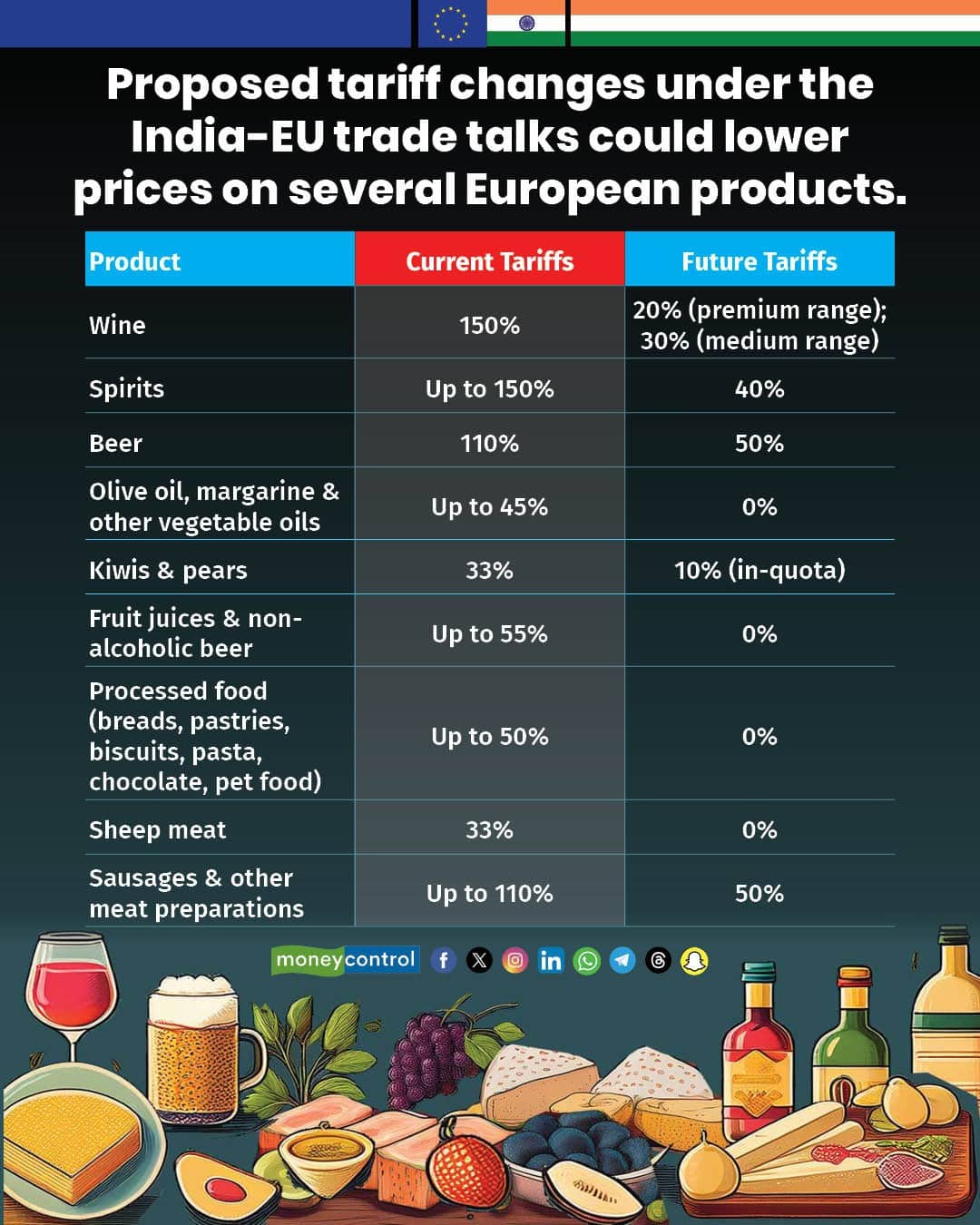
India has agreed to steep tariff cuts on select European agri-food products. Wine tariffs will be reduced from 150% to 75% at the time of implementation and progressively lowered to as little as 20%. Olive oil duties will fall from 45% to zero over five years, while tariffs of up to 50% on processed foods such as bread and confectionery will be eliminated.
However, the EU has clarified that its strict food safety and health standards will remain unchanged for all imports.
India-EU FTA negotiations were first launched in 2007 but stalled in 2013 due to differences in ambition. Talks were revived in June 2022 as both sides sought to diversify supply chains and deepen strategic ties amid global geopolitical shifts.
The EU is currently India’s largest trading partner in goods, with bilateral trade valued at about $136 billion in FY25.
European Commission President Ursula von der Leyen called the agreement historic, saying it creates a free trade zone of two billion people. Prime Minister Narendra Modi described it as a blueprint for shared prosperity that goes beyond commerce.

Discover the latest Business News, Sensex, and Nifty updates. Obtain Personal Finance insights, tax queries, and expert opinions on Moneycontrol or download the Moneycontrol App to stay updated!
Find the best of Al News in one place, specially curated for you every weekend.
Stay on top of the latest tech trends and biggest startup news.





