Rajasthan Chief Minister Ashok Gehlot on August 10 launched a free smartphone scheme for women in the state. Under the Indira Gandhi smartphone scheme, the state government will transfer Rs 6,800 to the e-wallet of beneficiary women after the completion of their KYC process in special camps.
Coming down heavily on Congress during his reply to the no-confidence motion in the Lok Sabha on August 10, Prime Minister Narendra Modi said the Congress wants a country whose economy is weakened.
“They make unrealistic promises to people in elections and development programmes are being stopped in states. They are a guarantee for India going bankrupt, they are a guarantee of a drowning economy, for double-digit inflation …”, the Prime Minister said as per a report on News18 website.
Last year, the Supreme Court stepped in to sound the alarm, saying freebies will “continue to destroy the economy”.
Also Read: PM slams 'revdi culture' in virtual meet with BJP workers in state
Economists say welfare schemes and freebies are diametrically opposite. Freebies (revdi) are not public or merit goods such as education and healthcare. They, however, validate state welfare schemes such as PDS and MGNREGS as it supports the majority of the marginalised people and offer a respite against economic distress and also contribute significantly to human development.
On the contrary, freebies mould the voters' opinion in favour of the ruling party and have nothing to do with long-term development.
Eminent journalist TN Ninan wrote an article in the Business Standard in June, saying, “India creating a sufficiently large productive economy that generates the taxes to pay for a welfare system? The answer is that the tax-to-GDP ratio has shown little improvement, despite a quadrupling of per capita income over three decades.”
Also Read: States must curb freebies to spend more on expanding their economies
He further said: “So are we simply piling up public debt, servicing which eats up about 40 per cent of tax revenue? There is an urgent need for public debate on this central political-economy question.”
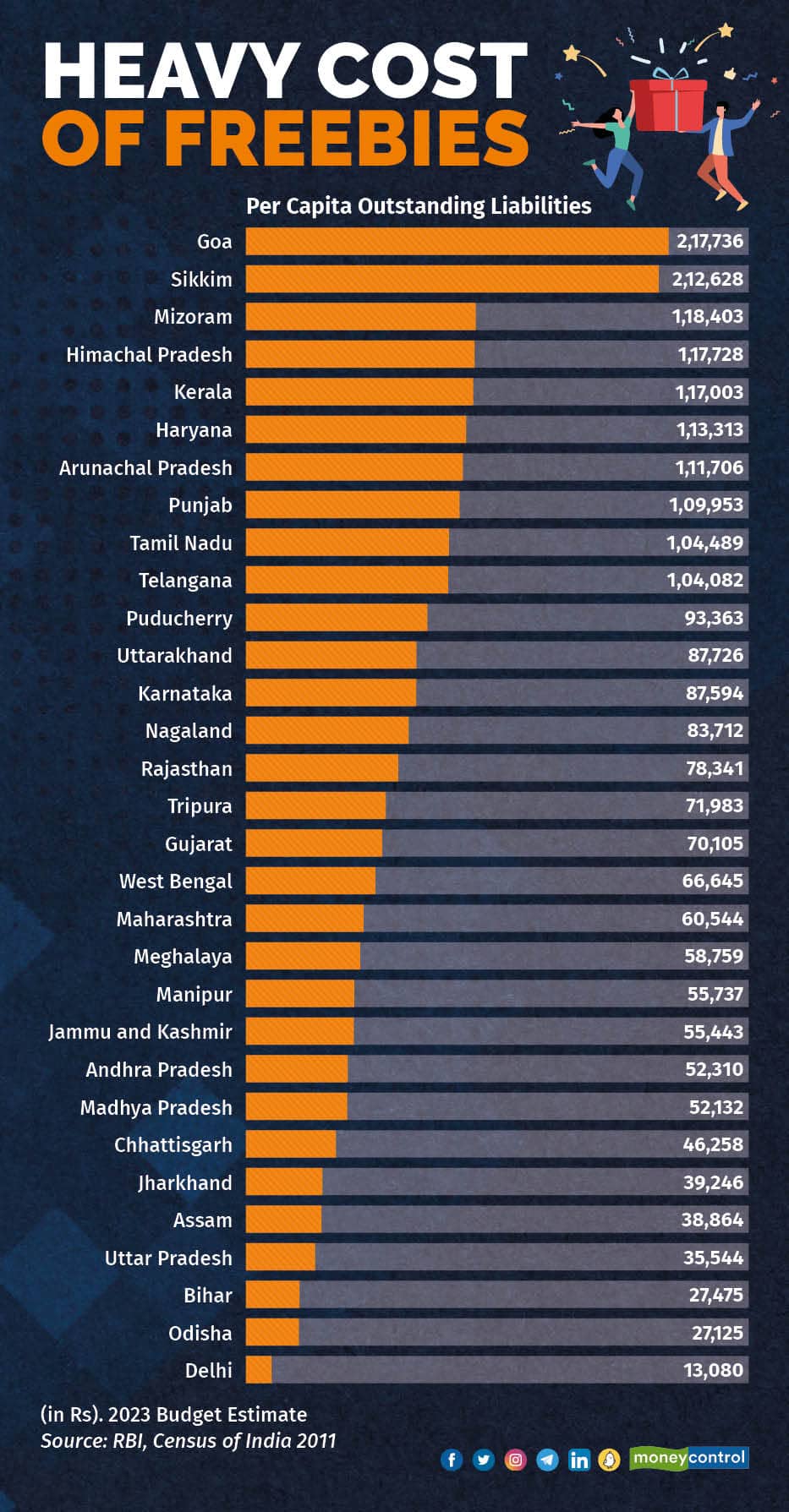
The freebie culture really started in the 1990s with the rise of regional political parties. Some regional parties like the DMK and SP, have made tall promises such as free TVs and computers.
At present, the Congress government in Karnataka is grappling with the implementation of its Anna Bhagya scheme as it cannot afford to buy rice from the Food Corporation of India (FCI) at market rates.
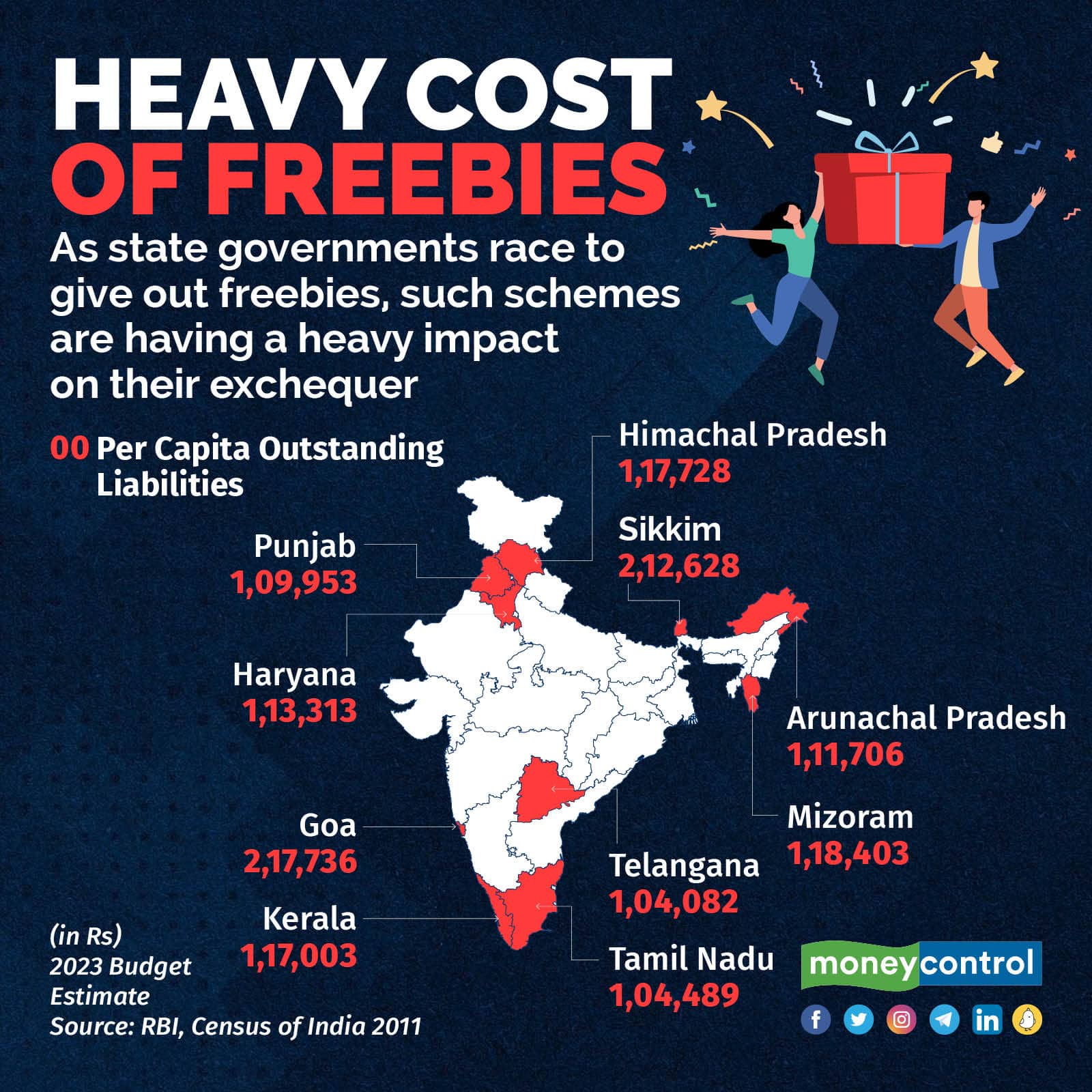
The Ashok Gehlot-led Rajasthan government is likely to face hard times in distributing free smartphones to women as it has already unveiled more such freebies such as free emergency care, power up to 100 units, subsidised LPG and so on.
More importantly, the Rajasthan government’s fiscal deficit has been swelling and reached 4.36 percent in FY22.
The poll-bound Telangana, earlier this month, said the third phase of the crop loan waiver scheme would continue up to the second week of September, during which the state government would waive loans worth Rs 19,000 crore. In 2018, the state government waived loans of up to Rs 1 lakh per farmer. There have been two phases of loan waiver so far.
The Aam Aadmi Party-led Delhi government's decision to give free power up to 200 units and a 50 percent subsidy for those consuming 201-400 units was estimated to cost the exchequer around Rs 1,800-2,000 crore annually.
Further, the Delhi government’s decision to make bus rides free for women would cost approximately Rs 700 crore annually.
India Ratings and Research (Ind-Ra) last year said even with a crunch in the fiscal position, subsidy levels in several states remain at elevated levels. A study by the rating agency puts Chhattisgarh, Punjab, Rajasthan, Karnataka and Bihar as the top five states in terms of subsidies as a percentage of GSDP (gross state domestic product) during FY19-FY22.
In December, the Reserve Bank of India in its Financial Stability Report had raised concerns over the increasing subsidies announced by multiple states, adding that this is likely to constrain the fiscal space available to states for developmental and capital spending.
Discover the latest Business News, Sensex, and Nifty updates. Obtain Personal Finance insights, tax queries, and expert opinions on Moneycontrol or download the Moneycontrol App to stay updated!
Find the best of Al News in one place, specially curated for you every weekend.
Stay on top of the latest tech trends and biggest startup news.