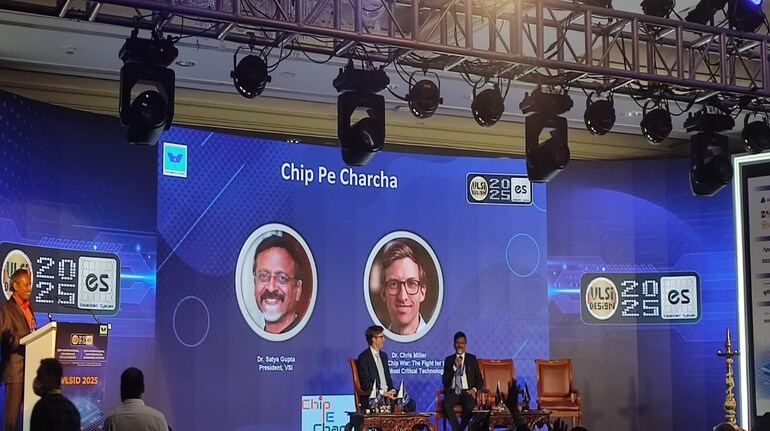
Globally, venture capitalists (VCs) have under-invested in the semiconductor ecosystem, primarily because the industry operates on a long-term horizon that doesn’t align with the typical VC model, said Chris Miller, historian and author of "Chip War" during a media interaction.
Miller was speaking on the sidelines of the 38th International VLSI Design and 24th Embedded Systems Conference, held in Bengaluru on January 6.
Unlike software or consumer tech startups, which can achieve significant growth and returns within a few years, semiconductor companies require extensive time, resources, and capital before delivering substantial outcomes.
"Venture capitalists (VCs) have traditionally under-invested in the semiconductor ecosystem, largely because the industry operates on a long-term horizon that does not align well with the typical VC model," Miller said.
However, this trend could change, according to Satya Gupta, President of VLSI Design, who noted that VCs are driven by success stories. “Once semiconductor companies begin to achieve multimillion-dollar exits, VCs will follow the money and start investing in this sector,” he said.
While the VCs have under-invested, the government has offered several subsidies and incentives for the semiconductor ecosystem, added Gupta.
Miller also emphasised on the importance of nurturing talent to unlock the full potential of the semiconductor industry in India.
“Governments naturally have to look at where there is underinvestment, and I think talent is one such area,” said Miller. “Universities and industrial training programs must work together to ensure students are industry-ready.”
As India and other nations work to establish themselves as semiconductor leaders, success stories and strategic investments will play a crucial role in attracting more private capital. “The journey is long,” Miller said, “but the potential rewards make it worth the effort.”
Miller and Gupta both pointed to India as a promising market, where the government has ramped up its focus on semiconductor manufacturing and ecosystem development. With states like Karnataka and Tamil Nadu emerging as hubs, the broader ecosystem is gaining momentum.
India, they noted, also has the potential to excel in adjacent markets, such as locally produced smartphones and electric vehicles (EVs). “With the right amount of investment and government support, India can dominate markets like EV two-wheelers and three-wheelers,” Miller added.


Discover the latest Business News, Sensex, and Nifty updates. Obtain Personal Finance insights, tax queries, and expert opinions on Moneycontrol or download the Moneycontrol App to stay updated!
Find the best of Al News in one place, specially curated for you every weekend.
Stay on top of the latest tech trends and biggest startup news.