






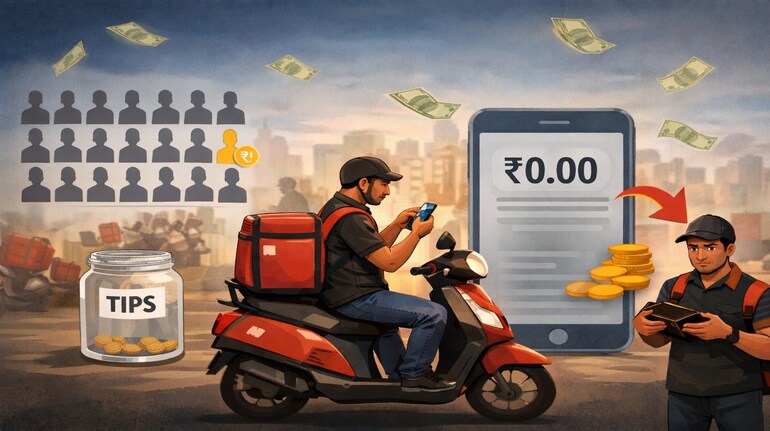
As the debate over gig worker earnings resurfaces across India’s food delivery and quick commerce sector, tipping has emerged as a frequently cited, but rarely exercised, part of the income equation. While platforms have ensured a full pass-through of the entire tip amount, including nudges along the checkout process, it is found that a very small percentage of users tip the delivery riders, barely moving the needle on gig workers' earnings.
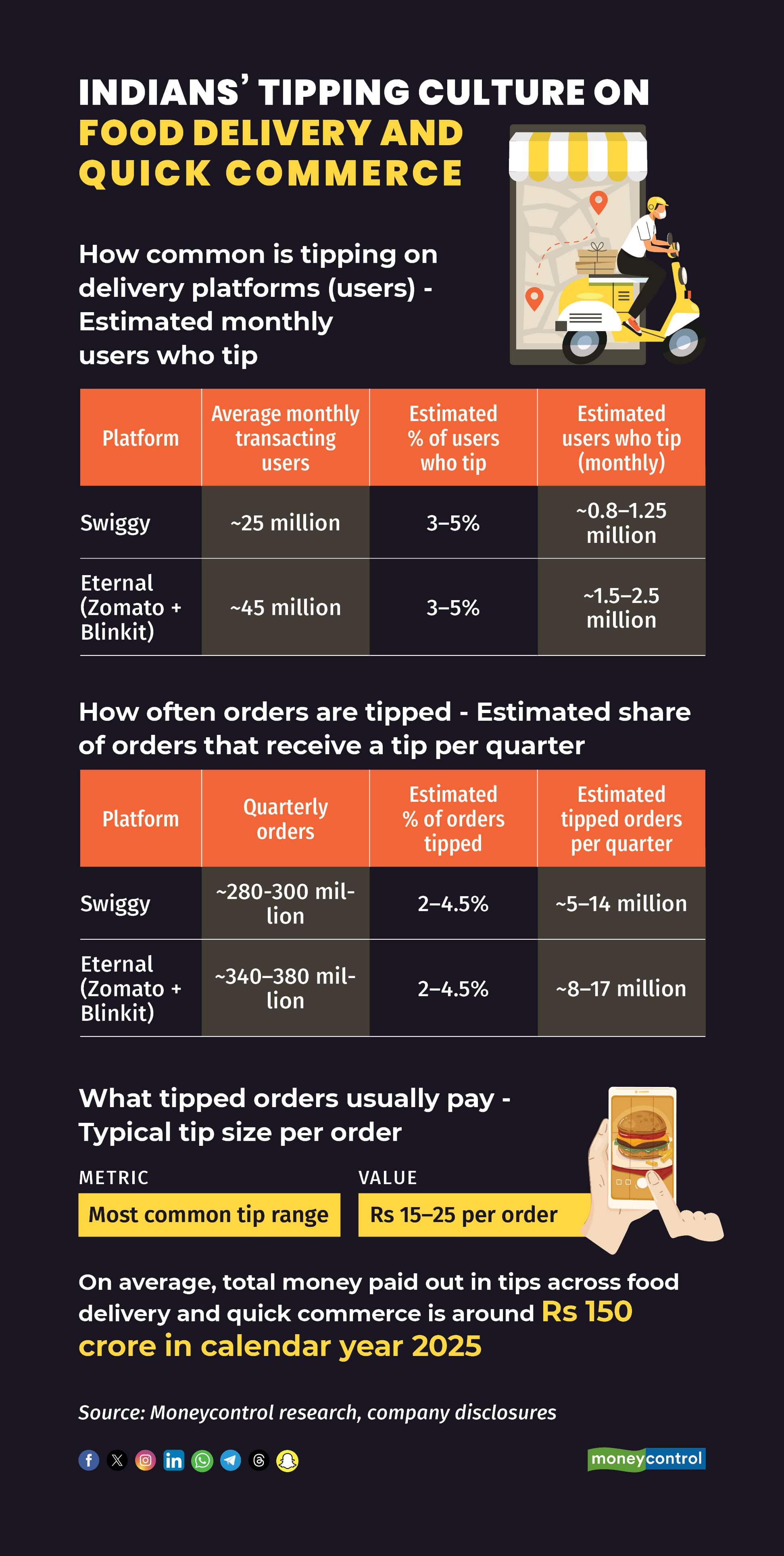
Several industry sources told Moneycontrol that most users, across food delivery and quick commerce, do not tip their delivery riders. "Only around 3–5 percent of total transacting users tip these delivery boys," a top executive at a large delivery platform said.
There are about 30-35 million unique monthly transacting users (MTUs), at best, who purchase on quick commerce platforms and order food online.
"A rough translation of that would mean just one in 25 users tip their delivery rider," the executive added.
In addition to few customers tipping their delivery people, the average tip amount also remains low which translates to almost no additional income to these riders.
"The most tipped amount is between Rs 15 and 25 per order. While it hardly moves the needle for anyone, it is a welcome step for these riders," the executive cited above added.
For delivery workers, this plays out as a modest add-on rather than a meaningful income stream. Delivery partners Moneycontrol spoke with said tips typically add around Rs 800-Rs 1,000 to their monthly earnings, depending on how many peak-hour or high-value orders they complete. Tips, they said, tend to come sporadically — often during bad weather or late-night deliveries — and are not something they factor into daily income expectations.
“Some months you get a few good tips, some months almost nothing,” said one delivery worker working with Zomato. “It sure helps a bit, but it’s not something you can plan around.”
Across all platforms, delivery partners would have earned a maximum of Rs 150 crore in tips in calendar year 2025, as per two industry sources. While the total amount may seem large, it represents the amount earned in tips by at least over 600,000 delivery partners present in the food and quick commerce ecosystem, or just around Rs 2,500 per head, on average, per year.
"Tips being low in our industry is understandable. Food delivery and quick commerce users are in contact with the delivery person for just a few seconds which makes it extremely difficult to complete the process of tipping," another executive at one of the large platforms told Moneycontrol.
In contrast, while dining in and during other activities such as a cab ride, an exchange between the two sides lasts for over 15-20 minutes which "significantly increases the likelihood of receiving higher tips."
While some may opt to tip their riders directly, there are hardly any users who tip outside the platforms as per companies' conversations with tens of thousands of delivery partners, Moneycontrol has learnt.
How does tipping actually work on Swiggy and Eternal?
The limited scale of tipping becomes clearer when industry estimates are applied to platform volumes.
Swiggy currently has around 25 million monthly transacting users. Applying an estimated 3–5 percent tipping incidence suggests that approximately 0.8–1.25 million users leave a gratuity in a typical month, based on indicative calculations using industry data.
A similar approach applies to Eternal, the parent company of Zomato and Blinkit. With about 45 million monthly transacting users across its platforms, the same estimated tipping rate implies that around 1.5–2.5 million users tip in a given month.
To be sure, there will be overlaps in the MTUs as several users use more than one service on each of the platforms. The other figures, including payouts, are rough estimates and calculations based on conversation with different stakeholders.
Order-level estimates point in the same direction. Swiggy processes roughly 280-300 million orders each quarter, of which only 2–4.5 percent receive tips, translating to around 5–14 million tipped orders over three months. Eternal, which handles approximately 340–380 million quarterly orders, would see roughly 8–17 million tipped orders over the same period.
That limited reach is also visible when tips are averaged across working time.
“Delivery partners earn 100 percent of tips given by customers. The average tip per hour in 2025 on Zomato was Rs 2.6 and in 2024 (that number) was Rs 2.4 per hour. Tips are transferred instantly, with zero deductions. We absorb the payment gateway processing cost ourselves. About 5 percent of the orders get tipped on Zomato; 2.5 percent on Blinkit,” said Deepinder Goyal in a recent string of posts on social media platform X.
To be sure, the average hourly earnings of a delivery worker on Zomato are Rs 102, indicating that tips add only a small increment to overall earnings, even as they are fully passed through to delivery partners.
Why do tips add little to overall delivery worker earnings?
The limited contribution of tips matters in the context of how delivery incomes are structured. A recent Moneycontrol analysis showed that full-time riders in large cities can gross in the mid-to-high Rs 20,000 range a month if they log long hours consistently, but net earnings typically settle closer to the low Rs 20,000s after fuel and maintenance costs. Against that baseline, a small and irregular stream of tips does little to materially change monthly outcomes.
Industry sources said the roughly Rs 150 crore earned by delivery partners through tips in 2025 has remained largely flat year-on-year, even as overall order volumes across food delivery and quick commerce platforms expanded.
“Tips on just 3–5 percent of orders are not meaningful. Tipping is not deeply embedded in Indian consumer behaviour — even in restaurants, customers rarely tip, as service charges are often built into the bill,” said Satish Meena, founder of Datum Intelligence.
“As a result, we don’t see earnings from tips increasing meaningfully over the next two to five years. In fact, as food delivery growth slows, tip income could flatline or even decline," he added.
Moneycontrol reported earlier that food delivery growth at platforms such as Zomato and Swiggy has moderated in recent quarters, adding to concerns that tip income may struggle to scale as overall demand softens.
Why is the tipping debate resurfacing now?
The focus on tipping comes amid renewed scrutiny of gig worker pay following late-December strike calls by delivery workers over pay structures, incentives and social security. While deliveries continued largely uninterrupted, the protests renewed attention on how delivery incomes are built — and whether smaller components such as tips can meaningfully supplement a model dominated by base pay, incentives and hours logged.
For now, the data suggests tipping remains a thin layer atop India’s delivery economy. Even with full pass-through and instant crediting, gratuities account for a small and uneven share of earnings, leaving delivery workers overwhelmingly dependent on utilisation, incentives and peak-hour demand rather than customer tips.


Discover the latest Business News, Sensex, and Nifty updates. Obtain Personal Finance insights, tax queries, and expert opinions on Moneycontrol or download the Moneycontrol App to stay updated!
Find the best of Al News in one place, specially curated for you every weekend.
Stay on top of the latest tech trends and biggest startup news.






